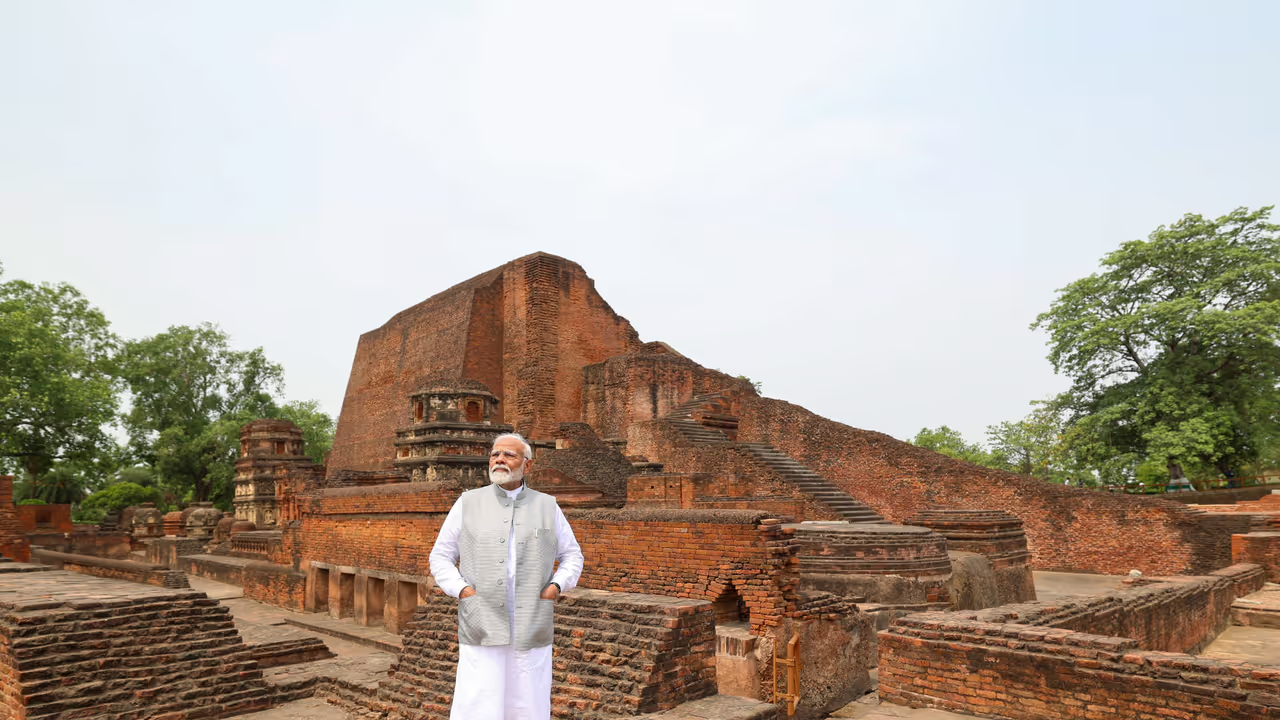
India revives Nalanda to project soft power globally. Blending ancient wisdom with modern growth, it reclaims its intellectual legacy to shape global dialogue, diplomacy, and leadership.
By Prof. (Dr.) Sriparna Pathak: In an era where hard power, combining military might and economic coercion, often dominates headlines, soft power remains the subtle yet enduring force shaping international influence. Coined by Joseph Nye, soft power relies on culture, values, ideas, and intellectual appeal to attract rather than compel. Nations that master it build alliances, inspire admiration, and project leadership without firing a shot. As the world grapples with geopolitical fragmentation, soft power offers a path to sustainable global standing.
India’s Economic Rise Meets Cultural Influence
India today exemplifies this dynamic. As the world's fastest-growing major economy, with robust projections sustaining its momentum into 2026 amid global uncertainties, India continues to outpace peers. Driven by strong domestic consumption, public investment, manufacturing growth, and ongoing structural reforms, this ascent bolsters India's hard power through trade leverage and strategic partnerships. Yet, an important part of its true global resonance lies in cultural and intellectual depth.
Related Articles

This rise reconnects with India's pre-colonial legacy as a beacon of knowledge and pluralism. Long before European colonialism disrupted its trajectories, ancient India nurtured centers of learning that drew scholars from afar. Foremost among them was Nalanda Mahavihara, a premier center of learning from the 5th to 12th centuries, focusing on Buddhist studies, science, medicine, and philosophy. The revival aims to blend this ancient interdisciplinary approach with modern education.
Nalanda: The World’s First Global University
Established in the 5th century CE under Gupta patronage and sustained by successive rulers, Nalanda emerged as the world’s first great residential monastic university. For centuries, it flourished as a hub of Buddhist learning, intercultural dialogue, and intellectual exchange, attracting students and teachers from Tibet, China, Korea, Southeast Asia, and beyond via Silk Route and maritime networks.
Nalanda's historical evolution showcased institutional sophistication: a vast Mahavihara complex with monasteries, lecture halls, libraries, temples, and meditation chambers. Its curriculum holistically integrated philosophy, logic, grammar, medicine, astronomy, mathematics, linguistics, and Buddhist scriptures. Pedagogical methods emphasized debate, dialectics, memorization, and commentary writing, underpinned by monastic discipline that blended rational inquiry with ethical values and spiritual cultivation. This model of educative holism, fusing intellect, ethics, and mindfulness; set a precedent for higher education.
Philosophically, Nalanda advanced profound traditions. It systematically articulated Madhyamaka (emptiness) and Yogachara (consciousness-only) schools. The Dignaga–Dharmakirti lineage pioneered Buddhist logic and epistemology, influencing rigorous reasoning worldwide. Acharyas engaged Brahmanical schools like Nyaya, Sankhya, and Vedanta in debate, fostering pluralism rather than dogma. Distinguished masters defined this era: Nagarjuna and Aryadeva helped the foundations of Madhyamaka; Asanga and Vasubandhu refined Yogachara and Abhidharma; Dignaga and Dharmakirti shaped logic; Shantarakshita and Kamalashila synthesized traditions and transmitted them to Tibet.
These acharyas served as cultural ambassadors, translating texts and disseminating knowledge across Asia. Chinese pilgrims Xuanzang and Yijing documented Nalanda's prestige, while translation projects preserved its treasures in Tibetan and Chinese, ensuring continuity after its decline. Nalanda's fall came gradually through reduced patronage and instability, culminating in the 12th-century invasion by Bakhtiyar Khilji, whose forces burned its libraries and dispersed scholars, erasing centuries of wisdom. Yet its legacy endures as a symbol of resilience, openness, and cross-cultural learning.
Rebuilding a Civilizational Beacon in Modern India
India revives this heritage today through the modern Nalanda University in Rajgir, Bihar. Conceptualized in the mid-2000s, with impetus from A.P.J. Abdul Kalam, East Asia Summit leaders, and the Indian Parliament's 2010 Act - the institution advanced significantly with Prime Minister Narendra Modi inaugurating the new eco-friendly campus in June 2024. Designed by the late B.V. Doshi, this net-zero campus features modern amenities, international enrollment, and ongoing admissions for the 2026-27 academic year, alongside events like international seminars in March 2026 focused on soft power and youth diplomacy. The initiative reflects a desire to re-establish India as a world leader in education, promoting a “civilizational heritage”, and providing a space for academic discourse that is not solely Western-centric. Its legacy resonates with modern themes of ethics, compassion, non-violence, and interdependence, offering a framework for peace-building, intercultural dialogue, and even contemporary discussions on the interface between Buddhism and science, exemplified by the revival of Nalanda University.
Why Nalanda Matters in a Multipolar World
Why now? India's economic ascent provides the platform and confidence to reclaim this narrative. As the fastest-growing major economy, India leverages material strength to amplify cultural diplomacy. Reviving Nalanda counters colonial-era distortions that diminished India's intellectual past, asserts civilizational continuity, and positions India as a bridge in a multipolar world. It aligns with contemporary needs: Nalanda’s emphasis on debate, inclusivity, compassion, non-violence, and interdependence resonates with global challenges like peace-building, ethics in emerging technologies, Buddhism-science dialogues, and sustainable development.
In fostering intercultural pluralism, evident in Nalanda's ancient role and modern revival, India promotes universal brotherhood (Vasudhaiva Kutumbakam). This soft power strategy complements economic rise, attracting partnerships, talent, and goodwill.
Ultimately, Nalanda's revival is more than historical nostalgia. It signals India's ambition: to lead not just economically, but through ideas that unite. In a fractured world, reclaiming such legacies offers hope for dialogue over division, wisdom over conflict. India's trajectory, from ancient Mahavihara to modern powerhouse - reminds us that true influence stems from the light of knowledge, enduring across millennia.
(The author is Professor of China Studies at O.P. Jindal Global University, Director of the Centre for Northeast Asian Studies, and a former consultant to the Ministry of External Affairs.)
Disclaimer: The opinions expressed are solely those of the author and do not reflect the views or stance of the organization. The organization assumes no responsibility for the content shared.