
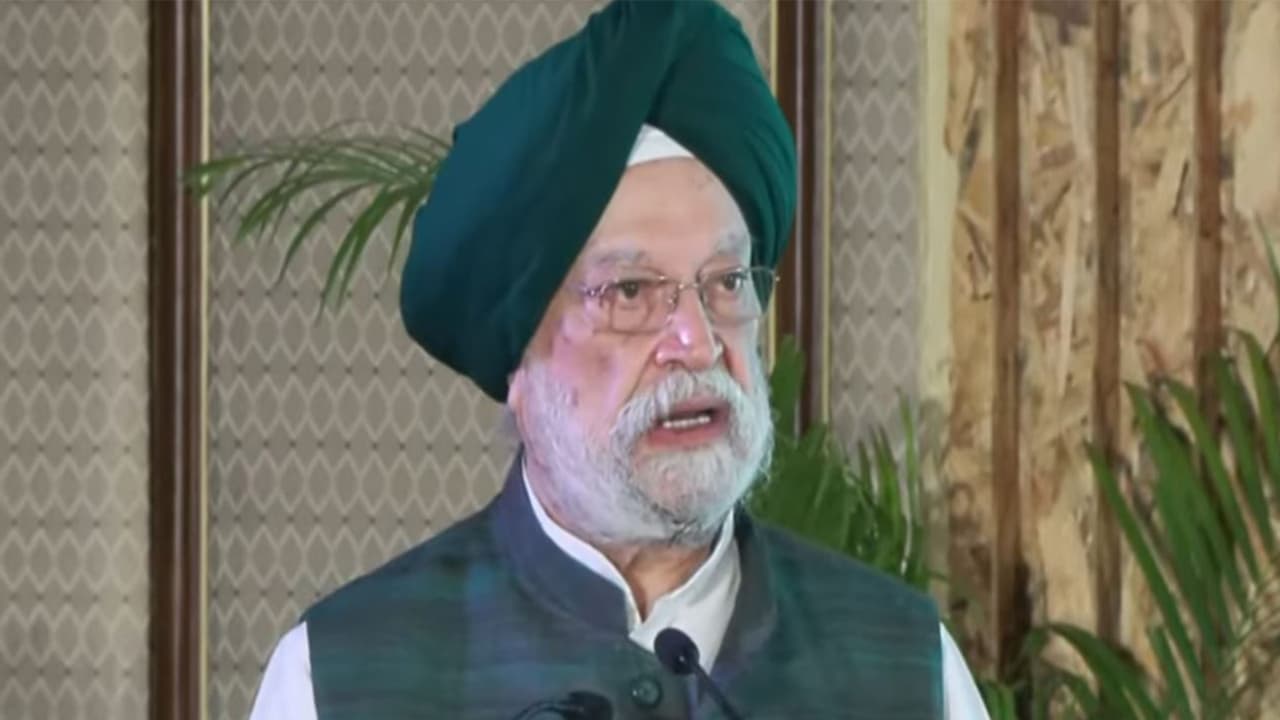
Union Minister Hardeep Singh Puri announced the govt is examining supportive policies for affordable flex-fuel vehicles. At Hero MotoCorp's first flex-fuel bike launch, he termed it a pragmatic path to cut imports and advance low-carbon goals.
Union Petroleum and Natural Gas Minister Hardeep Singh Puri has emphasised that the government is "actively examining supportive policy frameworks to accelerate affordable adoption", including fuel price support and targeted fiscal incentives.
Speaking at the Launch of Hero MotoCorp's First Flex-Fuel Motorcycle in the national capital on Wednesday, he said India's future mobility will combine EVs, biofuels, hydrogen and renewables, but flex-fuel vehicles offer a "pragmatic and immediately deployable pathway" to cut imports, strengthen the rural economy, and advance low-carbon goals. The event also marked the presence of Union Road, Transport and Highways Minister Nitin Gadkari.
A Practical Solution for India
Puri asserted that the Flex Fuel Vehicles offer India a practical solution to reduce crude oil imports, strengthen the rural economy through ethanol demand, and advance low-carbon mobility.
Hero MotoCorp Leads Mass-Market Shift
Puri described the launch as a new chapter in India's energy history, with the introduction of new motorcycles compatible with ethanol blends from E20 to E85.
He added that the launch of the Splendor+ and HF Deluxe Flex Fuel motorcycles marks India's entry into mass-market flex-fuel mobility with Aatmanirbhar vehicles.
India has one of the world's largest two-wheeler ecosystems with an active two-wheeler fleet of over 300 million vehicles. The flex-fuel technology has the potential to transform mobility at an unprecedented scale, a release said.
The shift to mass-market flex-fuel mobility can cut crude imports, support farmers, and make vehicle ownership cheaper for consumers.
Puri said the launch marks India's entry into large-scale flex-fuel mobility.
Hero is the world's largest manufacturer of motorcycles and scooters for 25 consecutive years, with nearly 29% market share in India. It has an active two-wheeler fleet of over 30 crore vehicles.
The new bikes are compatible with ethanol blends from E20 to E85 and use upgraded fuel systems, revised ECU calibration and flex-fuel capable components.
India's Ethanol Blending Success
Puri said India imports nearly 88.5% of its crude oil and "every geopolitical disruption impacts our economy and energy security."
He recalled that ethanol blending was just 1.4% in 2014, rose to 10% five months ahead of the November 2022 target, and hit 20% six years ahead of the 2030 goal. That progress has already saved 1.84 lakh crore in foreign exchange, substituted 302 lakh metric tonnes of crude, cut 909 lakh metric tonnes of CO2 emissions, and delivered Rs 1.58 lakh crore in income to farmers. "Our annadatas have become urjadatas," he said.
The Impact of 1% Adoption
He gave basic arithmetic to show the impact of even 1% adoption. If 1% of annual petrol vehicle sales shift to E85 in ethanol supply year 2026-27, it will generate over 4 crore litres of ethanol demand, Rs 266 crore in payments to distilleries, Rs 195 crore in forex savings, 0.28 lakh metric tonnes less crude imports, 0.86 lakh metric tonnes of CO2 reduction, and Rs 160 crore directly to farmers.
"And this, my friends, is just with 1% adoption. Imagine the transformational impact when flex-fuel technology scales across India's vast two-wheeler ecosystem," Puri said.
Consumer Economics and Indigenous Production
On consumer economics, Puri said E85 will be made available at designated pumps and will be "substantially cheaper than normal fuel." With appropriate pricing, studies show ownership cost parity with E20 can be achieved quickly.
He added that the platform is "made almost entirely in India" with hardly 1-2% imports, and if it runs on "fuel which is totally indigenous," it beats imported crude on cost. (ANI)
(Except for the headline, this story has not been edited by Asianet Newsable English staff and is published from a syndicated feed.)