
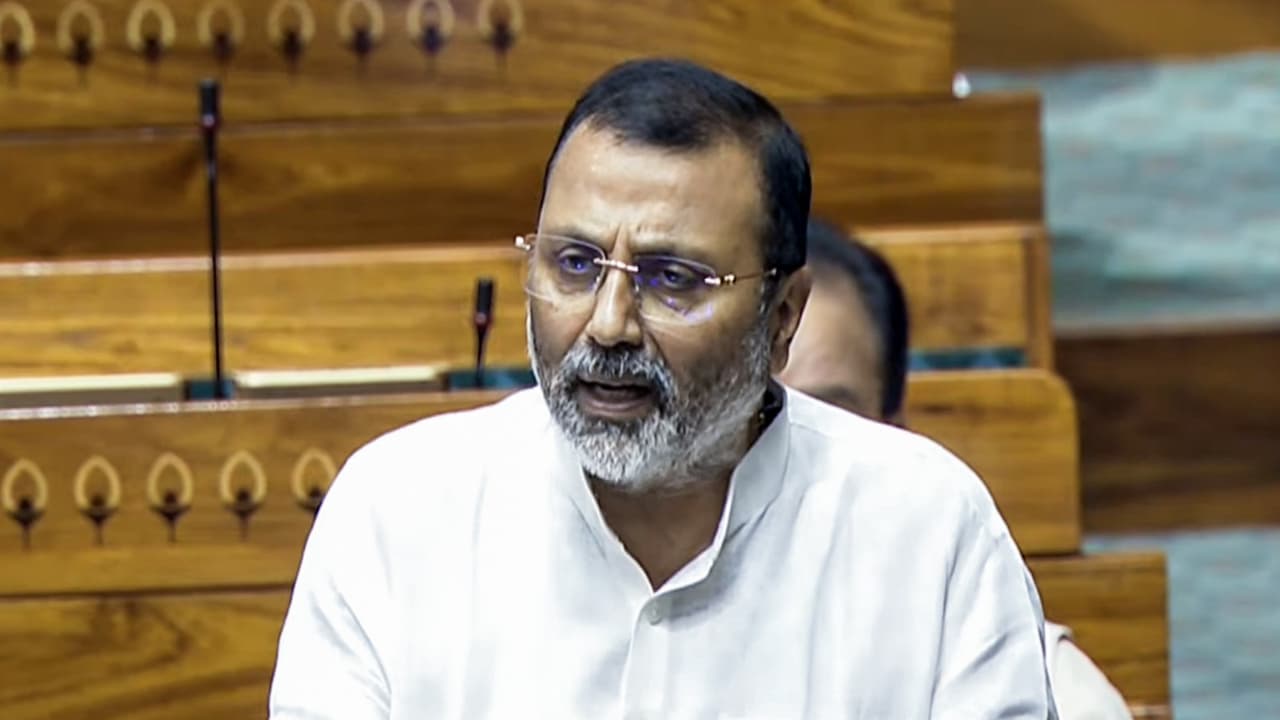
BJP MP Nishikant Dubey has accused the former Manmohan Singh-led Congress government of 'surrendering India' by handing over Sir Creek and Siachen to Pakistan after the 2006 Mumbai train blasts, alleging they acted on orders from the US.
Dubey's 'Congress Black Chapter' Allegations
BJP MP Nishikant Dubey on Sunday accused the former Congress government of "kneeling before America and surrendering India" after the Mumbai train blasts of 2006 by "handing over" Sir Creek and Siachen to Pakistan. In a post on X about his series, "Congress' Black Chapter," Dubey alleged that the former Prime Minister Manmohan Singh-led Congress government compromised on the innocent lives claimed in the 2026 Mumbai train blasts, allegedly through the guise of a 'civil nuclear agreement."
Dubey alleged that the then-Congress government, including Congress Parliamentary Party (CPP) Chairperson Sonia Gandhi, party leader Rahul Gandhi, agreed to hold talks with Pakistan on then US President George Bush's "order" despite the Mumbai train blasts of July 11, 2007, which claimed 189 lives. He said that the details of the talks, held on May 17, 2007, revealed that the Gandhi family allegedly "handed over Sir Creek and Siachen to Pakistan." "Congress's Black Chapter 62. On May 17, 2007, Sonia Gandhi ji, Rahul Gandhi ji, and then-Prime Minister Manmohan Singh ji knelt before America and surrendered India. The Gandhi family celebrated on the bodies of 187 innocent people killed in the Mumbai train blasts on July 11, 2006. Under the guise of the civil nuclear agreement, they fooled the public--meaning, handed out a lollipop. On May 7, 2007, then-US President George Bush ordered Prime Minister Manmohan Singh ji over the telephone to hold talks with Pakistan, and the Gandhi family, bowing before America, sent Indian officials to Pakistan for talks on the same day, i.e., May 17, 2007. The details of the continuous talks were later revealed when the Gandhi family decided, out of fear of America, to hand over Sir Creek and Siachen to Pakistan," he wrote on X. कॉंग्रेस का काला अध्याय 62. 17 मई 2007 सोनिया गांधी जी,राहुल गांधी जी और तत्कालीन प्रधानमंत्री मनमोहन सिंह जी ने अमेरिका के आगे घुटने टेक कर भारत को सरेंडर कर दिया ।सरेंडर गॉंधी परिवार ने 11 जुलाई 2006 को मुम्बई के ट्रेन में निरीह 187 लोगों के लाश पर जश्न मनाया ।सिविल न्यूक्लियर… pic.twitter.com/TZQb3qZadk — Dr Nishikant Dubey (@nishikant_dubey) May 17, 2026
Official Records vs. Political Commentary
A comparative analysis of historical archives from May 2007 reveals two distinct narratives surrounding India's foreign policy engagements. Official bilateral records document routine, pre-scheduled diplomatic processes under the institutionalised India-Pakistan "Composite Dialogue" framework and standard G-8 summit preparations with the United States. Conversely, political commentary, such as statements by BJP MP Nishikant Dubey, frames these synchronised dates as evidence of external pressure and a compromise of national sovereignty.
A formal press release details a telephone conversation between Prime Minister Manmohan Singh and US President George W. Bush. The documented agenda focused primarily on coordinating positions for the upcoming G-8 Outreach Summit, emphasising climate change mitigation, the Doha multilateral trade round, and a review of the ongoing Civil Nuclear Cooperation framework.
Official records show that technical-level talks concerning the Sir Creek dispute were held in Rawalpindi. This meeting was the scheduled Fourth Round of the Composite Dialogue--a peace process initiated in 2004. The Indian delegation was led by the Surveyor General of India, Major General M. Gopal Rao, focusing on the exchange of maps and joint survey data rather than territorial concessions.
The 2006 Mumbai Train Blasts
On the evening of July 11, 2006, bomb blasts took place at seven different places in the Mumbai local trains within just 11 minutes. In this incident, 189 people died, while more than 827 passengers were injured. The bombs were placed in first-class compartments of trains from Churchgate. They exploded near the stations of Matunga Road, Mahim Junction, Bandra, Khar, Jogeshwari, Bhayandar, and Borivali.
Legal Proceedings and Supreme Court Intervention
A trial court in 2015 convicted 12 people in the blasts' case. In July 2025, the Supreme Court stayed the Bombay High Court's judgment on acquitting 12 accused people in connection with the 2006 Mumbai blasts. A bench comprising Justices MM Sundresh and N. Kotiswar Singh clarified that the stay order would not affect the release of the accused persons from jail. The top courts' decision came on a plea filed by the Maharashtra government following the Bombay High Court's July 21 decision to acquit twelve persons who were accused in the 2006 train blasts.
During the hearing, the Solicitor General of India (SGI) Tushar Mehta, appearing for Maharashtra, sought a stay of the Bombay High Court judgement by contending that certain findings of the said verdict will affect other cases being probed by the Maharashtra Control of Organised Crime Act (MCOCA). The High Court had earlier acquitted the twelve accused persons, noting that the Maharashtra Anti-Terrorism Squad (ATS) had failed to prove the offences beyond a reasonable doubt. In doing so, the High Court set aside a September 2015 judgment of the Maharashtra Control of Organised Crimes Act (MCOCA) court that had imposed the death penalty on five of the 12 accused persons and had sentenced the remaining seven to life. (ANI)
(Except for the headline, this story has not been edited by Asianet Newsable English staff and is published from a syndicated feed.)