The Red Fort blast shows white-collar terrorism isn’t new. From Osama, a civil engineer, to Zawahiri, a surgeon, educated professionals have long joined extremist plots.
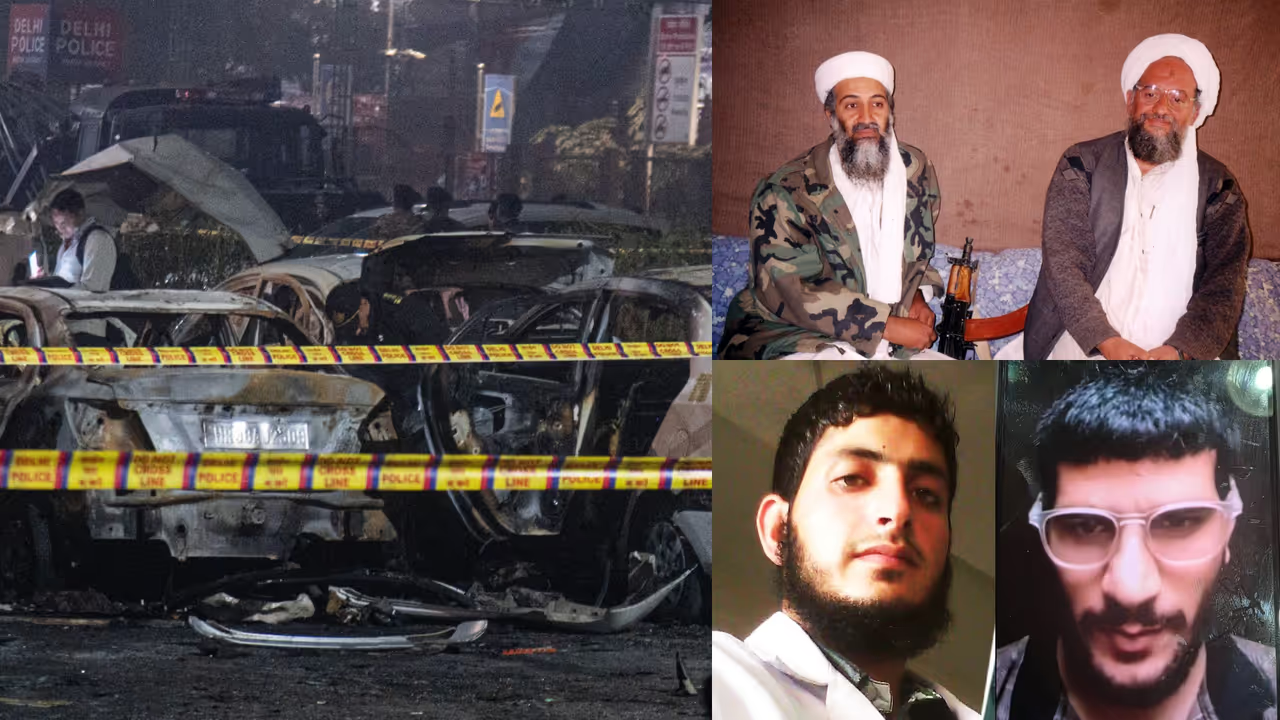
We like to believe doctors heal, engineers build, and professionals contribute positively to society. That belief is violently upended when individuals with these profiles appear at the center of a terror plot. The recent car explosion near Delhi’s Red Fort, which killed at least 12 people and injured 20, lays bare this chilling truth. Investigations revealed links to an inter-state terror module spanning Kashmir, Haryana, and Uttar Pradesh, involving Jaish-e-Mohammed (JeM) and Ansar Ghazwat-ul-Hind. Authorities recovered nearly 3,000 kilograms of explosives from two Faridabad homes and arrested several individuals, including doctors and university professionals.
What makes this case especially unsettling is that the perpetrators were not marginalised youth but educated, respected members of society—the so-called “white-collar” terrorists who live among us unnoticed until tragedy strikes.
Educated Extremists: A Global Pattern
The notion that terrorism stems from poverty or illiteracy is a dangerous misconception. History and contemporary evidence repeatedly show that highly educated individuals often commit acts of violence for ideology, identity, or perceived moral duty.
Related Articles

Examples of Educated Global Terrorists
- Osama bin Laden: Studied civil engineering/technical subjects at King Abdulaziz University, Jeddah.
- Ayman al-Zawahiri: Medical degree from Cairo University; served as a surgeon before becoming Al-Qaeda’s second-in-command.
- Abu Bakr al-Baghdadi: Studied Islamic law at Islamic University of Baghdad; reportedly earned BA/MA/PhD degrees
- Anwar al-Awlaki: B.S. in civil engineering from Colorado State University; later earned a master’s in education leadership from San Diego State University.
- Khalid Sheikh Mohammed (9/11 Mastermind, Al-Qaeda): Civil Engineering degree (North Carolina A&T State University)
- Mohamed Atta (9/11 hijacker): Studied architecture and engineering in Egypt and later in Germany (Hamburg).
- Ziad Jarrah (9/11 Hijacker, Al-Qaeda): Aeronautical engineering degree (University of Applied Sciences, Hamburg)
- Marwan al-Shehhi (9/11 Hijacker, Al-Qaeda): Civil Engineering student in Germany
- Omar Saeed Sheikh (British-Pakistani terrorist): Studied at London School of Economics, mathematics topper; Involved in kidnappings in Kashmir; convicted for the murder of journalist Daniel Pearl.
- Umar Farouk Abdulmutallab (“Underwear Bomber”): Studied engineering at University College London (UG and PG studies).
- Ted Kaczynski (“Unabomber”): Entered Harvard at 16; Ph.D. in mathematics from the University of Michigan.
- Anders Behring Breivik: Completed secondary and higher education in Norway; studied political science/public policy at university.
Even in India, educated professionals have participated in terror networks: engineers, doctors, software developers, and research scientists have been arrested in connection with attacks by the Indian Mujahideen. Intelligence reports also indicate the growing involvement of women from educated backgrounds in recruitment for terrorist outfits.
In May this year, a Thane-based engineer was arrested on the charge of spying, shared sensitive information about warships and submarines to the Pakistani intelligence operative through sketches, diagrams and audio notes, and received money from various bank accounts in India and abroad in return.
In March this year, an engineer working with Bharat Electronics Limited (BEL) in Bengaluru was arrested for leaking sensitive information to his handlers in Pakistan. In the same month, a 36-year-old man from Ghaziabad was arrested for allegedly leaking sensitive information about Indian government offices to Pakistan in exchange for Bitcoin payments.
Speaking to Asianet Newsable English, Former Special Director of the Intelligence Bureau and Secretary (Security) Yashovardhan Jha Azad said this disturbing pattern of having ‘white-collar’ terrorists isn’t entirely new.
“Radicalisation attempts are on since very long time. You must have seen the ISIS module. Youths from Kerala and Andhra Pradesh were attracted to them. Some of them were educated also. In their interrogation, they told how they were impressed with the ISIS. So this attempt was on since long.”
The Red Fort Connection: Doctors at the Heart of the Plot
In Delhi and Faridabad, this unsettling pattern has become real. Dr Umar Nabi, a Pulwama-based doctor, was driving the Hyundai i20 that exploded near the Red Fort. Investigators are probing links to an inter-state terror module spanning Kashmir, Haryana, and Uttar Pradesh. Preliminary evidence points to explosives like ammonium nitrate being used, suggesting a planned attack rather than an accident.
Alongside Dr Nabi, Dr Muzammil Ganaie and Dr Shaheen Sayeed—both linked to Al-Falah University in Faridabad—were arrested. Dr Shaheen is alleged to lead JeM’s women recruitment wing in India through the Jamaat-ul-Mominaat, a group recently formed by JeM. Officials say the group mirrors ISIS-style recruitment of female attackers, signaling a worrying trend of radicalisation in educated circles.
Dr Nabi, described by his family as introverted and studious, allegedly carried out the attack fearing apprehension, showing how ordinary, educated individuals can be drawn into extremism. Investigators also detained Tariq, another individual from Pulwama, who reportedly provided the vehicle. Security agencies in Delhi and Kashmir are now conducting raids, scanning CCTV footage, and intensifying surveillance at schools and colleges.
Why White-Collar Terrorism Happens
Why do educated professionals—doctors, engineers, academics—turn to terrorism?
Dr Fathali Moghaddam of Georgetown University explains that radicalisation is often rooted in perceived moral humiliation, social disrespect, and political marginalisation.
“Radicalisation is not born in poverty or ignorance alone. It happens when people feel morally humiliated, socially disrespected and politically unheard. Educated individuals are often more vulnerable because they seek meaning and grand narratives. Violence becomes, in their mind, not destruction but purpose,” he said.
In his book, ‘The Muslims are Coming! Islamophobia, Extremism and the Domestic War on Terror’, Scholar Arun Kundnani echoes this view, noting that radicalisation is not "the product of a sudden psychological vulnerability" but "a political response to a political context".
Former Jammu and Kashmir DGP SP Vaid believes the evolution of terrorist strategy explains why professionals are being drawn into the fold.
“They continuously change their tactics because they were not succeeding in their normal routine. So they keep changing their tactics and the reason why they change this time also," he told Asianet Newsable English.
In Kashmir, intelligence agencies have flagged a surge in radicalisation among young women in private schools, with clerics promoting rigid interpretations of Islam over the valley’s centuries-old Sufi traditions. Radical ideas thrive where communities feel unheard, undervalued, or alienated.
"Becoming a doctor is the ultimate dream of youth in the Kashmir Valley. Despite becoming a doctor, if you get radicalised and get ready to kill your own countrymen and break your own country, then imagine the kind of radicalisation that is taking place. The country will have to see what it is doing on this Front...This is a big challenge, and work needs to be done on this front,” SP Vaid said in an separate interview with ANI.
Red Fort Blast: Human Toll
The blast at Delhi’s Red Fort claimed the lives of at least 12 people, while 20 were injured, including residents from Delhi, Uttar Pradesh, Uttarakhand, and Himachal Pradesh. Security has been heightened across Delhi and other parts of the country, with vehicle checks intensified, metro closures, and strict vigil maintained at airports, bus terminals, and major transport routes. The NIA has taken over the investigation, while police continue to track associates of the suspects in Kashmir and Faridabad.
The Faridabad and Delhi incidents illustrate that terrorism is not only a threat to physical security—it is a moral and civic challenge. The individuals involved were not strangers from remote regions or underprivileged communities. They were neighbours, colleagues, and members of the educated middle class.
The Red Fort blast, orchestrated by individuals who were doctors, underscores a harsh truth: extremism can reside where we least expect it. India’s task is not only to bring the perpetrators to justice but also to confront the broader challenges that make radicalisation possible, ensuring that knowledge and profession are wielded to nurture life, not destroy it.