
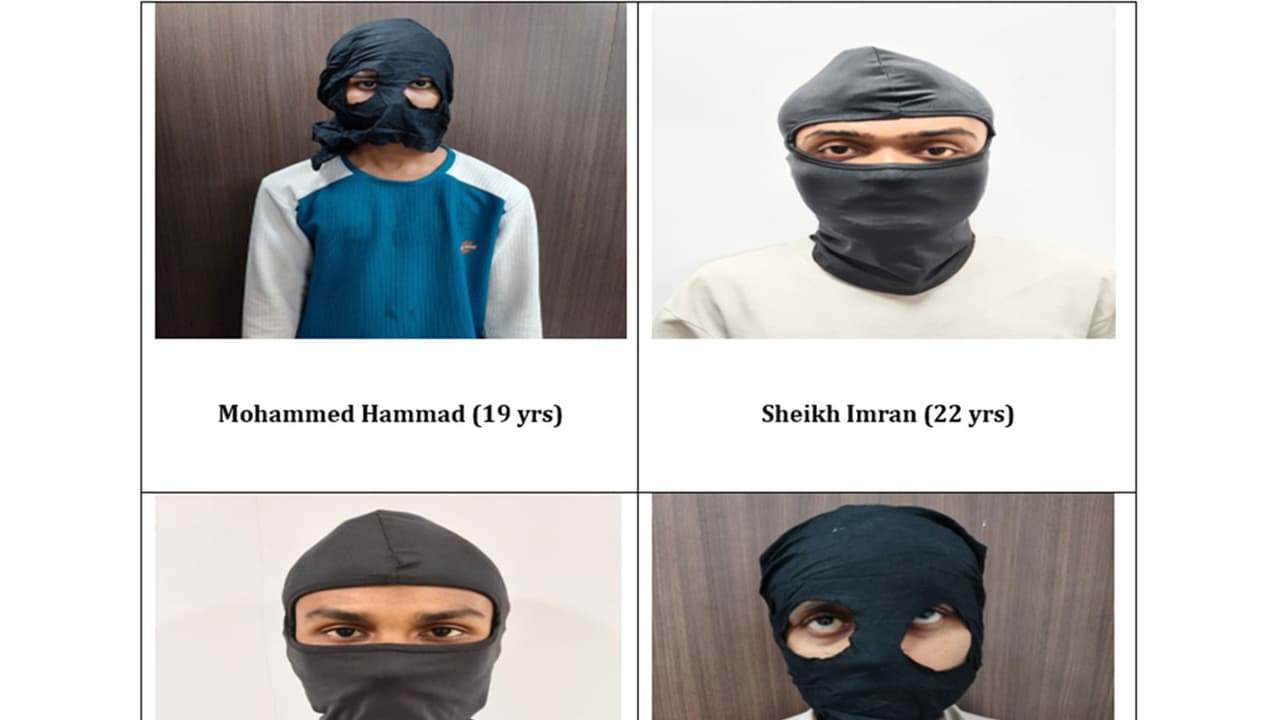
Delhi Police Special Cell arrested four radicalised youths from Maharashtra, Odisha and Bihar. They were allegedly preparing IEDs, radicalising others online and planning terror strikes on high-value targets like Ram Mandir and Parliament House.
The Delhi Police Special Cell (NDR team) on Saturday arrested four radicalised youths from Maharashtra, Odisha and Bihar in an intelligence-led operation for allegedly preparing improvised explosive devices (IEDs), radicalising recruits online and planning terror strikes at high-value locations across the country, officials said.
According to police, the accused were influenced by extremist ideology related to establishing a caliphate and believed in the emergence of a "lashkar from Khurasan" carrying black flags. They were allegedly preparing themselves to participate in "Ghazwa-e-Hind" while also radicalising and recruiting others through encrypted social media groups. Material used for preparation of an IED was recovered from one of the accused.
Terror Plot and Targets Identified
Investigators said two members of the module were collecting locally sourced materials to assemble a remote-controlled IED that could be used for a terror attack at an opportune time. Police said the accused had identified high-value targets including Ram Mandir, Parliament House and military installations. One of the accused had also visited Red Fort in December 2025 and circulated an edited image showing a black flag atop the monument to radicalise followers online.
Profiles of the Accused
The arrested accused have been identified as Mosaib Ahmad alias Sonu alias Kalam from Thane, Maharashtra; Mohammad Hammad from Mumbai, Maharashtra; Sheikh Imran from Bhubaneswar, Odisha; and Mohammad Sohail from Katihar, Bihar.
Online Radicalisation and Fundraising
Police said the accused were administrators and members of closed encrypted social media groups where discussions related to jihad, khilafat and recruitment for extremist activities were taking place. One member allegedly exhorted followers to collect weapons and explosives for "Ghazwa-e-Hind" and shared his bank account and QR code details to raise funds in support of jihad. Another member promised to arrange arms training and physical training for module members and asked others to contribute money.
Individual Roles in the Module
Officials further said the accused Sheikh Imran began listening to lectures/takreers of Tareeq Jameel, Israr Ahmed, Zakir Naik etc. and gradually developed radical beliefs in 2024 and conducted reconnaissance visits to sensitive installations in Delhi including Red Fort and India Gate and discussed targeting Ram Mandir, Parliament and military establishments. He also assured members of arranging arms training and physical training, including horse riding, in Odisha.
Police added that the accused Mosaib Ahmad, originally from Azamgarh in Uttar Pradesh and had previously employed as a welder, auto mechanic and auto electrician in India and Gulf countries including Saudi Arabia and Qatar, assisted co-accused Mohammad Hammad in modifying the circuit of a remote-controlled toy car for assembling an IED after Hammad shared images of ball bearings, nails, boxes and the toy car as explosive components within a closed group.
Another accused Mohammad Sohail, a plumber from Katihar, Bihar, allegedly created multiple social media accounts and and exhorted youth in the name of jihad. He incited his followers in March 2026 to collect weapons and explosives for extremist activities while sharing his bank account and QR code details for fundraising.
Investigation and Legal Action
The arrests were made by the Special Cell's NDR team led by Inspectors Vinay Pal and Manoj Kumar under the supervision of ACP Ashish Kumar. An FIR under relevant provisions of the Bharatiya Nyaya Sanhita, 2023 has been registered at the Special Cell police station. Further investigation is underway.
(Except for the headline, this story has not been edited by Asianet Newsable English staff and is published from a syndicated feed.)