
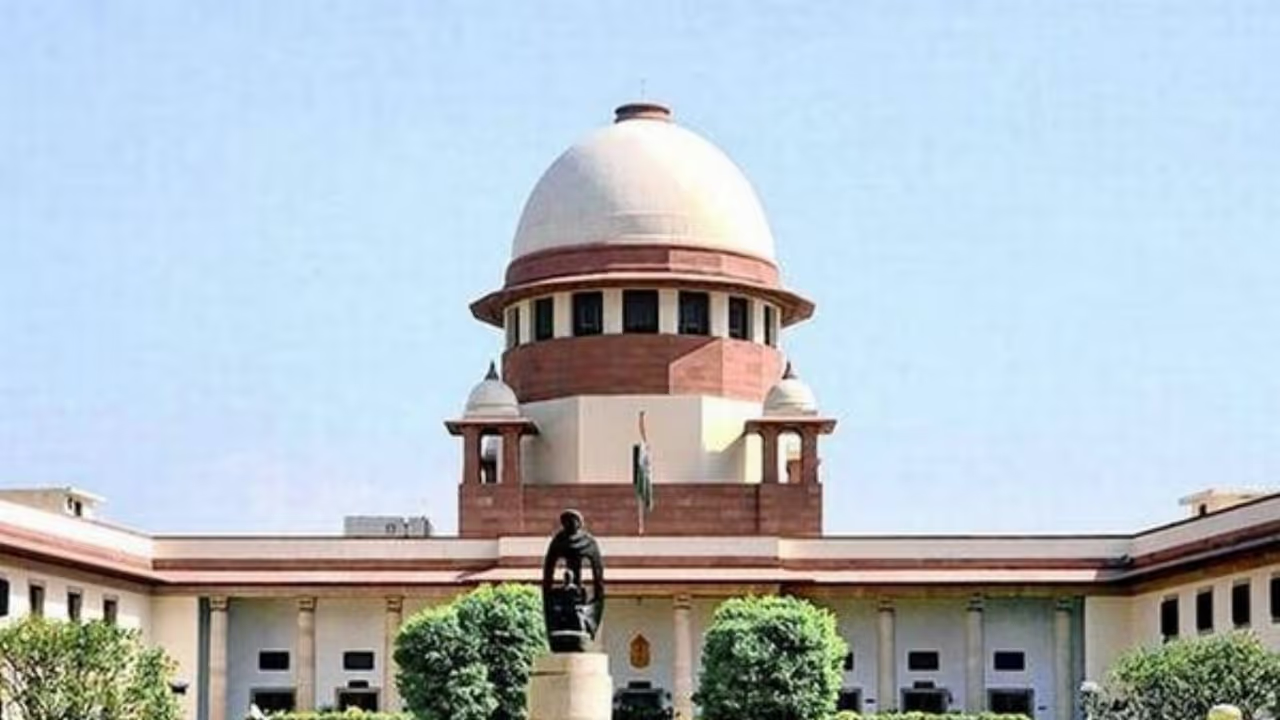
The Supreme Court has sought a response from the Centre and DMRC on a plea challenging the closure of 17 Delhi Metro stations during protests, raising constitutional questions about restricting public rights and the lack of a proper legal framework.
SC Seeks Centre's Response on Plea
The Supreme Court on Thursday issued notice to the Centre and others on a plea challenging the closure of 17 Delhi Metro stations during the Cockroach Janata Party (CJP) protests, with the petitioner raising questions over the legality and proportionality of shutting down a public utility and restricting the movement of the public at large.
A bench of Chief Justice of India Surya Kant and Justices Joymalya Bagchi and V Mohana sought a response from the Central government, Delhi Police, Delhi Metro Rail Corporation (DMRC) and the Delhi government on the plea.
Proportionality and Executive Power Questioned
The apex court was told that the closure of Metro stations raised substantial constitutional questions concerning the standards governing restrictions on public rights and the exercise of executive power.
Justice Bagchi observed that courts ordinarily defer to the executive on law-and-order matters, but judicial intervention may be warranted when the exercise of discretion becomes disproportionate.
Lack of Legal Framework Highlighted
The counsel submitted that the closure of the stations could not be justified merely as a law-and-order measure, particularly when there was no specific statutory provision authorising such a shutdown.
It was also submitted that there was no Standard Operating Procedure (SOP) governing the closure of Metro stations during protests. Counsel said that the decision was not communicated through any formal order but through posts on X, raising further questions about the legal basis of the shutdown.
It was further pointed out that the Metro Act contains no provision permitting authorities to shut down a Metro station and that underground railways fall within the Union List.
On the demand for a specific SOP governing Metro shutdowns during protests, Justice Bagchi remarked that the concept of an SOP in such circumstances was “actually a mirage”. He said courts have generally deferred to executive authorities on law-and-order questions and intervene when the exercise of discretion becomes disproportionate.
The DMRC on July 20 and 22 had closed Metro stations and cited security reasons while announcing the closures through service updates on X during the protest.
(Except for the headline, this story has not been edited by Asianet Newsable English staff and is published from a syndicated feed.)