
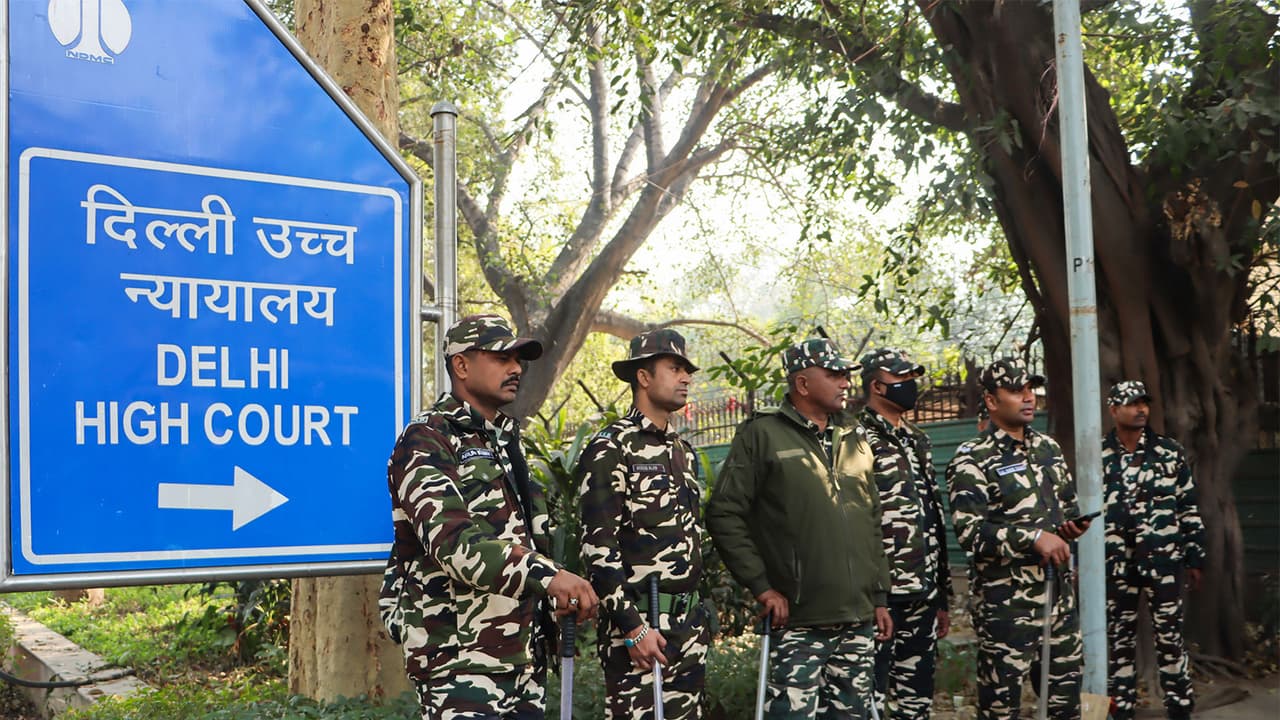
The Delhi HC set aside an order that stopped eviction proceedings against the Delhi Race Club. A Division Bench held the govt has a statutory right to proceed against the club, whose lease expired in 1994, under the Public Premises Act.
Delhi HC Allows Eviction Proceedings to Resume
The Delhi High Court has set aside an interim order that had restrained the Estate Officer from proceeding against the Delhi Race Club under the Public Premises (Eviction of Unauthorised Occupants) Act, 1971, holding that the Union government has a statutory right to initiate eviction proceedings against an alleged unauthorised occupant of public premises.
A Division Bench comprising Chief Justice Devendra Kumar Upadhyaya and Justice Tejas Karia held that the Single Judge's order dated April 24, 2026, which deferred proceedings arising from the show-cause notice issued to the Delhi Race Club, could not have been passed without recording findings on a prima facie case, balance of convenience, and irreparable loss.
Appearing for the Union of India, Additional Solicitor General Chetan Sharma, along with CGSC Ashish K. Dixit and other government counsel, argued that the writ petition challenging the show-cause notice itself was not maintainable and that the Delhi Race Club ought to raise all its objections before the Estate Officer in proceedings under Section 4 of the Public Premises Act.
The Bench observed that the Estate Officer's proceedings under Section 4 of the Public Premises Act stem from a statutory right available to the government for eviction of unauthorised occupants from public premises. It held that any interim order restraining the Estate Officer from proceeding further directly impacts that statutory right and therefore amounts to a "judgment" amenable to an intra-court appeal under Clause 10 of the Letters Patent.
Lease Expired in 1994
The Court noted that the Delhi Race Club's lease pertaining to 84.484 acres of land granted in 1926 had expired on December 31, 1994, and no further extension or renewal had been granted thereafter. Referring to the definition of "unauthorised occupation" under Section 2(g) of the Public Premises Act, the Bench held that even occupants whose possession was lawful at inception would become unauthorised once the lease expired.
The dispute arose after the Estate Officer issued a fresh show-cause notice dated April 17, 2026, asking the Delhi Race Club to explain why an eviction order should not be passed. The Race Club challenged the notice before a Single Judge, who directed that no further proceedings be taken pursuant to the notice until the next date of hearing.
Race Club's Contentions Rejected
Senior Advocate Suhail Dutt, appearing for the Delhi Race Club along with advocates Azhar Alam and Sankalp Goswami, argued that the intra-court appeal itself was not maintainable since the impugned order was merely interlocutory in nature. The Race Club also contended that a similar show-cause notice issued in 1999 had already been quashed by the High Court in 2012, and therefore, the fresh proceedings were legally unsustainable.
Rejecting the contention, the Division Bench held that the 2012 judgment had merely quashed the earlier notice and directed consideration of the Race Club's representation seeking renewal of the lease. Since the government subsequently rejected the request for renewal, issuance of a fresh notice under Section 4 could not be termed an abuse of process or a premeditated action.
Court Cites Lack of Prima Facie Case for Stay
The Court further observed that the Race Club would have "amplest opportunity" before the Estate Officer to raise all legal pleas available to it, including challenges to the legality of the notice itself.
The Bench emphasised that even in writ proceedings, interim relief cannot be granted mechanically and courts must examine established principles governing injunctions, including a prima facie case, balance of convenience, and irreparable injury. Relying on Supreme Court decisions in Union of India v. Era Educational Trust and Deoraj v. State of Maharashtra, the Court held that no such exercise had been undertaken by the Single Judge before restraining the Estate Officer from proceeding further.
Accordingly, the Division Bench held the intra-court appeal maintainable and proceeded to interfere with the interim protection granted to the Delhi Race Club. (ANI)
(Except for the headline, this story has not been edited by Asianet Newsable English staff and is published from a syndicated feed.)