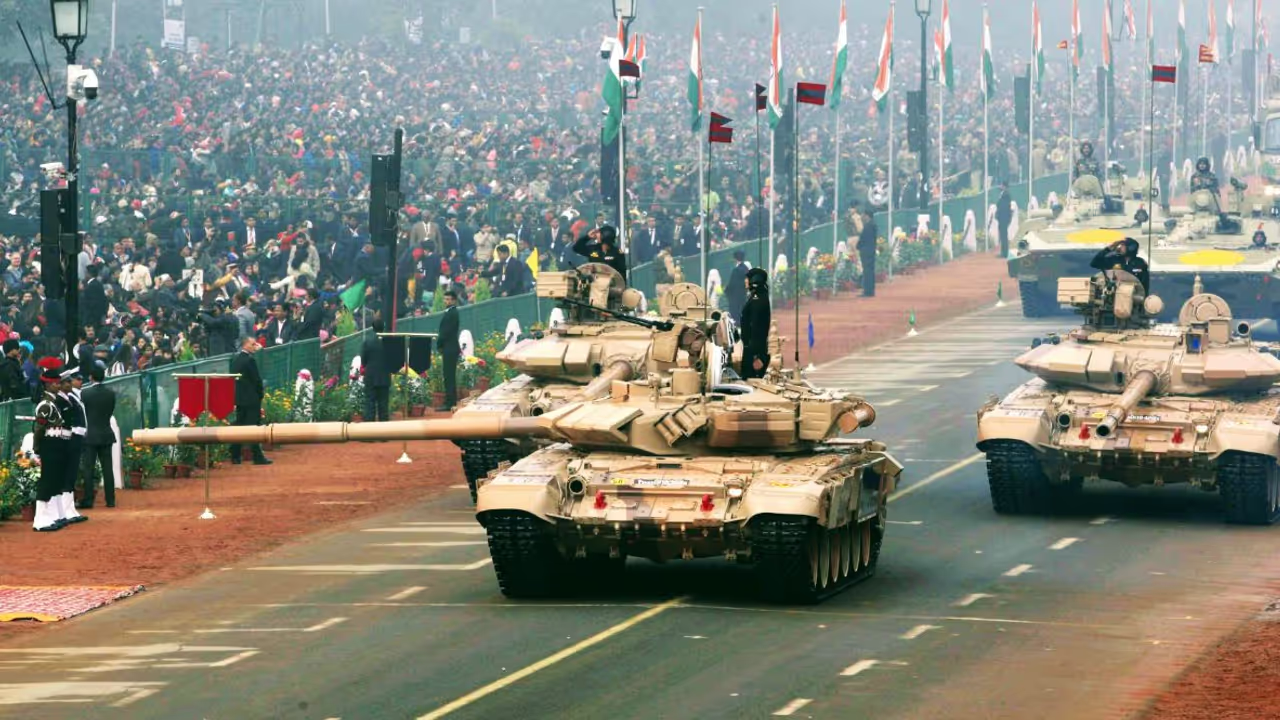
The Ministry of Defence has floated a request for information (RFI) to procure around 50 Basic Gunnery Simulators (BGS) for the Indian Army’s Tank T-90 fleet training.
New Delhi: The Ministry of Defence has floated a request for information (RFI) to procure around 50 Basic Gunnery Simulators (BGS) for the Indian Army’s Tank T-90 fleet training. The simulators will train T-90 gunners without putting them on a live range.
As per the RFI, the equipment should be robust enough to meet military grade ruggedness in design to withstand terrain, climatic variations and should enable training of basic and advanced gunnery skills of the Tank T-90 Gunner.
The simulators should be capable of replicating live firing conditions, including AI-generated enemy threats of escalating difficulty.
Related Articles

What the simulator must do
A gunner must be able to practise the full firing sequence, including spotting, identifying, tracking, ranging, aiming and firing for the main 125mm gun, the 7.62mm co-axial machine gun, the INVAR missile and smoke grenade launchers, all from inside a replica of the T-90's gunner station.
The replication must be faithful -- autoloader conveyor, brow-pad recoil, lighting, and the physical jolt of a 125mm round going off.
The fire control system simulation must cover the TISAS/TIFCS suite in normal, manual and emergency modes, with ballistic solutions for HE, HEAT and APFSDS ammunition.
“Recoil and muzzle flash will be CGI-rendered; the audio must reproduce engine noise, autoloader cycling, incoming fire and general battlefield sounds,” the RFI stated.
AI-driven training
The RFI puts artificial intelligence (AI) at the centre of the training design. Enemy forces in the simulator must grow harder to engage with each successive exercise, or as set by the instructor.
Vendors are asked whether their software can run single-player and multiplayer combat missions set in terrain matching actual ground along India's western and northern borders – the international boundary, line of control and line of actual control.
The AI must also assess the trainee automatically, flagging errors in technique and feeding corrections back into the training loop without the instructor stepping in.
A conventional instructor console will handle malfunction injection, scenario programming, performance recording and replay, with an external display for waiting crew members to watch ongoing engagements.
Size, weight and endurance
The simulator must fit inside an Ashok Leyland Stallion lorry – roughly 5.2m by 2.4m footprint, height just under 4m and weigh no more than around 6.5 tonnes. It must work in temperatures from -10°C to 45°C, run 12 to 16 hours a day, and carry 30 minutes of UPS backup.
The required service life is 15 years, with a condition that the vendor give two years' notice before shutting down the production line so the government can stock up on spares.