
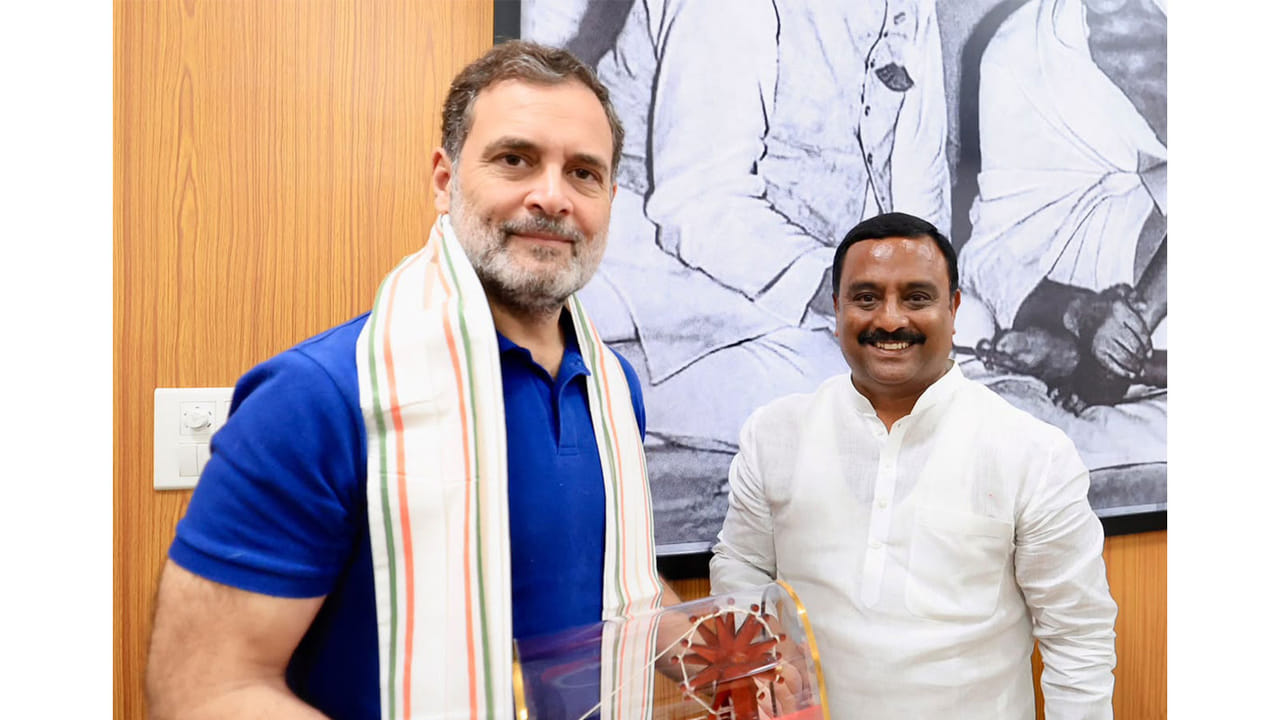
Telangana Congress MLA Komatireddy Rajagopal Reddy will meet new AICC in-charge BM Sandeep following public criticism of CM Revanth Reddy. The meeting aims to address internal rifts over development funding and government performance.
Congress MLA Rajagopal Reddy to Meet AICC In-charge BM Sandeep Soon
Hyderabad (Telangana) [India], November 22 (ANI): Munugode Congress MLA Komatireddy Rajagopal Reddy has been asked to meet newly appointed AICC Telangana in-charge BM Sandeep on November 23, following his recent public criticism of Chief Minister A Revanth Reddy and the functioning of the state government.
As per media reports, AICC Secretary Sachin Sawant contacted Rajagopal Reddy over the phone, enquired about the latest political developments in Telangana and asked him to make himself available for a meeting with Sandeep on Monday. Sandeep arrived in Hyderabad on Sunday on his first visit to the state after being appointed Telangana Congress in-charge, replacing Meenakshi Natarajan.
He is scheduled to participate in meetings of the Political Affairs Committee (PAC) and the extended Pradesh Congress Committee (PCC) executive at Gandhi Bhavan. Chief Minister A Revanth Reddy, Deputy Chief Minister Bhatti Vikramarka, TPCC president B. Mahesh Kumar Goud, ministers and other senior party leaders are expected to participate in the deliberations.
The meeting with Rajagopal Reddy comes against the backdrop of his recent remarks questioning the government’s approach towards constituency development and the allocation of funds to Munugode. The MLA has alleged that adequate attention has not been given to development works in his constituency and has also criticised what he described as preferential allocation of resources to certain constituencies. His remarks have also included criticism of the Chief Minister’s public statements.
On Friday, Rajagopal Reddy called upon leaders holding high constitutional and political positions to maintain dignity in their public statements and exercise restraint while dealing with political differences. As per media reports, the Munugode MLA said he had no intention of leaving the Congress. He reiterated his commitment to the party and said his political objective was to see Rahul Gandhi become Prime Minister. He also indicated that he would raise his concerns directly with Sandeep during their proposed meeting.
Meanwhile, TPCC president B Mahesh Kumar Goud has said that the party leadership is examining the public statements made by Rajagopal Reddy and Jadcherla MLA J Anirudh Reddy. He indicated that the newly appointed AICC in-charge would review the issues and that the leadership would take an appropriate decision at the appropriate time.
Sandeep’s immediate task is understood to include addressing differences among party legislators, improving coordination between the government and the party organisation, and strengthening the state unit. During his Hyderabad visit, he is also scheduled to interact with ministers, District Congress Committee presidents and heads of affiliated organisations. He is expected to return to Hyderabad on November 27 for individual meetings with MPs, MLAs and MLCs.
The developments come at a time when the Congress leadership is dealing with differences among several leaders in Telangana. Issues relating to constituency development, organisational appointments, coordination between elected representatives and the government, and public criticism by party members have figured in discussions within the state unit. The proposed meeting between Rajagopal Reddy and Sandeep is expected to provide an opportunity to discuss the MLA’s concerns and the party’s position on the issues raised by him. However, the specific agenda of their meeting and any decision on disciplinary action have not been officially announced.
The ruling Congress in Telangana is facing mounting internal trouble, with differences among ministers, MPs and MLAs increasingly spilling into the public domain. A series of controversial remarks, allegations and open criticism by party leaders has exposed growing discontent within the organisation, raising questions about the party’s ability to maintain unity as it approaches its third year in power. The latest and perhaps most significant flashpoint came on Wednesday, when Munugode MLA Komatireddy Rajagopal Reddy launched a scathing attack on Chief Minister Revanth Reddy, openly questioning his leadership style and the government’s approach to development funding. In unusually strong remarks, the Congress legislator warned the Chief Minister that a “war will begin” if he assumed that being in power allowed him to act as he pleased.
Taking exception to the Chief Minister’s alleged remarks against those questioning him, Rajagopal Reddy questioned the language used against an elected representative seeking development funds for his constituency. He also took a swipe at Revanth Reddy, saying he had become Chief Minister through good fortune and should at least govern properly for the remaining two years. The MLA’s principal grievance centred on what he described as unequal distribution of development funds. Questioning the alleged preference being given to Kodangal, represented by Revanth Reddy, and Madhira, represented by Deputy Chief Minister Mallu Bhatti Vikramarka, he asserted that Telangana was not limited to these constituencies. He said there was no objection to allocating even Rs 10,000 crore or Rs 20,000 crore to Kodangal, but backward constituencies such as Munugode should also receive their fair share.
Warning against withholding funds for his constituency, Rajagopal Reddy said the issue could turn into another “Kurukshetra”. He alleged that several development projects, including roads and irrigation works, were stalled due to a lack of funds. He also raised concerns over delays in the proposed 100-bed hospital at Choutuppal and the problems faced by fluoride-affected areas. In another pointed remark, he said people of Telangana were not happy even after nearly three years of governance. Dismissing suggestions that his criticism stemmed from not being accommodated in the Cabinet, he maintained that he was not interested in ministerial positions and had entered politics to work for the people. He also challenged the government on public expenditure, claiming that he would execute works at 20 per cent below the quoted tender value and asserting that he neither paid nor accepted commissions.
The direct and public challenge to the Chief Minister by a senior legislator from the ruling party has added a new dimension to the growing internal discord. It has also brought simmering differences over power, funds and the functioning of the government into sharper focus. The confrontation is not an isolated incident. Differences among senior leaders have surfaced repeatedly, with disputes over organisational appointments, constituency-level development works and the treatment of party legislators adding to the tensions. One of the major flashpoints involved Health Minister C Damodar Rajanarasimha and Jukkal MLA T Laxmikantha Rao, who reportedly had a heated confrontation in New Delhi. The MLA accused the minister of using abusive language and threatening him during the altercation. The dispute was reportedly linked to disagreements over organisational appointments, particularly the selection of the Sangareddy District Congress Committee president. The controversy brought internal differences into the open and reportedly attracted the attention of the party’s central leadership. Differences have also surfaced between Peddapalli MP G Vamshi Krishna and Industries Minister D Sridhar Babu. The MP publicly questioned the minister over the absence of certain party leaders from a Congress programme in Delhi and opposed disciplinary action against some legislators and party workers, alleging that different standards were being applied within the organisation.
Discontent over development funding has emerged as another major source of friction. Rajagopal Reddy is not the only legislator to have expressed dissatisfaction over the issue. Jadcherla MLA J Anirudh Reddy has also voiced frustration over delays in clearing development bills and questioned the government’s response to pending works in his constituency. He has separately raised allegations about officials allegedly demanding commissions from contractors, adding to the criticism surrounding governance. The repeated public criticism by legislators has reportedly caused concern among senior party leaders, particularly as such statements risk undermining the government’s image and providing ammunition to the Opposition. The underlying tensions appear to extend beyond individual disagreements. Competing political interests, differences between long-time Congress leaders and those who joined the party from other political formations, and dissatisfaction over the functioning of the government are believed to be contributing to the growing unease. The party leadership now faces the difficult task of balancing competing interests, addressing the grievances of elected representatives and enforcing organisational discipline without aggravating the divisions.
Another episode underscoring the internal tensions involved former minister Konda Surekha, who was dropped from the Cabinet on September 3 following a controversy over remarks made by her daughter, Konda Sushmita Patel, against Chief Minister Revanth Reddy over the Parkal Assembly constituency. Surekha questioned the disciplinary action, alleging that she was being selectively targeted and politically sidelined. She also raised concerns about discrimination against her as a senior Backward Classes woman leader. Her removal triggered fresh debate within the party over disciplinary standards and the treatment of senior leaders. With sitting MLAs openly challenging the government’s approach, former ministers questioning disciplinary action and differences among senior leaders becoming increasingly visible, the internal discord has become difficult to dismiss as routine political disagreements. Whether the Congress leadership can contain the dissent through dialogue and corrective measures, or whether the continuing confrontations will develop into a larger organisational challenge, remains to be seen. (ANI)










