
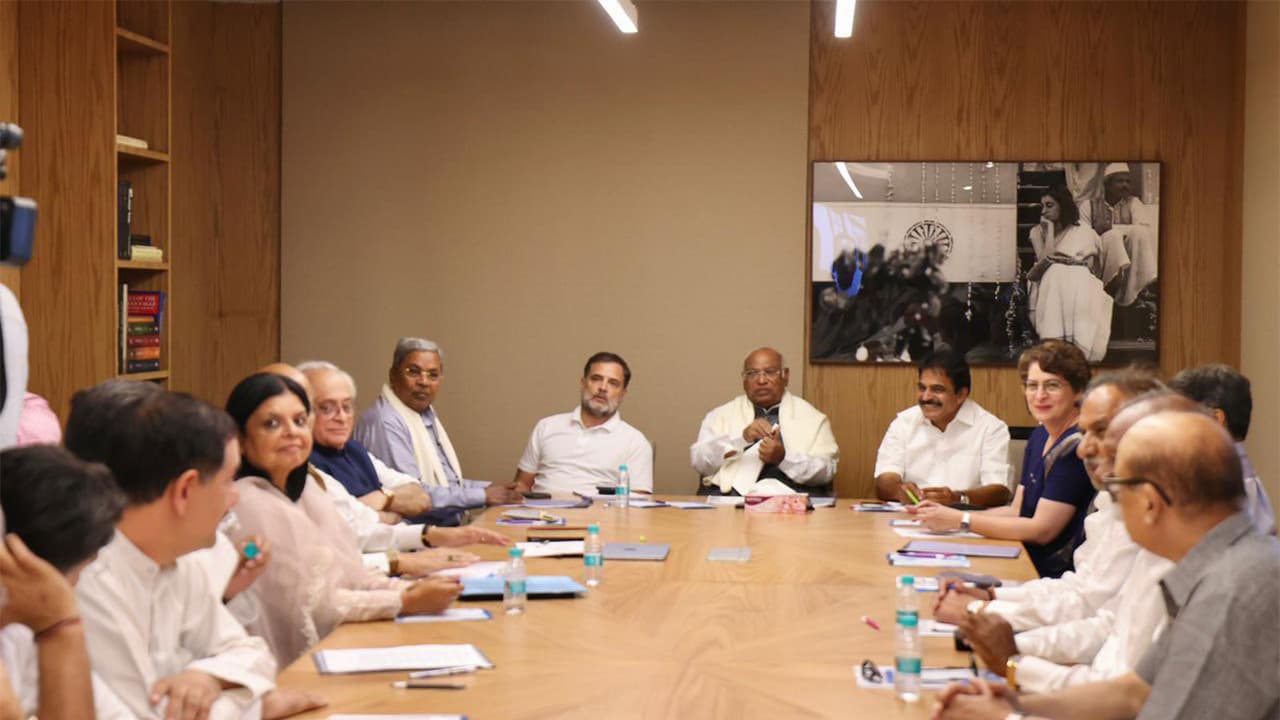
The Congress CWC met to strategise on the Women's Reservation Bill ahead of a special Parliament session. President Mallikarjun Kharge accused the BJP of rushing the bill and a delimitation plan for electoral gains, warning of serious consequences.
The Congress party held a high-level meeting of its Working Committee (CWC) in Delhi on Friday to deliberate developments related to the Women's Reservation Bill, ahead of a three-day special session of Parliament scheduled to begin on April 16.
The Congress meeting saw participation from top brass, including Party President Mallikarjun Kharge and Lok Sabha Leader of Opposition Rahul Gandhi. Alongside senior leaders like Priyanka Vadra Gandhi, Jairam Ramesh, Shashi Tharoor, Sachin Pilot, KC Venugopal, the meeting included chief ministers of Telangana, Revanth Reddy, and Karnataka Siddaramaiah.
Kharge Accuses Govt of Rushing Bill for Political Gain
During the meeting, Kharge said that no formal proposal about the Women Reservation Amendment Bill has been recieved by the Congress yet, alleging that the "Modi-government" wants to pass this Bill in the upcoming Parliament session to "take credit and benefit from it in this year's assembly elections."
"Based on the information received so far, the government wants to implement women's reservation from the 2029 elections. In addition, it wants to increase the current seats in the Lok Sabha and state assemblies by 50%. It wants to increase the number of seats in the Lok Sabha from 543 to 816. There will also be a proportional increase in the state assemblies," he said.
Kharge warned that this "delimitation proposal" could carry serious consequences, accusing the ruling party of wanting to rush it through without proper deliberation for "gaining political advantage".
"We and the floor leaders of opposition parties had written three times to the Minister of Parliamentary Affairs saying that after the last day of polling for the West Bengal elections on 29 April, the government should convene an all-party meeting and discuss the matter seriously. But despite all our requests, the government has not heeded our words, only to change the narrative and for electoral gains," he said further claiming that this is a violation of the Model Code of Conduct, which is enforced in all poll-bound regions.
Arguing that most MPs would be busy in Tamil Nadu and West Bengal during the parliamentary session, he accused the BJP-led government of a habit of "weakening democracy and taking arbitrary decisions".
Highlighting Congress's long-standing focus on women's welfare, Kharge said that the CWC meeting is being held to formulate a solid strategy for the Parliament session. "The proposed amendments are such that they can have a serious impact on our electoral system. Therefore, after this meeting, we will also discuss these questions with our opposition colleagues and formulate a collective strategy. We will move forward united," he said.
Key Details of Proposed Amendments
This comes as the Parliament is set to meet for a three-day special session from April 16, with a focus on the Women's Reservation Amendment Bill. The Government has planned two major amendments. 2023's Nari Shakti Vandan Act tied women's reservation to the new census and delimitation. Due to census delays, the plan is to proceed with the 2011 census data.
The 2011 census is to be the basis for delimitation and seat redistribution. Lok Sabha seats may increase from 543 to 816 post-amendment. A bill will be introduced in Parliament to amend the Nari Shakti Vandan Act. A separate Delimitation Bill will be introduced. Both bills need to be passed as Constitutional amendments for women's reservation. The new Lok Sabha is likely to have more than 800 seats.
Keeping up with the status quo, there is no provision for OBC reservation, and SC/ST reservation will continue. However, states won't have a role; the bill passed by Parliament will apply to them.
Currently, the Lok Sabha has 543 seats. With a proposed 50% increase, the number of seats will rise to 816, with 273 (about a third) reserved for women.T The government's key point is that they won't wait for a new census to give women, comprising half the country's population, fair representation in Parliament. Instead, delimitation will be done using the 2011 census data. (ANI)
(Except for the headline, this story has not been edited by Asianet Newsable English staff and is published from a syndicated feed.)