
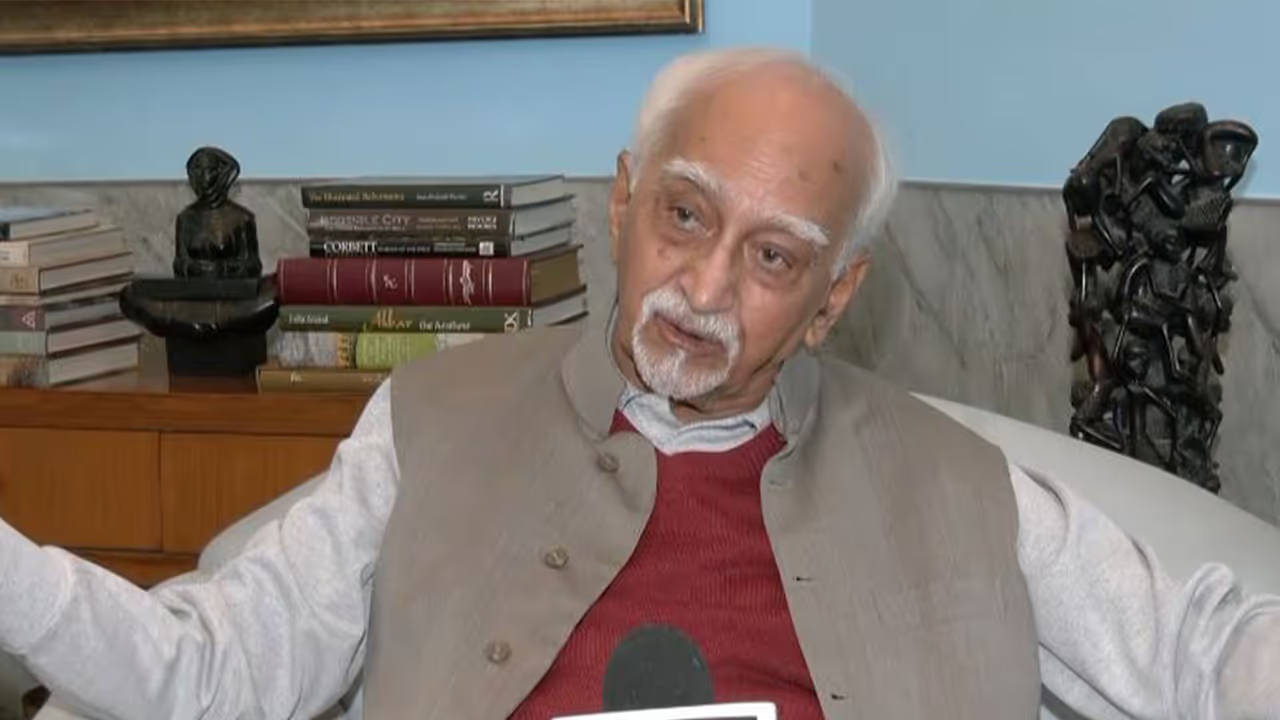
Former VP Hamid Ansari links the Kotdwar shop attack to rising casteism and language divides. He warns that an eroding sense of national brotherhood is weakening India's social fabric, stressing that all citizens share the responsibility to nurture it.
Former Vice President of India, Hamid Ansari, on Friday linked the recent attack at a clothing shop in Kotdwar in Uttarakhand, to rising casteism and language divides, describing them as symptoms of a deeper erosion of national brotherhood across India's diverse regions.
Erosion of National Brotherhood
Speaking exclusively to ANI, Ansari emphasised that while India's regions differ in language, lifestyle, food habits and customs, from Ladakh in the north to Kanyakumari in the south, a shared sense of citizenship binds the nation together. He warned that neglecting this unifying thread weakens the social fabric.
The Former VP articulated the gravity of the trend. "Casteism is one thing, language is another, and this incident in Uttarakhand - these things aren't separate. It's all a result of the fact that brotherhood is decreasing," he said. "Start from Ladakh and go all the way to Kanyakumari. What is the commonality? Neither their language is the same, nor their way of life, nor their food and drink. But one thing unites them: they are all fellow citizens of this country, and that is what holds us together. So, if you don't nurture that plant, the plant begins to wither..." he added.
A Shared Responsibility
Ansari underlined that responsibility for nurturing fraternity rests with society as a whole, noting that both leaders and citizens have a role to play. "We are all responsible for this, each one of us. I can't hold anyone solely responsible... Everyone has a role in creating the atmosphere that exists in society. A big leader has a big role, a small leader has a small role... The feeling of fraternity is gone, brotherhood is gone," he said.
The Kotdwar Incident
The comments refer to the January 26 incident at Baba School Dress and Matching Centre in Kotdwar, Uttarakhand, in which a group demanded that the shopkeeper rename his outlet. When he refused, the local gym trainer, Deepak Kumar, reportedly confronted the mob, triggering protests by January 31.
On Constitutional Authorities
On the functioning of constitutional authorities, including the Election Commission of India (ECI) and the Supreme Court, Ansari stressed that officials are aware of their responsibilities. "People sitting in the posts of CJI, CEC, know very well what they have to do. They do not need instructions... There is a time for everything. If you have to revise the voters' list, you should do so, but not two days before the election," he said. (ANI)
(Except for the headline, this story has not been edited by Asianet Newsable English staff and is published from a syndicated feed.)