
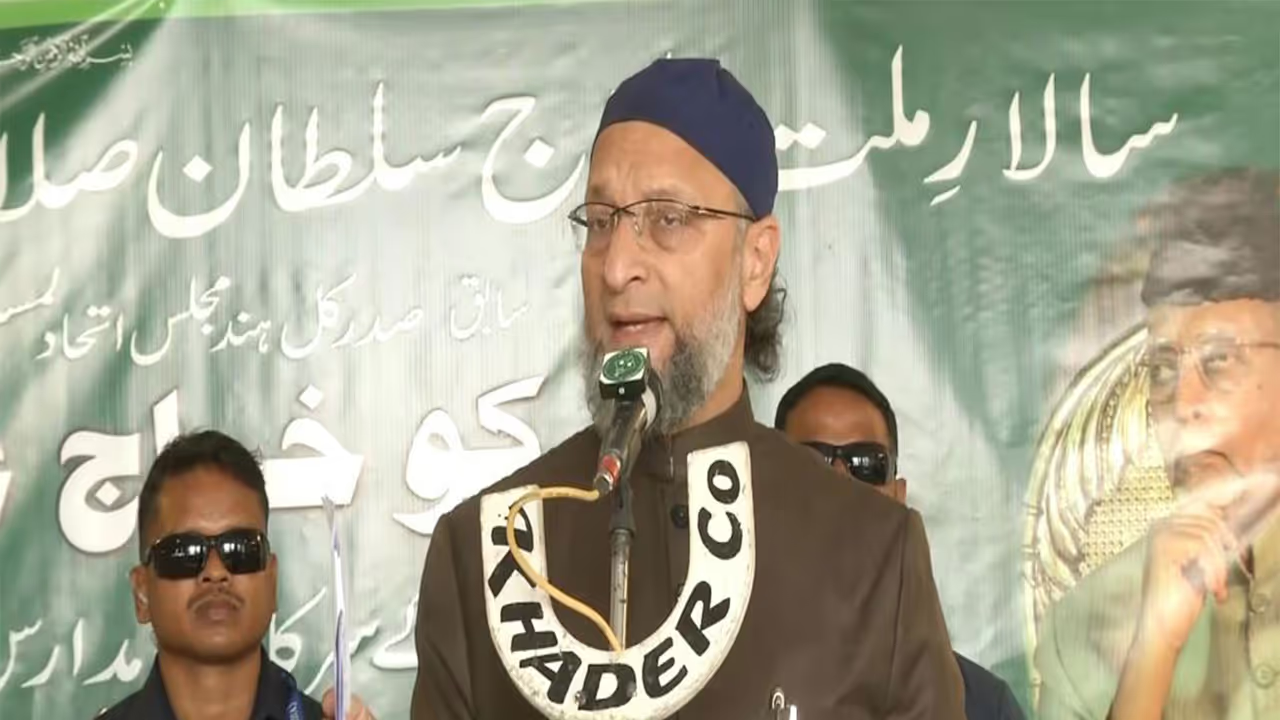
AIMIM chief Asaduddin Owaisi called the Babri Masjid demolition a 'Black Day' that weakened the Indian Constitution. Meanwhile, suspended TMC MLA Humayun Kabir laid the foundation stone for a Babri Masjid replica in Murshidabad.
Owaisi terms Babri demolition a 'Black Day'
All India Majlis-e-Ittehadul Muslimeen (AIMIM) chief Asaduddin Owaisi on Saturday said that the Babri Masjid demolition on December 6, 1992, weakened the Indian Constitution and marked a "Black Day" for the country. Owaisi criticised attempts to downplay the impact of the incident, saying it violated the rule of law and left lasting wounds on the nation.
Addressing an event in Hyderabad, Asaduddin Owaisi said, "...It is 6th December today. You and I know what happened on 6th December 1992...Babri Masjid was demolished in the presence of Police... The Supreme Court said that the Babri Masjid demolition was a violation of the rule of law...vaziir-e-aa'zam (Prime Minister) recently said that the 500-year-old wounds are being tended to. The Supreme Court said that no temple was demolished to build a mosque there. So, on what basis does the PM say this? The wounds are actually that on 6th December 1992, a mosque was not demolished but the Indian Constitution was weakened...6th December is a Black Day..."
The Babri Masjid was demolished on December 6, 1992, in Ayodhya by a large group of 'kar sevaks'. In the aftermath, many Muslim residences in Ayodhya were ransacked, torched, and destroyed. Riots broke out across multiple parts of the country, leading to the deaths of over 1,000 people
Suspended TMC MLA lays foundation for Babri Masjid in Murshidabad
Meanwhile, today, Suspended Trinamool Congress (TMC) MLA Humayun Kabir laid the foundation stone for the construction of Babri Masjid in Murshidabad. He drew attention to the constitutional right to build places of worship and said that he is not doing anything unconstitutional, "as anyone can make a temple or church, so can I".
Addressing the gathering, Kabir said, "I am not doing anything unconstitutional. Anyone can build a temple, anyone can build a church; I will build a mosque. It is being said that we cannot build the Babri Masjid. It is not written anywhere. The Supreme Court gave a judgment which stated that the Hindu people had demolished the Babri Masjid. Considering the sentiments of Hindus, the decision was taken to build a temple here. Now we see someone laying the foundation stone for a Ram Temple in Sagardighi. But the Constitution allows us to build a mosque."
Kabir asserted that legal challenges would not deter the mosque's construction. "Five cases have been filed against me, but no one can stop someone with whom Allah is. The court has also clearly stated that it is written in the Constitution of India that one can build a mosque; it is a right," he said.
He referred to the demolished Babri Masjid in Ayodhya, calling it a historically controversial site. "There are four crore Muslims in Bengal. Don't they have the right to build the Babri Masjid? Threats have been made against me, including by the former Chief Minister of Madhya Pradesh. If anyone has the courage, let them come here to Murshidabad and show it," he said.
(Except for the headline, this story has not been edited by Asianet Newsable English staff and is published from a syndicated feed.)