India wants to revise the 1996 Ganga water-sharing treaty with Bangladesh before it ends in 2026. Citing rising domestic needs, New Delhi seeks a shorter-term deal and more water during the dry season.
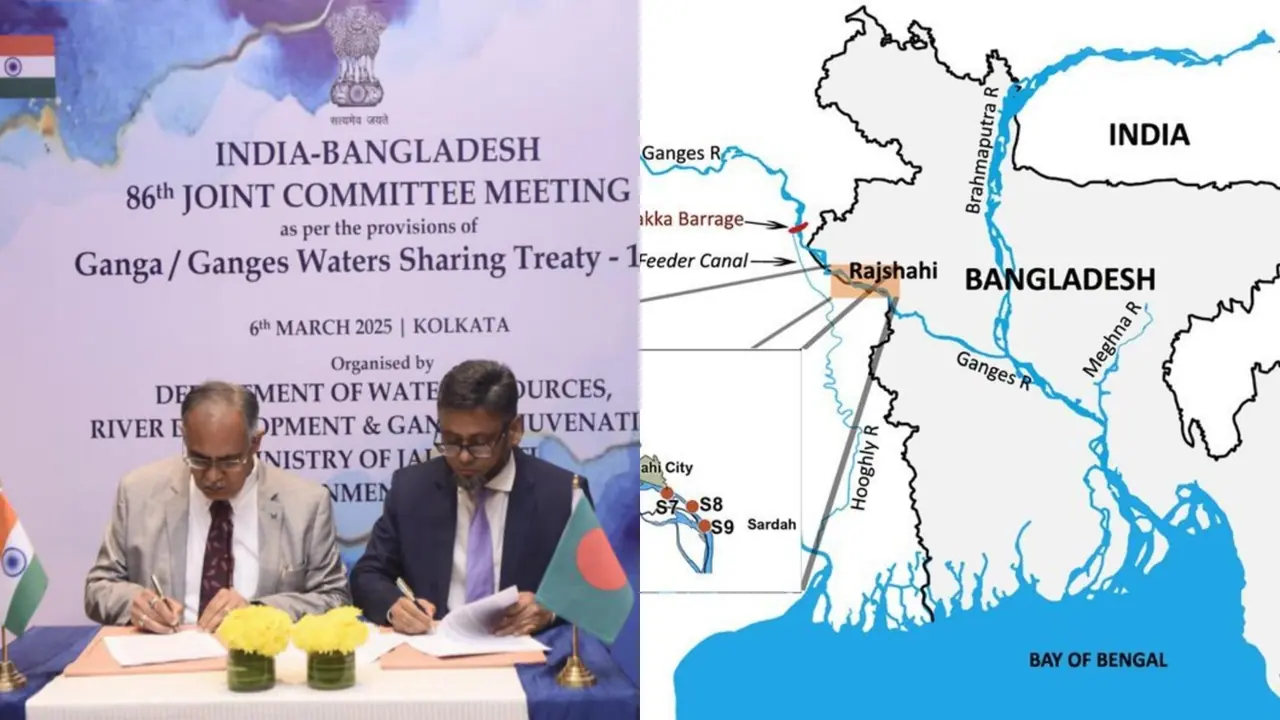
India and Bangladesh signed the Ganga Water Sharing Treaty in 1996 to settle long-running disputes over how much water each country would get from the Ganges River during the dry season. The treaty mainly covers the Farakka Barrage in West Bengal, close to the Bangladesh border. The barrage was built to divert water into the Hooghly River to help keep the Kolkata port running.
What is the Ganga water-sharing treaty?
Under the treaty, both countries share water between January 1 and May 31 every year, the driest part of the year. The agreement outlines how much water flows to each side during 10-day blocks, with 35,000 cusecs usually allocated to one country and then to the other, depending on the availability of water.
Why is India reconsidering the treaty now?
The treaty is set to expire in 2026, 30 years after it came into force. For the treaty to continue, both countries must agree to renew it. But India now wants to revise the agreement.
Related Articles

A senior official from the Ministry of External Affairs said that India had earlier been open to renewing the Ganga water-sharing treaty with Bangladesh for another 30 years, reports The News Indian Express.
“Before the Pahalgam attack, we were inclined to extend the treaty for a full term,” the official said. “But after that, the situation changed significantly.”
He added that the recent meeting with Bangladesh, held in May, was a regular interaction that happens twice a year. However, this time, India used the platform to raise its growing concerns.
"It was a routine meeting," the officer said, "but it allowed us to clearly express that India's development needs are rising. That will have to be reflected in the terms of any future treaty," says the The News Indian Express report.
Officials say that India’s development needs have grown, and the current water allocation no longer meets the demands of irrigation, harbour operations, and power production, especially in West Bengal. New Delhi also wants to reduce the treaty’s duration from 30 years to around 10 to 15 years.
The call to revise the treaty comes shortly after India suspended the Indus Waters Treaty with Pakistan in April this year, following the terror attack in Pahalgam. This has raised concerns in Bangladesh, which fears that India may take a tougher stand on shared water resources.
How did the treaty come about?
After Bangladesh became independent in 1971, India and Bangladesh made several temporary arrangements to share Ganga waters. A short-term agreement in 1977 ensured a minimum flow for Bangladesh, but when it expired in 1982, no long-term deal was made. Instead, both countries used ad-hoc methods for many years.
Tensions increased after India opened the Farakka Barrage in 1975, diverting water for its own use. Bangladesh, as the downstream country, saw its dry-season flow reduce sharply. This hurt agriculture, fisheries, and livelihoods in the region.
After years of talks, the 1996 treaty was finally signed when Sheikh Hasina took office for the first time as Prime Minister of Bangladesh. It gave a detailed framework for sharing water and ensured more stable cooperation between the two countries.
What is India asking for now?
Reports say India is asking for an additional 30,000 to 35,000 cusecs of water during the most critical dry-season period, especially between March 11 and May 11. Indian officials argue that with a growing population and increasing pressure on water, the old arrangement does not work anymore.
The West Bengal government is also backing the Centre's position. State officials believe that current water supplies from the Ganga are not enough to support irrigation and urban needs.
India also wants to shorten the renewal cycle of the treaty, possibly to a 10-15 year term instead of 30 years, so that future needs can be assessed and renegotiated more frequently.
What does this mean for Bangladesh?
Bangladesh depends heavily on Ganga water during the dry season. Any cut or change in flow could hurt farming, drinking water supply, and overall environmental health in the country’s northwestern areas.
Dhaka is concerned that if India, the upstream country, tightens control over water or asks for more, Bangladesh’s share could drop, especially during low-rainfall years.
While India has not formally withdrawn from the treaty, its call for renegotiation has made Bangladesh anxious, especially in the backdrop of the Indus Treaty suspension with Pakistan. Diplomats say talks between the two countries will be key in the coming months.
The current treaty ends in 2026, so both countries have about a year and a half to decide the future course. For the treaty to be renewed, mutual consent is needed.
India is expected to press for a revised deal that reflects its growing needs. Bangladesh will likely try to maintain or improve its share. Discussions through the Joint Rivers Commission, a group formed in 1972, will play a key role in shaping the next agreement.