
You look up as you drive around Hussainsagar lake in Hyderabad, gaping with amazement at the largest national flag in India installed at the Sanjeevaiah Park, abutting the water body. It helps take your mind off the stench emanating from the filth in the lake.
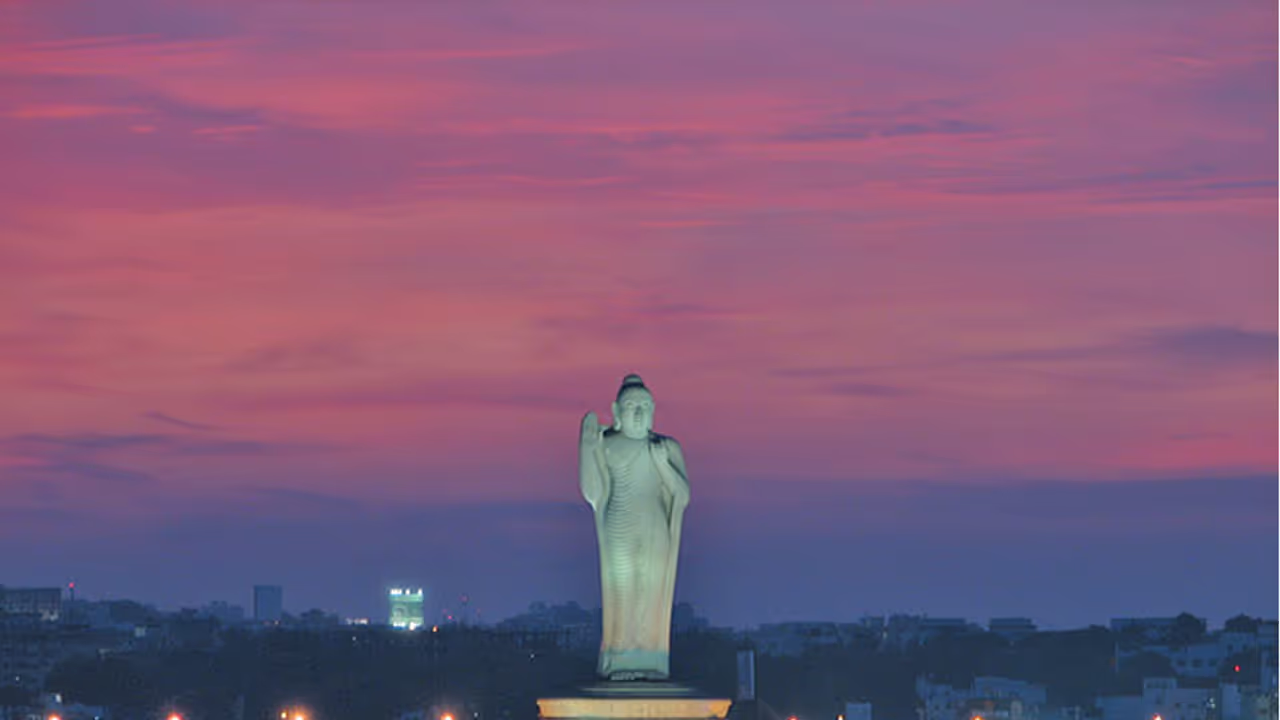
Hussainsagar lake does not visually shock the country like its frothing counterparts like Bellandur and Yemlur do, 550 km away in Bengaluru. In fact, it is pretty much like the Buddha, whose statue stands in the midst of the lake. The Buddha is calm, at peace, watching the slow death of Hyderabad's landmark. Killed by a mix of encroachments and pollutants released into the lake, with governments of the day and civil society willing conspirators.
From being a drinking water source since its construction in 1561 (thirty years before the Charminar) till 1930, Hussainsagar lake has fallen on bad days. Once famous for its aquatic life and the delicious murrel fish in particular, a biodiversity index report released in October 2012 admitted a huge decline in the number of fish species - from 78 to 12 in Hyderabad's lakes.
The original size of the Hussain Sagar Lake which in a way, acts as the boundary between twin cities Hyderabad and Secunderabad, was 1,600 hectares. In 1995, National Remote Sensing Agency imagery declared its size was 416 hectares, which meant three-fourths of its area had been eaten away. Five years later, the Hyderabad Urban Development Authority (HUDA) issued a notification, where it put the area of the lake at 549 hectares. Despite a directive by the Andhra Pradesh High Court in 2001 that no permanent structure shall be built near the water spread or the catchment area of the lake, violations in the name of promoting tourism have been more the norm than the exception.
To make matters worse, roughly 50 million litres per day (MLD) of sewage and pollutants are dumped into the lake through four nullahs. The sludge has excess of cadmium, from the industrial effluents from the steel galvanising and electroplating units located on the city's outskirts. Environmentalists dub the sewage treatment plant located inside the lake an eyewash.
More by the author: As Telangana turns two, there is a method to KCR's politics
Taking bath in houses in the lake's neighbourhood is fraught with risk as the groundwater within a radius of 5 km from the Hussainsagar is highly contaminated. Borewell water tested in labs has been found to have E.coli presence 20 times more than the permissible limit.
Efforts have been made by successive governments to cleanse the Hussainsagar, but with little success. In 2004, HUDA announced a Rs 300 crore Japan Bank International Cooperation aided project to prevent pollution of the Hussainsagar. It even announced that by 2010, pollution in the lake will be a thing of the past. Six years later, Hyderabad is still waiting.
When K Chandrasekhar Rao came to power in 2014, his government mooted the idea of drycleaning the lake. It was not without precedent. In January 1922, the entire water of Hussainsagar had been taken out for desilting and then filled with fresh rainwater. But now, with the amount of sludge deposit on the lake bed, it would be a task that would take many months and the bigger problem would be where to deposit that muck. The idea has since been dropped.
The authorities have now procured an amphibious excavator machine at a cost of Rs 2.48 crore, to clean the lake near the shoreline. The jury is still out on how much of the lake it will be able to restore to its former glory.
On World Environment Day, it is some solace that the Hussainsagar still exists. Spare a thought for those water bodies that are no more. Old Hyderabadis will tell you about Masab Tank that was converted into Chacha Nehru Park, with only the area bearing the name to remind us of the water body
But as the world and Hyderabad celebrate World Environment Day, it is some solace that the Hussainsagar still exists. Spare a thought for those water bodies that are no more. Old timers of Hyderabad will tell you about Masab Tank that was converted into Chacha Nehru Park, with only the area bearing the name to remind present-day Hyderabadis of the water body. Likewise Anamula Kunta which after being converted into a dumpyard was 'revived' as Vengal Rao Park in Banjara Hills. Jubilee Bus Stand in Secunderabad came over Picket Lake. And modern-day Cyberabad was developed, killing several lakes in the area.
In 2012, in a grandiose plan, a London Eye-like project was mooted in Hyderabad, overlooking the Hussainsagar lake. However, the plan came unstuck because of the court ruling against constructions around the lake. But if the administration has its eye on ensuring Hussainsagar lake does not become Hussainsagar nallah, it would have done a favour to future generations.
