
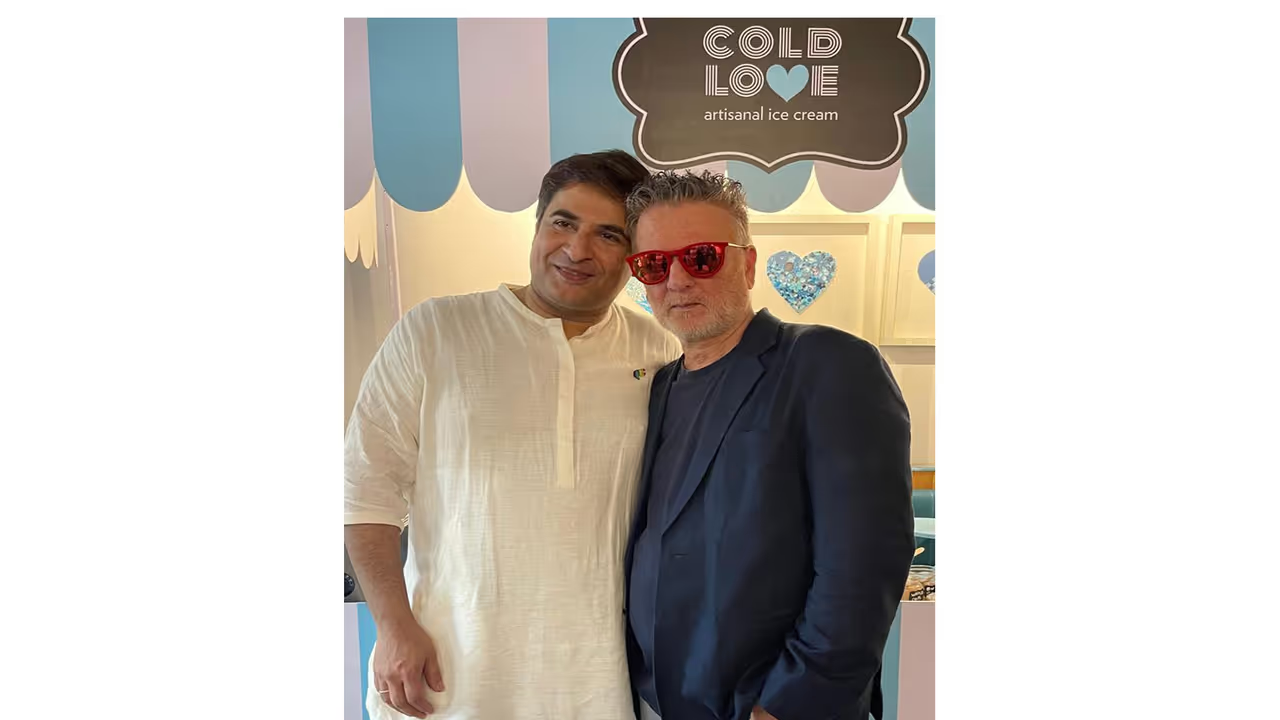
Chef Suvir Saran pens a moving tribute to designer Rohit Bal on his birthday, more than a year after his passing. He recalls Bal's profound impact on his life, their intimate friendship, his final moments, and the enduring legacy of his brand.
Time has passed, but grief does not move in straight lines. It circles, it returns, it settles into the body in unexpected ways. It has now been more than a year since Rohit Bal -- my Gudda -- left this world, around Diwali the year before last. And yet, there are days, like today, his birthday, when the distance collapses entirely. He is here. Immediate. Intimate. Impossible to forget.
Gudda was not just a designer of extraordinary talent -- he was a man who altered lives. I know this not as an observer, but as someone who was changed by him at a formative age. I was fourteen. Lost. Confused. Frightened by my own thoughts, by desires I did not understand, by a world that did not yet have language for who I was becoming. And then there was Gudda. He did not lecture, he did not label, he did not judge. He simply saw. And in that seeing, he gave me something no one else had -- acceptance, affirmation, a sense that I was not wrong, that I was not alone. He emancipated me without ever declaring it. He gave me dignity before I knew how to ask for it.
Years later, when life brought me back into his orbit more frequently, I witnessed a different Gudda -- one who had begun to withdraw from many, who was navigating his own health struggles, quieter, but no less perceptive. And yet, with me, the door always remained open. The affection, if anything, grew more tender.
The Final Moments
In those final days, I visited him in the hospital. It was not unusual for me to massage his shoulders or his feet -- something I had done countless times. But that day was different. He insisted I massage his head. There was a softness to him, a stillness, and he said something I have carried with me since: "You will remember this for a lifetime. You are doing something different today."
At the time, I did not understand. Then he got up from the bed. And suddenly, there was a shock. Then another. Then another. I could feel something passing through him -- something violent, something invisible, something final. What we now understand were likely heart attacks, waves of cardiac failure moving through his body while I held him, trying to steady him, trying to make sense of what was happening.
The doctors came. They intervened. They administered medication to calm him, to ease him into sleep. There was a sense -- or perhaps a hope -- that he would rest, recover, return. I left. And within fifteen minutes of reaching home, I received the call. He was gone.
I was the last person he saw -- from family and from friends. For a long time, I did not know how to hold that truth. It felt heavy, almost unbearable. But then Rajiv Bal, his extraordinary elder brother, said something that changed how I understood those final moments. He told me: "Do not see this as anything but a gift. He left in the arms of a friend who loved him." And I chose to believe him. Because if there was one thing Gudda valued above all else, it was love -- expressed, embodied, immediate.
A Family's Bond and a Brand's Continuation
Rohit Bal's life cannot be spoken of without speaking of his family. Rakesh Bal, Rajiv Bal, and Anila, along with the sisters who are no longer with us -- they were not peripheral figures in his life. They were his core, his constant, his refuge. The bond they shared was not performative; it was lived, daily, deeply. There was a sense of communion within that family that was rare, and it gave Gudda both grounding and flight.
Today, that same family continues to hold the brand together with remarkable strength and clarity. Under the leadership of Rajiv Bal, and with Fraze Tasnim, head of Rohit Bal Design, alongside dedicated team members like Akriti and many others shaped by Gudda's vision, the house of Rohit Bal is not standing still in memory -- it is moving forward with purpose.
Remembrance in Motion: The Brand's Evolution
There is something extraordinary in witnessing this evolution. It does not feel like succession. It feels like continuation. The opening of the flagship store at The Dhan Mill in Delhi stands as a physical embodiment of this. Located near the city's farmhouse belt, the space carries with it both scale and serenity -- an environment that feels distinctly aligned with Gudda's sensibility. It is immersive, evocative, and unapologetically aesthetic.
Equally powerful has been the renewed focus on Balance by Rohit Bal, the pret line that has found remarkable resonance in today's world. In a time when fashion is seeking both accessibility and authenticity, this line bridges the two with elegance. It brings Gudda's language -- his embroideries, his silhouettes, his sensibilities -- into everyday life without diluting their essence.
This is not reinvention. This is remembrance in motion. The brand continues to honour its commitment to organic, natural fabrics, to intricate handwork, to craftsmanship that is rooted in India yet relevant globally. There is an understanding within the team that Gudda's vision was never static -- it was expansive, evolving, always reaching forward.
That forward movement was evident in the house's last show at Lakme Fashion Week -- a presentation that stood apart not because it sought attention, but because it commanded it. There was a quiet confidence in the work, a clarity of identity that did not need to prove itself. Models walked with memory in their stride. Many of them had known Gudda personally, and their presence carried a sense of homage.
There is a phrase often heard in those circles: "For Guddaji, we would do anything." It is not an exaggeration. It is a reflection of the loyalty and love he inspired. That love extends beyond the runway. It lives in the ateliers, in the stores, in the people who continue to show up every day not out of obligation, but out of devotion. Because Gudda did not just create garments. He created belonging.
More Than Fashion: The Friend, The Critic, The Man
But to speak of Gudda only through fashion would be to miss the man entirely. He was also that friend -- the rare one -- who read every column I wrote, sometimes twice over, and always with attention. He would tell me what he thought -- honestly, sharply, lovingly. He would tease me about the writers I was channeling. He saw shades of Oscar Wilde in my voice -- something others, like Geetanjali Shree, would later echo, and my sister Seema had long believed. Gudda would laugh and switch into Hindi, asking me, "Kahaan se aayi yeh English? Where have you come from? How do you know this English?" It was teasing, but it was also his way of acknowledging something he saw -- and that mattered.
And then there was music. After my father passed, there was no one left who insisted I sing. That gentle, constant nudging disappeared -- until Gudda stepped in. Whenever I was around him, especially if there was company, he would turn to me and say, "Gao." Sing. Just like my father had. And I would. Because with Gudda, refusal was never really an option -- and love was always the undertone.
I miss that deeply. I miss, too, his eye -- that instinctive, exacting gaze. I often wore kurtas from Good Earth -- some he found flattering, others he dismissed without hesitation. And Gudda was never one for polite approval. The ones he liked, he would claim instantly. "Give this to me," he would say, "I'll get others made for you -- different fabrics, different colours." It didn't matter that they weren't his designs. What mattered was the line, the fall, the way they sat on the body. He responded to what worked -- and when it did, he wanted to reinterpret it, refine it, make it his own for you.
Some of those pieces went to him, full of promise -- of returning transformed, reimagined. Some never came back. They exist somewhere now, perhaps unfinished, perhaps waiting, perhaps simply part of that quiet archive of intentions he left behind. And that, too, was Gudda. Not just generous in what he gave, but generous in what he imagined giving. Always creating. Always seeing ahead. Always shaping you, even when you didn't realise it.
An Unforgettable Legacy
Globally, as Indian fashion continues to assert itself with greater confidence, Rohit Bal's influence remains foundational. He was among those who insisted that Indian craftsmanship did not need validation from elsewhere -- it needed only to be presented with integrity. His work stood shoulder to shoulder with the finest in the world because it was unapologetically itself.
Today, as the brand looks outward -- to international exhibitions and to markets such as Dubai, Paris, and London -- it does so with that same conviction.
And yet, for those of us who knew him, the legacy is not only in the garments or the global reach. It is in the way he lived. In the way he could command a room and then retreat into nostalgia, watching old Hindi films, humming along, surrounded by friends. In the way he could be fierce and fiery, and then call moments later to apologise with disarming sincerity. In the way he showed up -- fully, intensely, without dilution.
He was not easy. He was not meant to be. He was unforgettable. And he remains so. Because true creators do not leave. They linger -- in fabric, in feeling, in form.
Rohit Bal lives on in the clothes we wear, in the aesthetics we absorb, in the standards he set for what Indian fashion could be. He lives on in the team that carries his torch, in the family that guards his legacy, and in the countless lives he touched in ways that had nothing to do with fashion and everything to do with humanity.
More than a year has passed. And yet, he is not gone. He is present -- in memory, in movement, in magnificence. And always, in gold. (ANI/Suvir Saran)
(Disclaimer: Suvir Saran is a Masterchef, Author, Hospitality Consultant And Educator. The views expressed in this article are his own.)
(Except for the headline, this story has not been edited by Asianet Newsable English staff and is published from a syndicated feed.)