
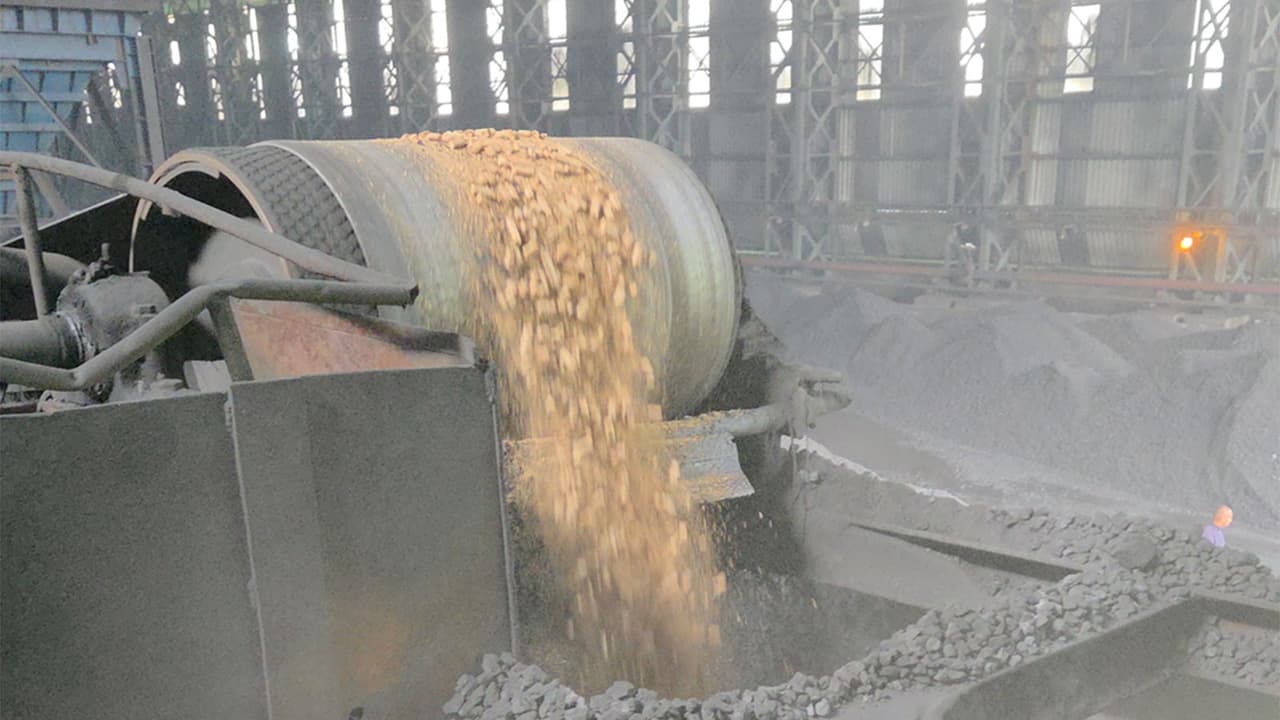
An Australia-India partnership achieved a 'world-first' in green steel by using agricultural waste. A commercial-scale trial in India saw researchers replace coal with rice husk pellets, demonstrating a viable way to cut emissions in steelmaking.
An Australia-India partnership took a step closer to green steel through a "world-first" use of agricultural waste in steelmaking during a successful commercial-scale trial in India. Researchers from Australia's national science agency, CSIRO, and the Indian Institute of Science (IISc) demonstrated a viable approach to cut emissions by partially replacing coal with locally sourced rice husk pellets. The breakthrough offers a scalable pathway to decarbonise one of the world's fastest-growing industrial economies in a sector currently responsible for approximately one-tenth of global carbon emissions.
Successful Biomass Trial
"Using locally sourced rice husk pellets, the CSIRO team validated sustained production of biomass-derived syngas (synthesis gas) for iron ore reduction at a large-scale commercial steelworks in India, in partnership with commercial steel innovator RESCONS Solutions Pvt., a commercial steel entity incubated at the Foundation for Science, Innovation and Development (FSID), IISc," CSIRO said in a release.
Professor Govind S. Gupta, Managing Director, RESCONS Solutions, said, "At RESCONS Solutions, we believe in environmentally sustainable solutions that benefit present and future generations. Collaborating with CSIRO and IISc, we are proud to help pioneer the use of biomass in steelmaking, supporting India's transition to greener industrial practices."
Trial at Jindal Steel
The trial involved blending 5 per cent and 10 per cent rice husk pellets into commercial gasifiers at Jindal Steel in Odisha, achieving production with no loss of performance. "Leveraging India's abundant agricultural waste, the CSIRO-led team, with funding from the Australian Government's India-Australia Green Steel Research Partnership, conducted a full-scale trial at Jindal Steel in Odisha. The team successfully blended 5 per cent and 10 per cent rice husk pellets into Jindal Steel gasifiers, achieving sustained syngas production with no loss of performance," the release said.
Damodar Mittal, Executive Director, Jindal Steel, said, "This collaboration marks a pivotal moment in our journey towards decarbonisation using green hydrogen and green energy, accelerating our transition to lower-emission steel. By integrating green energy and biomass into our production processes, we are not only reducing our carbon footprint but also setting a new benchmark for the Indian steel industry."
Decarbonisation Challenge and Potential
CSIRO highlighted that India's steel sector currently emits an average of 2.55 tonnes of CO2 per tonne of steel, significantly higher than the global average of 1.8 tonnes. The industry is projected to double its capacity to 300 million tonnes by 2030, posing a challenge for global emissions targets.
According to the research team, if this biomass process is "adopted across India, the process could reduce steel sector emissions by up to 50 per cent totalling approximately 357 million tonnes of CO₂ per year."
Warren Flentje, Senior Experimental Scientist, CSIRO, said, "This trial is a world-first demonstration of how agricultural waste can be harnessed to decarbonise steelmaking at scale. By blending rice husk pellets into commercial gasifiers, we've shown that biomass can replace coal without compromising performance. This is a major step forward for sustainable steel production in India and globally."
Supporting India's Net Zero Goal
The initiative supports the Indian Ministry of Steel's roadmap to achieve net zero emissions by 2070. Surplus crop residue biomass in India currently totals 228.52 million tonnes.
"India's steel sector is both a major employer and a significant source of emissions. Our partnership with the Indian Institute of Science and JSPL has demonstrated that biomass can be a viable alternative to coal, especially in regional areas where surplus agri-waste and coal DRI facilities co-exist. The next phase will focus on increasing biomass replacement rates and assessing impacts on the direct reduction process," said Keith Vining, Research Group Leader - Green Metals Production, CSIRO.
Facilitating Technology Adoption
To facilitate the adoption of the technology, the team published an interactive online map of India's steelmaking infrastructure overlaid with regional biomass availability. (ANI)
(Except for the headline, this story has not been edited by Asianet Newsable English staff and is published from a syndicated feed.)