
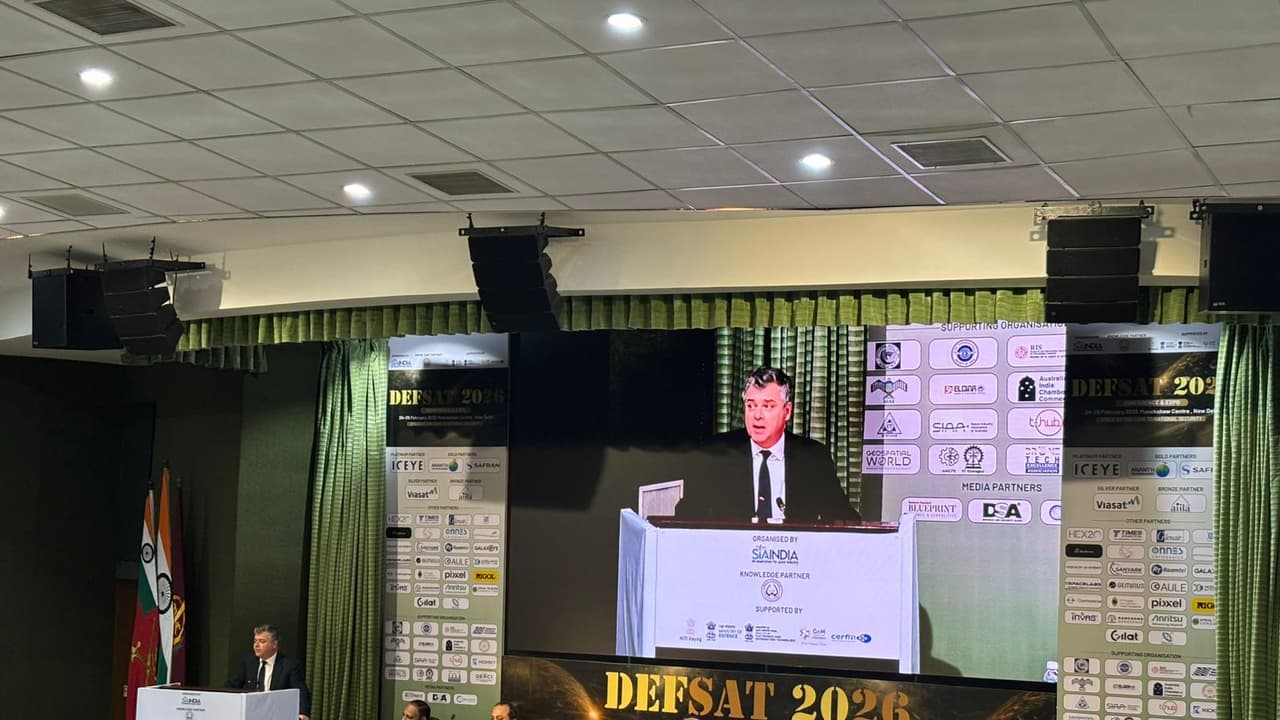
At DefSat 2026, Viasat highlighted the critical need for assured spectrum access and resilient SATCOM for national security. President Ben Palmer discussed innovation for drones and praised India's strategic approach to space sovereignty.
The global technology company Viasat on Tuesday highlighted the strategic importance of assured spectrum access and resilient satellite communications (SATCOM) at the DefSat 2026 conference held at New Delhi's Manekshaw Centre. Addressing the opening plenary session, Ben Palmer, President of Viasat Commercial, underscored the role of these technologies in safeguarding national security and sustaining economic stability. Palmer noted the necessity of assured connectivity across alternate orbits and radio frequency bands. He stated, "We're looking at ways to ensure governments have access to assured connectivity via alternate orbits and alternate radio frequency spectrum. We are innovating to deliver cyber and EW resilience, access to different spectrum and new ways to deliver these key enabling capabilities."
SATCOM: The 'Dual Use Oxygen' for Modern Societies
The three-day dialogue, which convenes military leadership, policymakers, and industry partners, focused on the future of space-enabled security. Palmer emphasised that societies cannot function without reliable access to space, describing satellite communications as the "dual use oxygen" that supports missions ranging from weather forecasting to early warning systems. "Without assured, resilient, global SATCOM, we would all be in the dark," he said.
Adapting to Modern Conflict with Uncrewed Systems
The discussion also addressed the increasing use of uncrewed systems in modern conflict. Palmer pointed to recent developments in Ukraine as evidence of how such platforms achieve military effects without risking personnel. He explained that Viasat is focused on developing compact terminals, some no larger than a coffee cup, to provide beyond line-of-sight communications for tactical uncrewed platforms. Palmer added, "Our work on satellite Direct to Device (D2D) will increase the capability available to the smallest uncrewed platforms."
Viasat on India's Strategic Approach to Space Sovereignty
Regarding India's strategic position, Palmer acknowledged the government's approach to space sovereignty as "long term, strategic and wise." He remarked that India's resistance to market dominance by others in international fora helps maintain freedom of choice. "The grand strategic approach which the Government of India is adopting to assure its space sovereignty is impressive. This isn't just about 'Make in India' and assuring freedom of operation, it's also about the responsible, pragmatic approach that India has adopted," he said.
Building Domestic Capabilities in India
Viasat, which recently integrated Inmarsat, continues to partner with local institutions like BSNL to build domestic capabilities. Palmer highlighted that the company employs hundreds of people in India to develop software-enabled capabilities that secure maritime and aerial transit. He noted that their provision of handheld satellite phone services and Ka-band services via local infrastructure provides the "sovereign communications capability required to underpin operational-to-tactical mission superiority."
(Except for the headline, this story has not been edited by Asianet Newsable English staff and is published from a syndicated feed.)