
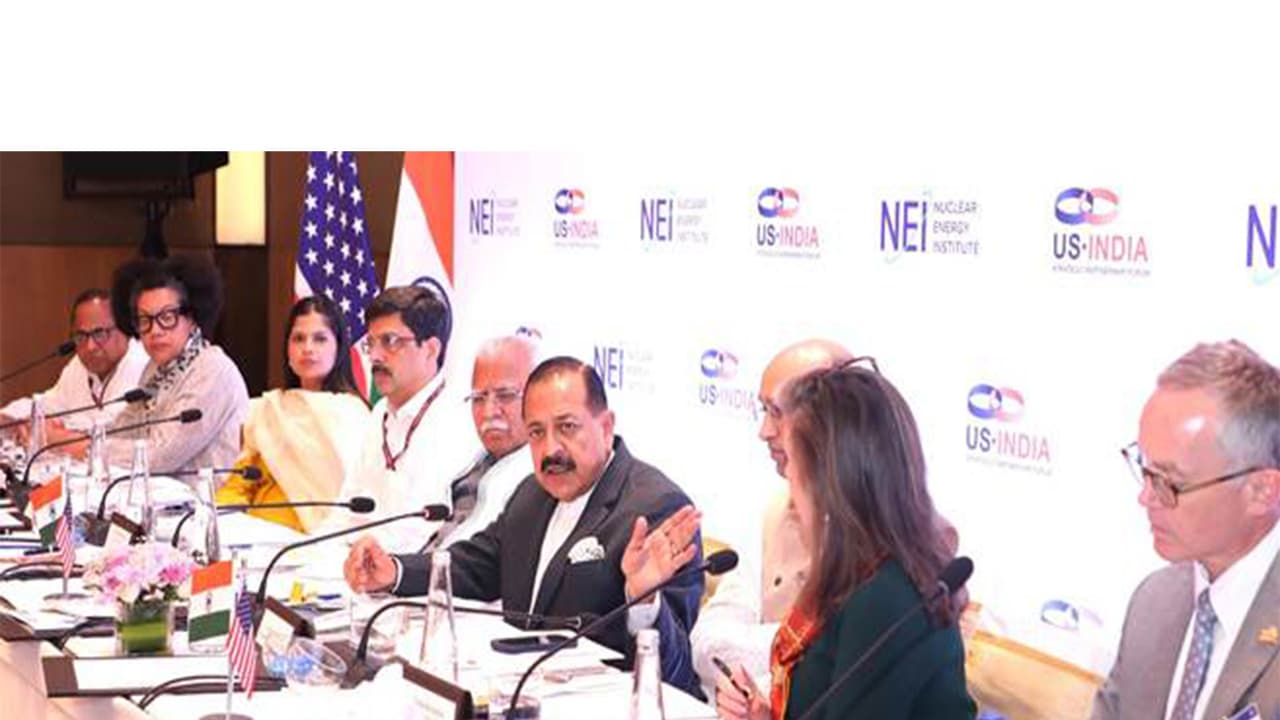
A US industry delegation met Union Minister Dr Jitendra Singh to discuss private investment in India's nuclear sector. The talks covered policy reforms, India's 100 GW target by 2047, and expanding US-India cooperation in clean energy.
A high-level US industry delegation comprising representatives from the Nuclear Energy Institute (NEI) and the US-India Strategic Partnership Forum (USISPF) today held discussions with Union Minister of State for Science and Technology Dr Jitendra Singh, on emerging opportunities for private investment and industry collaboration in India's nuclear sector. The delegations' visit, facilitated by the U.S.-India Strategic Partnership Forum, brought together senior representatives from the US nuclear industry, business stakeholders and officials associated with India-U.S. cooperation in civil nuclear energy and advanced technologies.
Strengthening Strategic Ties
Jitendra Singh said that India and the United States today share a strong and future-oriented partnership in science, technology, clean energy and emerging sectors, with civil nuclear cooperation steadily gaining strategic and economic significance. He said the launch of the US-India TRUST Initiative during the meeting between Prime Minister Narendra Modi and US President Donald Trump on February 13, 2025, has opened new avenues for collaboration in critical and emerging technologies. The Minister said the TRUST initiative, centred around trusted technology partnerships, resilient supply chains and innovation ecosystems, provides a strong framework for deeper engagement among governments, industry, academia and startups in areas such as artificial intelligence, semiconductors, biotechnology, quantum technologies, advanced materials, critical minerals, energy and space technologies.
India's Ambitious Nuclear Energy Goals
Referring to India's long-term clean energy goals under the vision of Viksit Bharat 2047, Dr Jitendra Singh said India aims to increase its nuclear power capacity from the present 8.8 GW to 100 GW by 2047 through a phased and carefully planned expansion strategy. He said India's rapidly growing nuclear energy programme is creating major opportunities for global partnerships in manufacturing, technology cooperation, supply chain integration and advanced research, according to a release.
Policy Reforms and Future Developments
The Minister informed the delegation that India has recently enacted the SHANTI Act, 2025, a major policy reform aimed at facilitating greater participation of the private sector, including foreign participation, in the nuclear energy sector. He said the reform is expected to create a more enabling ecosystem for investment, industrial collaboration, manufacturing partnerships and technology cooperation aligned with India's Nuclear Energy Mission. He added that the implementation framework under the Act is being finalised to further strengthen collaborative opportunities in the sector. The Union Minister said India is also moving ahead with plans for development of Small Modular Reactors (SMRs), supported by an allocation of nearly Rs 20,000 crore, and added that there is significant scope for India-US collaboration in advanced areas such as micro-reactors, AI-enabled nuclear safety systems, scientific computing, nuclear energy modelling and institutional capacity building.
Review of Ongoing Collaborative Initiatives
The discussions also reviewed progress in several ongoing India-US collaborative initiatives including the proposed Westinghouse AP1000 project at Kovvada, cooperation under the Indo-U.S. Civil Nuclear Energy Working Group (CNEWG), hydrogen production and integrated energy systems, machine learning and AI applications, rare earth collaboration, and high-intensity superconducting proton accelerator technologies through Fermilab partnerships.
LIGO-India Project Progress
The meeting further covered progress in the LIGO-India project being jointly implemented by the Department of Atomic Energy and Department of Science & Technology in collaboration with the U.S.-based LIGO Laboratory and the National Science Foundation. Approved with a budgetary provision of Rs 2,600 crore, the project is regarded as one of the most significant examples of advanced scientific collaboration between India and the United States.
Shared Commitment to Deepen Cooperation
The interaction concluded with a shared commitment to deepen practical, industry-led and mutually beneficial cooperation between India and the United States in clean energy, nuclear technologies, advanced manufacturing and innovation-driven sectors. The interaction focused on India's ambitious Nuclear Energy Mission, recent policy reforms enabling greater private sector participation, and the expanding scope of India-U.S. cooperation in clean energy and critical technologies. Secretary, Department of Science & Technology, Dr Rajesh S. Gokhale, senior officials from the Department of Atomic Energy and Department of Science & Technology, along with representatives from U.S. industry organisations, participated in the discussions.
(Except for the headline, this story has not been edited by Asianet Newsable English staff and is published from a syndicated feed.)