
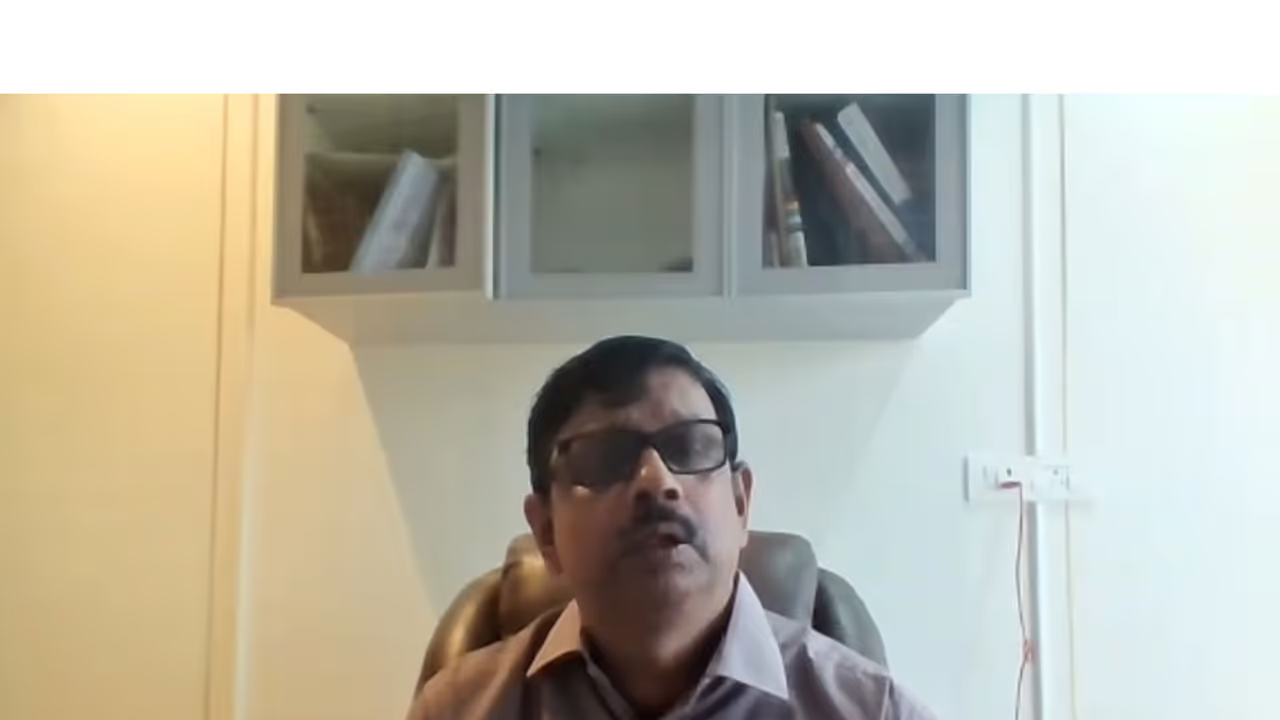
Ex-BPCL Director R Ramachandran decodes the US waiver on Russian crude sanctions, noting it boosts supply for Indian refiners. He advises a cautious approach, focusing on short-term economic gains while the opportunity lasts.
With global energy markets bracing for potential shockwaves, R Ramachandran, Director-Refineries (Retd.), BPCL, has stepped forward to decode Washington's unexpected policy shift. Speaking to ANI, Ramachandran weighed in on the US decision to waive sanctions under the Lindsey Graham Act for the Russian crude market.
Impact on Indian Refiners and Margins
Ramachandran noted that the policy shift would enhance formal Russian crude availability and offer Indian refiners a broader range of economical choices. However, he emphasised that the industry's approach remains measured. "The Lindsey Graham Act has been kept on a waiver with a certification from the President, and we do not know the duration for which it will be continued," Ramachandran said. "Presumably, we will assume at least a short term, if not a very long term."
Addressing the impact on gross refining margins (GRMs), Ramachandran explained that while Russian crude has historically supported refinery margins, a broader influx of global supply could cool down record-high diesel cracks. He highlighted that the real benefit for Indian refineries lies in operational familiarity and optimised processing. "The availability of Russian crude is a boon for the Indian sector because they are continuously looking for other crudes to be processed, but the Russian crude per se has been processed for several years inside the country, and hence, availability of familiar crude would also optimise the refinery processing," he stated.
Procurement and Logistics Strategy
Discussing procurement strategies and the possibility of shifting to long-term contracts, Ramachandran maintained that it is premature to jump into prolonged agreements without clear regulatory visibility. He noted that the immediate focus will be on maximising short-term opportunities based on prevailing economics and discounts. "In short, I see that the immediate future would be trying to buy as much crude as possible, economics permitting and opportunity being there, then to look at jumping into long-term contracts," he remarked.
On logistics, shipping freight premiums, and payment architectures, Ramachandran observed that a sustained waiver could alleviate shadow-ship restrictions and ease foreign exchange pressures, particularly if rupee-ruble trade mechanisms continue.
Geopolitical Outlook and Policy Context
Concluding with a perspective on geopolitical uncertainties, he urged stakeholders to embrace a balanced outlook. "So I would say, to support the thought that today we will be cautious but optimistic and make hay while the sun shines," Ramachandran added.
The move comes after US President Donald Trump waived the sanctions provisions under the Lindsey O. Graham Sanctioning Russia and Iran Act of 2026, which could have imposed tariffs of up to 100 per cent on goods imported from the five largest buyers of Russian crude oil or natural gas, including India and China. Trump invoked Section 115 of the Act, citing US national interests, amid a diesel supply deal with Russia.
India had conveyed its concerns to Washington over the legislation, with the Ministry of External Affairs on Wednesday, reiterating New Delhi's position that stability in global energy markets must be maintained. (ANI)
(Except for the headline, this story has not been edited by Asianetnews Editorial staff and is published from a syndicated feed.)