
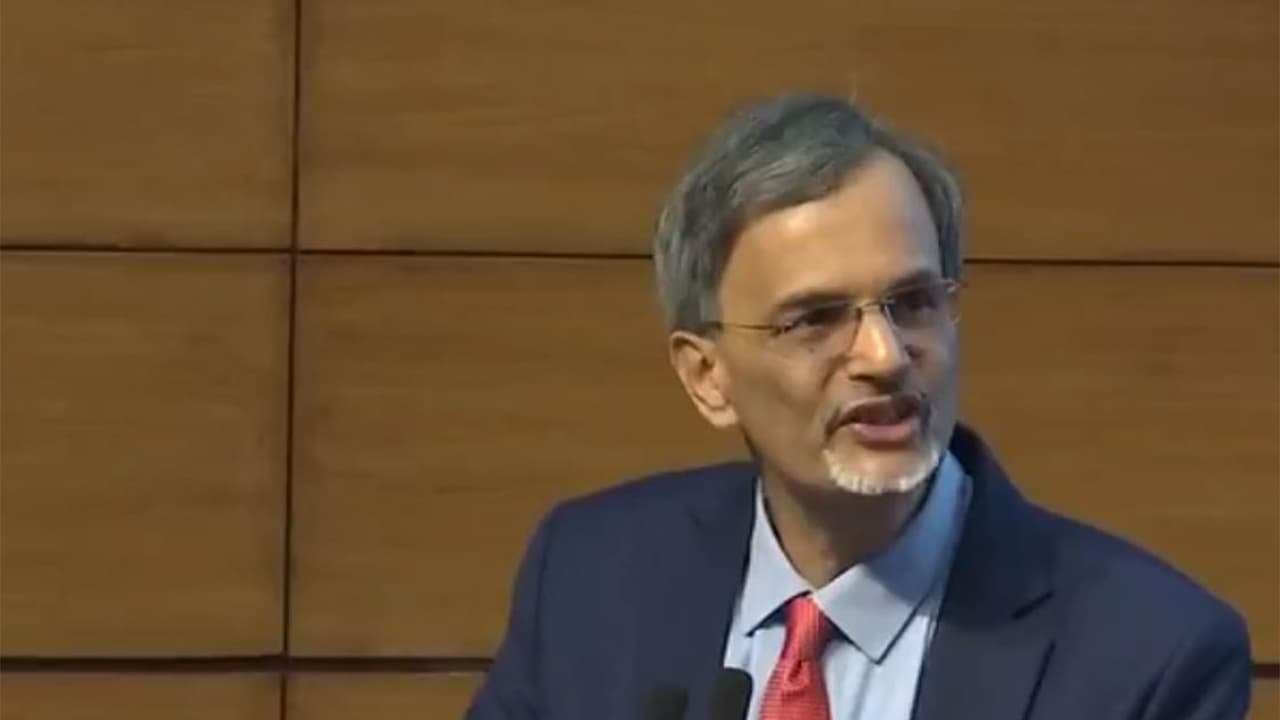
CEA V Anantha Nageswaran stated that strengthening manufacturing is essential for currency stability. Export-led growth boosts external balances and exchange-rate credibility. He noted the rupee's movement is in line with emerging markets.
Pathway to Currency Stability
Strengthening manufacturing capacity is essential for achieving long-term currency stability, as export-led industrial growth underpins stronger external balances and exchange-rate credibility, said the Chief Economic Adviser (CEA) V Anantha Nageswaran on Thursday.
CEA noted that currency strength ultimately depends on a country's industrial and manufacturing capacity. Across successful industrialisers, periods of strong manufacturing-led export growth have historically preceded improvements in current account balances, reserve accumulation, and exchange-rate credibility. Services exports, while important, play a secondary and complementary role and cannot fully substitute for a strong manufacturing base, the CEA noted.
During the presentation on the Economic Survey, CEA outlined a clear pathway to currency strength: robust growth in manufacturing exports leads to improved current account positions, which in turn support the build-up of foreign exchange reserves and enable a gradual strengthening of currency credibility over time.
Rupee's Performance in Global Context
Addressing concerns about currency movements, CEA Nageswaran noted that currency depreciation is a broad, emerging-market (EM) phenomenon rather than an India-specific issue. Data tracking EM currencies since 2000 show that the Indian rupee's depreciation has been broadly comparable to peers such as the Brazilian real, South African rand, and Indonesian rupiah.
Since 2020, EM currencies have experienced heightened volatility amid global monetary tightening and geopolitical shocks. The rupee's movement during this period has remained relatively stable compared to several peer currencies, underscoring India's external sector resilience, he highlighted. Notably, on Thursday, Indian rupee hit an all-time low against the US Dollar declining to 91.99, eclipsing its previous all-time low of 91.96 hit last week.
India's External Sector Resilience
In his presentation, CEA also mentioned that India's external sector has become significantly more resilient, with stronger buffers and improved stability indicators. Foreign exchange reserves have nearly doubled over the past decade, rising from USD 341.6 billion in FY15 to USD 701.4 billion as of January 16, FY26, providing a strong cushion against external shocks.
This improvement has enhanced the country's ability to manage volatility in global financial markets, CEA Nageswaran said. India's import cover improved from 8.9 months in FY15 to over 11 months in FY26 (as of January 16), reflecting greater external payment capacity, he highlighted in the presentation. (ANI)
(Except for the headline, this story has not been edited by Asianet Newsable English staff and is published from a syndicated feed.)