
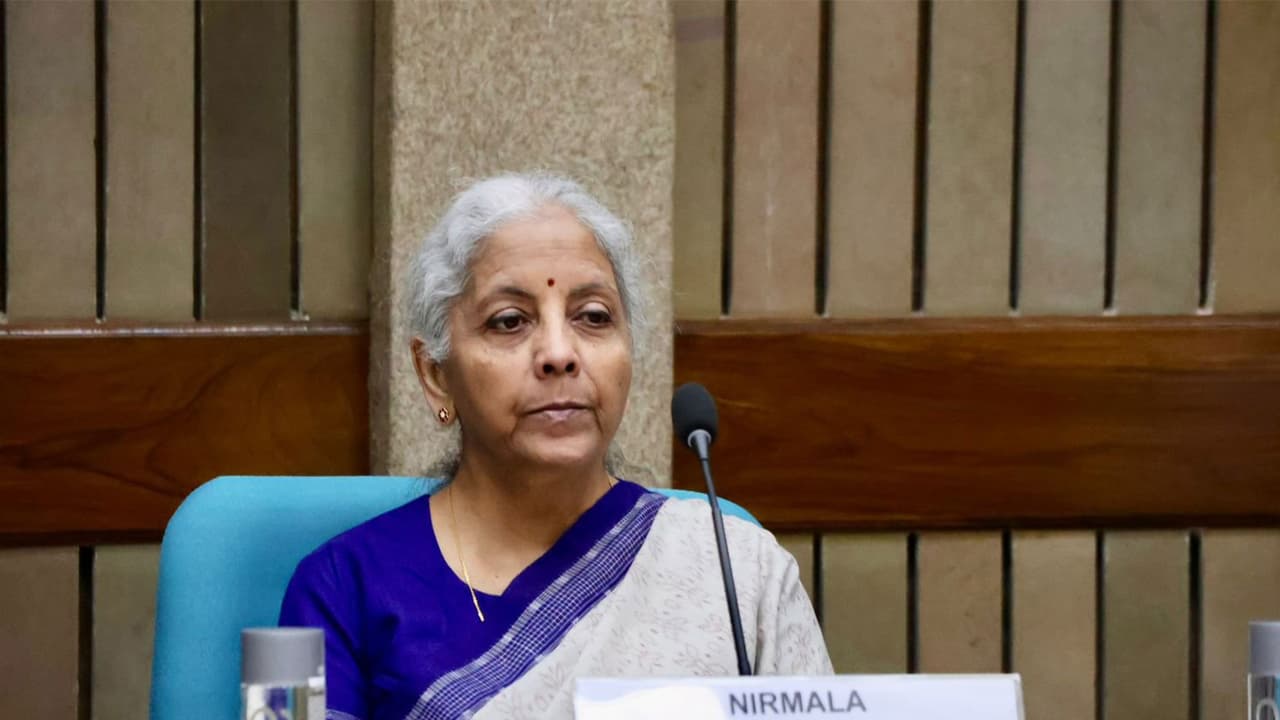
Finance Minister Nirmala Sitharaman said the global economy has moved from 'shocks' to 'permanent volatility' due to geopolitical tensions. She highlighted rising global debt but contrasted it with India's strong macroeconomic fundamentals.
Finance Minister Nirmala Sitharaman on Monday said the global economic landscape has moved from a phase of isolated shocks to one of "permanent volatility", underlining rising uncertainty due to geopolitical tensions and economic disruptions.
Addressing the Golden Jubilee event of the National Institute of Public Finance and Policy in Delhi, Sitharaman pointed to several global challenges that have reshaped the world economy in recent years. "The current year is even more challenging as we move from a landscape of 'shocks' to one of 'permanent volatility,'" she said. The global economy has faced repeated disruptions, beginning with the COVID-19 pandemic, followed by the Russia-Ukraine war, tensions in the Middle East, and trade-related uncertainties, including those linked to policies under US President Donald Trump.
Escalating Global Challenges
Sitharaman said the ongoing escalation in the Middle East has moved beyond a regional issue and is now affecting the global system. "The escalation of the Middle East conflict has evolved from a regional security concern into a systemic tremor, threatening the vital arteries of global energy and hardening the lines of a new, multipolar world order," she said.
Reflecting on the previous year, she said 2025 turned out to be more significant than expected. Trade fragmentation created uncertainty in global supply chains and led to downward revisions in growth forecasts, although the year ended on a relatively optimistic note, especially for India.
Global Debt Concerns
Highlighting global debt concerns, Sitharaman said public debt has risen to about USD 106 trillion, crossing 95 per cent of global GDP. Citing data from the International Monetary Fund, she noted that the United States has a debt-to-GDP ratio of 125 per cent in 2025, while Japan's stands at 235 per cent. She added that many advanced economies now have limited policy space after years of expansionary fiscal measures, making it harder for them to respond to current challenges.
India's Resilient Economic Position
In contrast, Sitharaman said India's macroeconomic fundamentals remain relatively strong. India's general government debt-to-GDP ratio is about 81 per cent, among the lowest for major economies after Germany. She added that India is the only major economy where the IMF expects a notable decline in this ratio, with projections that it will fall to 75.8 per cent by 2030.
Strong External Sector and Forex Reserves
India's external debt-to-GDP ratio stands at 19.1 per cent as of September 2025, among the lowest in emerging markets. The country's foreign exchange reserves are over USD 688 billion as of March 31, 2026, providing an import cover of around 11 months. (ANI)
(Except for the headline, this story has not been edited by Asianet Newsable English staff and is published from a syndicated feed.)