
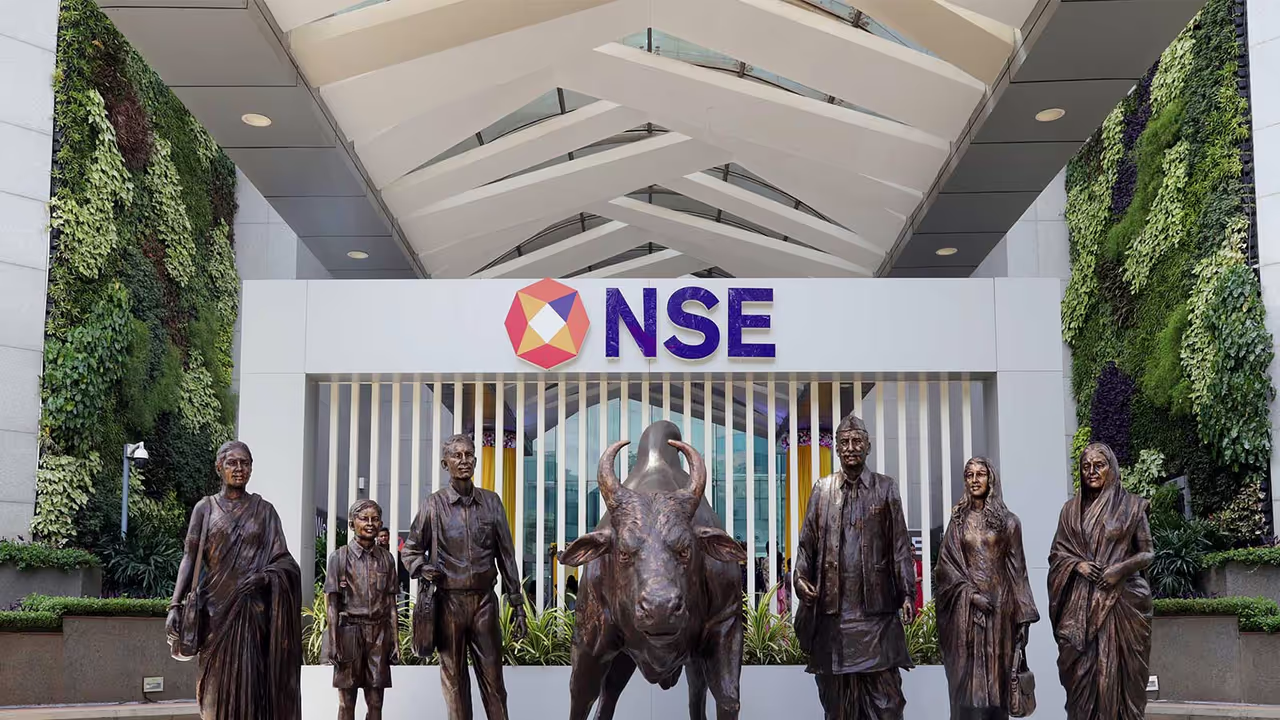
The Supreme Court allowed the settlement between SEBI and the NSE in the long-running co-location and dark fibre matters, ending the regulatory proceedings. The settlement covers a total payment of Rs 1,491.21 crore by NSE to close the cases.
The Supreme Court on Friday allowed the settlement between the Securities and Exchange Board of India (SEBI) and the National Stock Exchange (NSE) in the long-running co-location and dark fibre matters, bringing the regulatory proceedings arising from the cases to an end.
A bench of Justices JB Pardiwala and K Vinod Chandran permitted the settlement and disposed of the proceedings pending before it in connection with the two matters.
Details of the Settlement
The settlement covers a total payment of Rs 1,491.21 crore by NSE under SEBI’s settlement mechanism. The amount comprises Rs 1,223.56 crore towards the co-location matter and Rs 267.65 crore towards the dark fibre case.
NSE had already deposited Rs 776.47 crore with SEBI and subsequently paid another Rs 714.74 crore after SEBI accepted the settlement proposal, completing the Rs 1,491.21-crore settlement.
Background of the Allegations
The cases stem from allegations concerning the manner in which NSE’s co-location infrastructure and trading data were accessed by certain brokers. In the co-location matter, SEBI’s proceedings concerned allegations of preferential access to the Tick-by-Tick data feed and shortcomings in NSE’s system for ensuring fair and equitable access to its trading infrastructure. The proceedings also examined issues including the absence of a randomiser, IP allocation and load-balancing and access to secondary servers.
The dark fibre dispute related to Point-to-Point connectivity provided through an unauthorised service provider to certain brokers. SEBI’s investigation examined the connectivity between NSE’s co-location facility and the BSE co-location facility and the alleged advantage obtained through such connectivity.
Timeline of the Dispute
The dispute dates back nearly a decade. SEBI’s Whole Time Member passed an order on April 30, 2019 directing NSE to disgorge Rs 624.89 crore with 12% annual interest from April 1, 2014 to the Investor Protection and Education Fund.
NSE challenged the order before the Securities Appellate Tribunal. In January 2023, the SAT set aside the disgorgement direction. It, however, directed NSE to pay Rs 100 crore to the Investor Protection and Education Fund, holding that the exchange had committed lapses in ensuring fair access and due diligence.
The SAT had noted that NSE had a responsibility to ensure transparency and fair access to all trading members. At the same time, it held that the direction for disgorgement was not warranted on the material before it.
Separate proceedings relating to the dark fibre matter also reached the SAT, where the tribunal examined allegations concerning the use of Point-to-Point connectivity through Sampark Infotainment and the role of NSE officials and brokers.
Path to Final Resolution
SEBI subsequently pursued its challenges before the Supreme Court. The parties eventually moved towards a settlement, with NSE filing revised settlement terms for Rs 1,491.21 crore in March 2026. NSE’s own regulatory disclosures said the settlement applications covered the co-location and dark fibre orders.
SEBI accepted the settlement in July and raised a demand for the balance Rs 714.74 crore after adjusting the Rs 776.47 crore already deposited by NSE. The Supreme Court’s order on Friday now brings the proceedings arising from the two matters before it to a close.
Concurrent NSE IPO
The development comes as NSE’s maiden initial public offering is open for subscription. The IPO opened on September 17 and will close on September 21, with the price band fixed at Rs 1,700-Rs 1,785 per share.
SEBI was represented by Expletus Legal, while Advocate Abhijnan Jha represented the NSE. (ANI)
(Except for the headline, this story has not been edited by Asianetnews Editorial staff and is published from a syndicated feed.)