
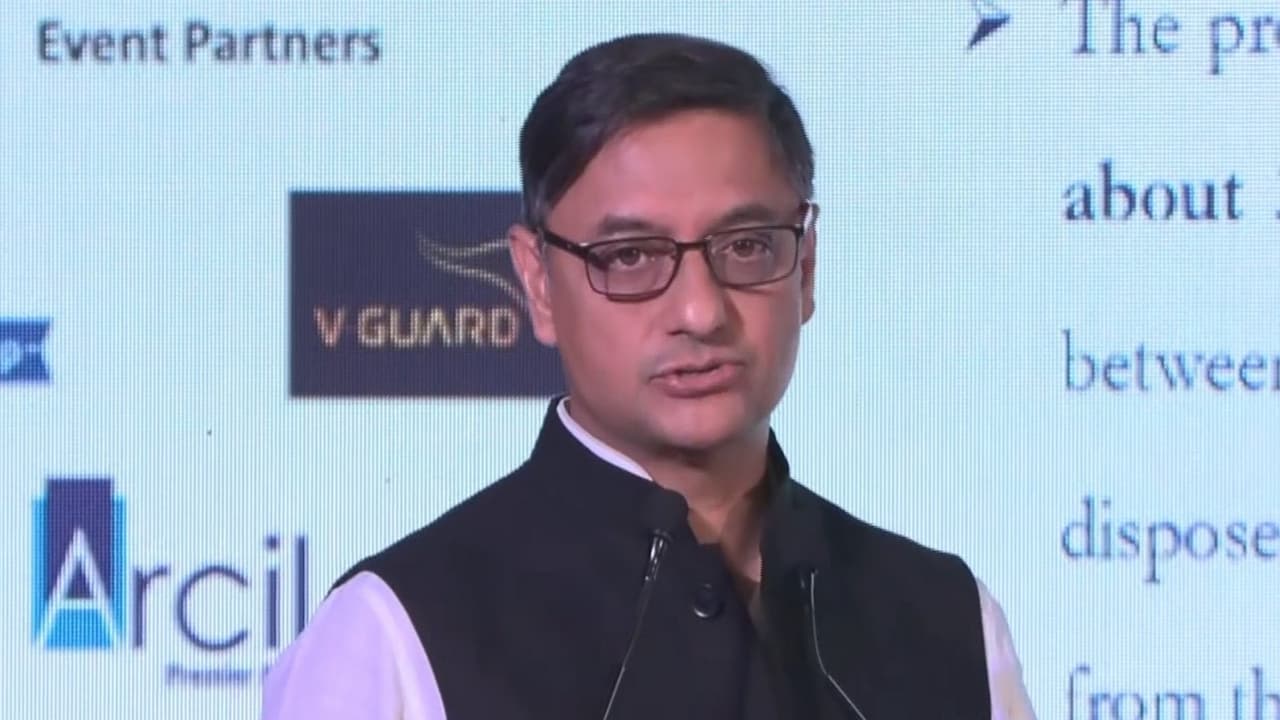
PM's economic advisor Sanjeev Sanyal proposed a 'Transparency of Rules Act' to simplify regulations. He said it would boost ease of doing business by consolidating all rules on a central portal, enhancing transparency and reducing regulatory opacity.
Proposal for 'Transparency of Rules Act'
Sanjeev Sanyal, member of the Economic Advisory Council to the Prime Minister, on Tuesday proposed for the enactment of a "Transparency of Rules Act" to make all norms, regulations and citizen-facing requirements easily accessible through a dedicated centralised portal.
Sanyal, said Transparency of Rules Act can help simplify regulations, improve transparency in governance and significantly enhance ease of doing business in the country by consolidating complex rules and reducing regulatory opacity. "Transparency of Rules Act, and the idea of this is very simple, and it will cost almost no money to do, but it will require public pressure to get it done, because it will remove from the bureaucracy a major problem, which is what are the rules I am supposed to follow," Sanyal said while addressing the ASSOCHAM'S India Business Reforms Summit 2026.
Success of Administrative Simplification
He said most governance reforms do not necessarily require major legislative overhauls and can often be achieved through process simplification and administrative streamlining.
Streamlining Company Closures
Citing reforms in voluntary closure of companies under the Companies Act, Sanyal said the government reduced the average time taken to strike off companies from nearly 500 days in 2021-22 to around 60 days through the C-PACE platform established by the Ministry of Corporate Affairs.
"This, by the way, is the fastest in the world. Faster than Singapore," he said.
According to Sanyal, the earlier system suffered from delays because No Objection Certificates (NOCs) and approvals were processed sequentially, there were no fixed timelines and companies often faced procedural bottlenecks despite there being no objections to closure.
He said the new digital mechanism now automatically processes applications, seeks approvals electronically and grants deemed approvals if departments fail to respond within specified timelines.
Reforms Under IBC
Referring to reforms under the Insolvency and Bankruptcy Code (IBC), Sanyal said the government also simplified voluntary liquidation procedures for large companies by introducing standardised checklists and clearer compliance frameworks.
He said the Insolvency and Bankruptcy Board of India (IBBI) issued clarification circulars and amended regulations to remove unnecessary ambiguity around NOCs and compliance requirements.
Tackling Outdated Compliances and Bottlenecks
Sanyal further said the government is reviewing outdated compliances and state-created bottlenecks that adversely affect businesses.
Citing examples, he said mandatory mediation in commercial disputes often adds unnecessary delays and costs despite very few disputes being resolved through the process.
He also flagged restrictions on branding and multidisciplinary partnerships for Indian consultancy firms, saying such rules have limited the emergence of large Indian professional services firms despite India being a major services-exporting country.
Boosting Innovation and R&D Capacity
The economist added that India is significantly expanding its patent processing ecosystem by recruiting additional patent examiners and controllers to support future growth in innovation and research.
He said the government aims to build sufficient capacity by 2030 to handle a much larger volume of patent applications and ensure that India's R&D ecosystem is not constrained by administrative delays.
The Goal: A Consolidated, Transparent Framework
Explaining the broader objective behind the proposed Transparency of Rules Act, Sanyal said laws and regulations should be consolidated and presented transparently rather than being scattered across thousands of circulars and notifications.
Citing the Reserve Bank of India (RBI) as an example, he said the central bank replaced 9,446 circulars with 244 master circulars in November 2025, helping improve clarity and reduce opacity in the regulatory framework. (ANI)
(Except for the headline, this story has not been edited by Asianet Newsable English staff and is published from a syndicated feed.)
