
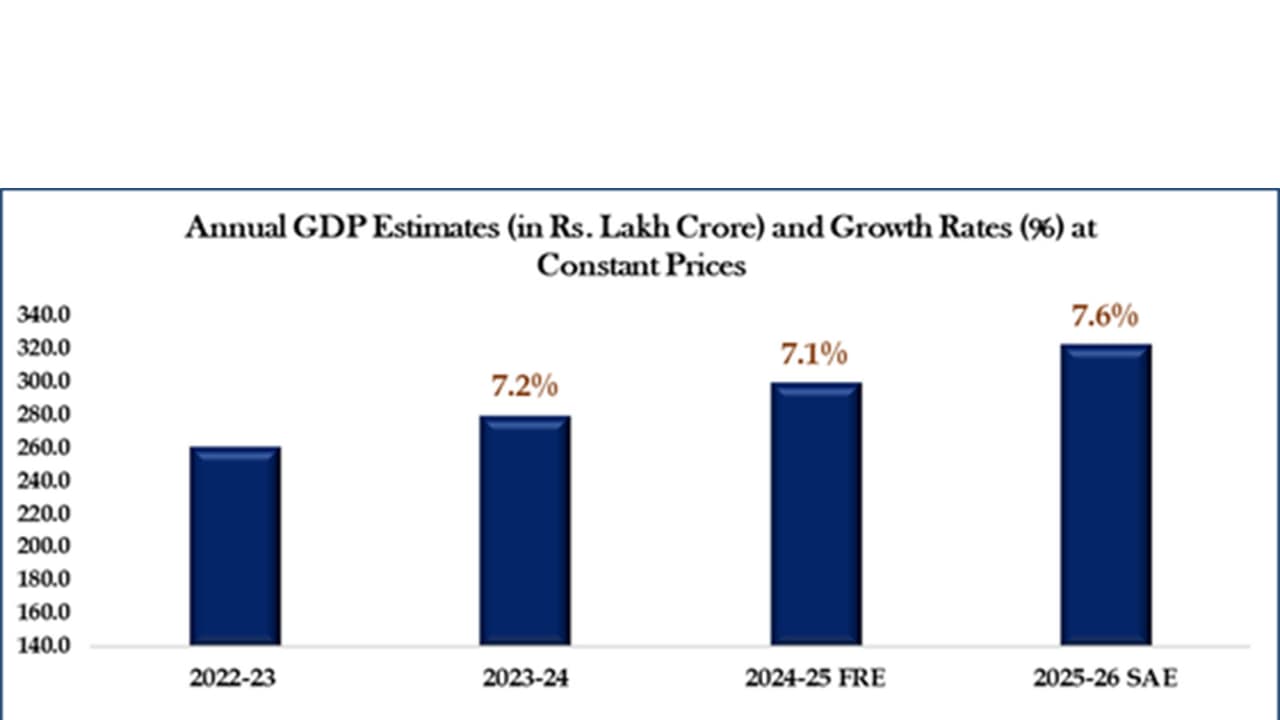
India's national accounts base year revision to 2022-23 has lifted the GDP growth estimate for 2025-26 to 7.6%. This update is seen as analytically significant, reflecting structural changes and incorporating new data sources like GST.
India's latest base year revision of national accounts has led to an upward adjustment in GDP growth estimates for 2025-26, with analysts seeing it as analytically significant given that it captures structural changes in the economy and incorporates new data sources. The Ministry of Statistics and Programme Implementation (MoSPI) on Thursday released the new series of Annual and Quarterly National Accounts Estimates, shifting the base year from 2011-12 to 2022-23. The revision is part of a broader exercise to update key macroeconomic indicators, including the Consumer Price Index (CPI), Gross Domestic Product (GDP), and the Index of Industrial Production (IIP).
New Base Year Lifts GDP Growth to 7.6%
India's real GDP is estimated to grow by 7.6 per cent in the current financial year 2025-26, Ministry of Statistics and Programme Implementation (MoSPI) estimates showed Thursday. Under the old series, the GDP was estimated to grow 7.4 per cent in the current financial year.
Overall economic performance in 2025-26 is primarily on account of robust real growth observed in the second quarter (8.4 per cent) and the third quarter (7.8 per cent).
In the October-December quarter, the economy grew 7.8 per cent, in real terms, data showed. In the January-March quarter, the economy is estimated to grow 7.3 per cent.
"We expected, or anticipated growth rate has to be 7.3 per cent or more in Q4 (2025-26) to be able to achieve the full year real GDP growth rate of 7.6 per cent," Chief Economic Adviser to the Government of India, V. Anantha Nageswaran, said. "I think the momentum in the economy is good enough to deliver the 7.3 per cent growth rate in the fourth quarter."
Under the new series, the GDP estimates for next year, 2026-27 has also been raised to 7-7.4 per cent, as against the projected 6.8-7.2 per cent growth in the recently tabled Economic Survey document.
The Indian economy has exhibited sustained performance, recording real GDP growth rates of 7.2 per cent and 7.1 per cent respectively during 2023-24 and 2024-25. According to official data, the economy grew 8.7 per cent and 7.2 per cent, respectively, in 2021-22 and 2022-23.
In late 2025, the International Monetary Fund had assigned India a 'C' rating on national accounts, citing concerns over outdated base year data. The new series is expected to address such concerns by better reflecting the current structure of the economy and aligning with global statistical standards.
Significance and Market Implications
These better-than-expected numbers have clear market implications, said Sujan Hajra, Chief Economist and Executive Director, Anand Rathi Group. "For equities, the improved growth impulse strengthens the outlook for corporate earnings, especially for cyclical and domestic-demand-oriented sectors. For the debt market, stronger real growth -- even with moderate nominal expansion -- improves the outlook for government finances by supporting tax collections and reducing fiscal slippage risks," Hajra added.
According to Vikrant Chaturvedi, Associate Director - Research, Brickwork Ratings, the rebasing of national accounts to 2022-23 is analytically significant as it captures structural changes in the economy, incorporates new data sources such as GST and updated surveys, and strengthens estimation methodologies by adopting internationally aligned statistical practices. "This ensures that growth estimates are more representative of the current economic structure, where digital services, modern manufacturing, and evolving consumption patterns play a larger role," Charurvedi added.
Expert Outlook and Credibility
ICRA currently projects the GDP growth at a healthy 7.0 per cent in FY2027, below government estimates, amid favourable developments, including the interim deal with the US with a lower tariff rate, improved prospects for domestic investment, aided by the robust hike in Central capital spending included in the Union Budget. "The reduction in GST rates, cumulative 125 rate cuts, as well as lower-than-expected rise in food inflation, along with upbeat farm sector trends, portend a favourable outlook for private consumption in the upcoming fiscal," said Aditi Nayar, Chief Economist, ICRA Ltd.
As India moves towards deeper integration in the global value chains, base year updates at regular intervals, current after every five years, reflects government's commitment to data-driven policy intervention to shocks in the global economy, said Rajeev Juneja, President, industry chamber PHDCCI.
The revised GDP framework will enhance the credibility and analytical usefulness of India's national accounts statistics. The updated methodology is expected to provide policymakers, businesses, and investors with a more accurate picture of economic activity across sectors, Rajeev Juneja added.
"For the next fiscal, we expect real GDP growth to remain healthy, with support from private consumption and investments, and likely steady global growth. That said, risks to global growth are tilted to the downside due to heightened uncertainties," Dharmakirti Joshi, Chief Economist, Crisil Ltd. (ANI)
(Except for the headline, this story has not been edited by Asianet Newsable English staff and is published from a syndicated feed.)