
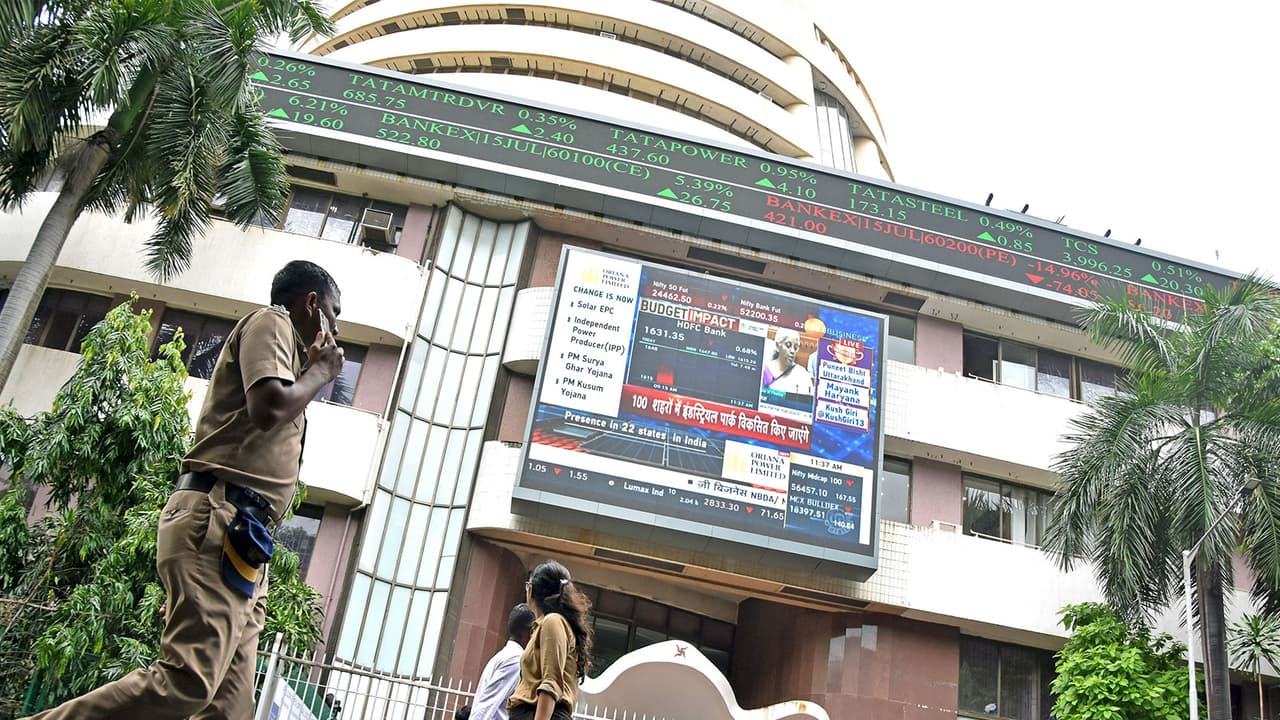
A Motilal Oswal report finds Indian equity markets are protected from a potential AI bubble due to limited exposure to pure-play AI firms and a balanced structure, showing more resilience than tech-heavy global markets like the US.
Indian equity markets are relatively protected from the risks of a potential artificial intelligence (AI) bubble, owing to their limited exposure to pure-play AI companies and a more balanced market structure, according to a report by Motilal Oswal Private Wealth. The report data highlighted that while global markets, especially the US, have seen sharp boom-bust cycles driven by technology-heavy indices, Indian markets have historically shown greater resilience during such phases.
Global Tech Concentration and Valuation Risk
One of the key comparisons in the report is between the market capitalisation of the global "MAG7" stocks and the GDP of major economies. The data showed that the market capitalisation of the MAG7 stands at USD 19.4 trillion, comparable to China's GDP at USD 19.4 trillion, and significantly higher than the GDP of countries like Germany (USD 5.3 trillion), Japan (USD 4.3 trillion), India (USD 4 trillion), and the UK (USD 3.7 trillion). This concentration highlighted the scale of valuation risk in global tech-heavy markets.
Historical Parallel: The Dot-Com Bubble
The report also compared the performance of the Nasdaq 100 and the Nifty 50 during the dot-com bubble period. Between 1996 and 2000, the Nasdaq 100 surged 643 per cent, while the Nifty 50 rose by a relatively modest 80 per cent. When the bubble burst between 2000 and 2003, the Nasdaq 100 fell sharply by 75 per cent, whereas the Nifty 50 declined by 39 per cent. During the recovery phase from 2003 to 2007, the Nasdaq 100 gained 88 per cent, while the Nifty 50 delivered a much stronger recovery of 557 per cent. So, as per the report data, this historical trend suggests that India remained relatively protected from the extreme boom-burst cycle seen during the dot-com period.
Recent Performance and Valuation Analysis
Looking at more recent performance, the report noted that from January 2016 till January 2026, the Nasdaq 100 delivered returns of 494 per cent, significantly higher than the Nifty 50's 246 per cent. However, valuation expansion tells a different story. During the same period, the PE re-rating for the Nasdaq 100 stood at 88 per cent, compared to just 28 per cent for the Nifty 50, indicating lower valuation froth in Indian equities.
The report concludes that India's relatively limited exposure to pure-play AI companies offers a layer of protection in the event of an AI-driven bubble burst. With less dependence on a narrow set of highly valued technology stocks, Indian markets are seen as more balanced and less vulnerable to sharp corrections driven by excessive optimism around AI. (ANI)
(Except for the headline, this story has not been edited by Asianet Newsable English staff and is published from a syndicated feed.)