
India plans to export green energy from 2028-29, targeting 5 million metric tonnes of green hydrogen production by 2030 under its National Green Hydrogen Mission. Europe is seen as a key market as India's prices become globally competitive.
India expects to begin exporting green energy from 2028-29 as it builds capacity under the National Green Hydrogen Mission, while the country is increasingly being seen as a potential supplier of green hydrogen and its derivatives to Europe, according to government and industry experts.
India's Green Hydrogen Export Roadmap
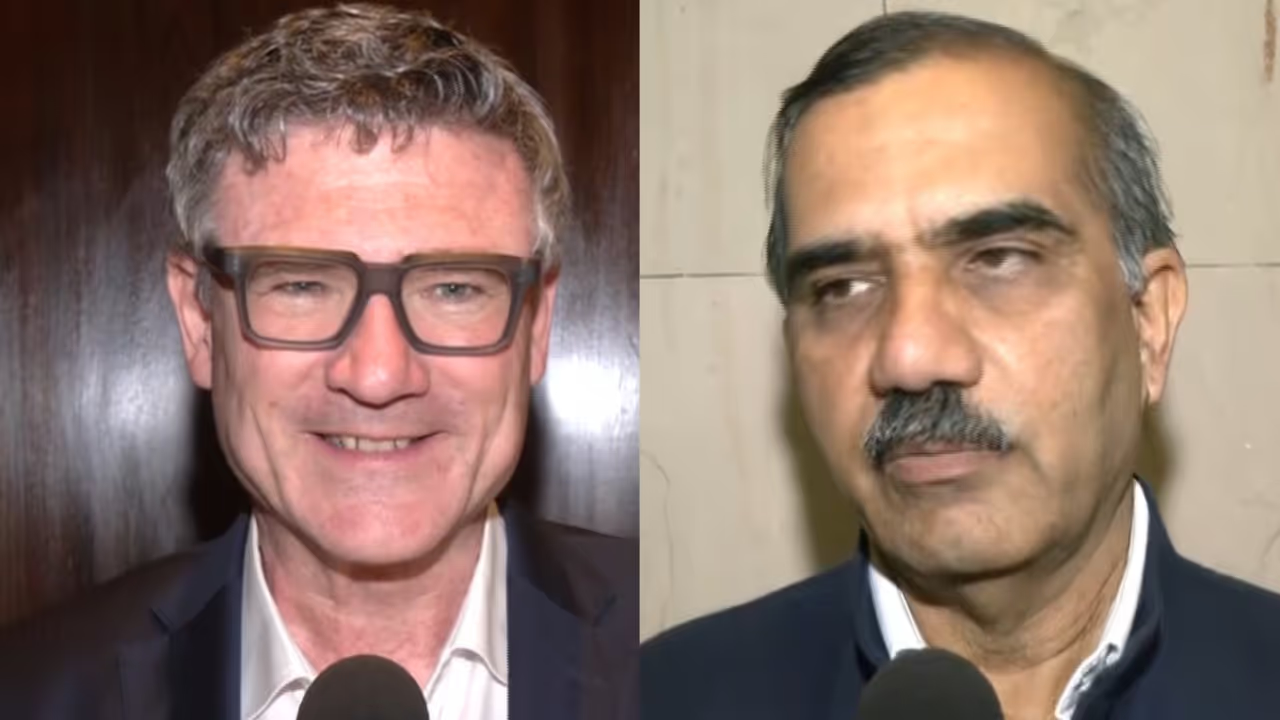
Abhay Bakre, Mission Director of the National Green Hydrogen Mission at the Ministry of New and Renewable Energy, said India is working towards creating 5 million metric tonnes of green hydrogen production capacity by 2030, supported by both exports and rising domestic consumption. "From 2028, 2029 onwards, we will be actually having the export of green energy," Bakre told ANI on the sidelines of S&P Global's Horizons Clean Energy Expansion India Conference.
He said India's renewable energy potential could help it produce green hydrogen and derivatives at globally competitive prices, creating opportunities as countries look to reduce their dependence on fossil fuels. "India is in the best position to offer that kind of green fuels. These fuels are actually produced through green hydrogen like green ammonia, green methanol, etcetera," Bakre said.
The 2030 production target would include hydrogen used directly in sectors such as refineries, steel and mobility, as well as green ammonia for fertilisers and green ammonia and methanol for shipping. "We are able to meet the 2030 targets through a majority portion in the exports and also increasing the domestic consumption," he said.
Achieving Global Cost Competitiveness
Union Minister for New and Renewable Energy Pralhad Joshi, addressing the same conference through a video message, said recent price discoveries also showed that India's green hydrogen sector was moving towards global cost competitiveness. “The lowest bid for green ammonia was Rs 49.75 per kg. Meanwhile, green hydrogen was discovered at Rs 279 per kg. These prices show that Indian green hydrogen is moving towards global cost competitiveness,” Joshi said.
India-Germany Partnership Opportunities
Meanwhile, Stefan Kaufmann, a former German parliamentarian and former Green Hydrogen Commissioner of the German government, said India has increasingly emerged as an important potential producer of green hydrogen and derivatives for overseas markets. "We see India as one of the most important and interesting producers of green derivatives and hydrogen," Kaufmann told ANI at the same conference.
He also pointed to opportunities for Indian and German companies to work together in electrolyser manufacturing, combining German technology with India's potential to manufacture at competitive costs. "In Germany, we have some of the best technologies in that field of electrolysers, but the costs are much too high," Kaufmann said, adding that cooperation between German and Indian companies could help build manufacturing capacity.
"For sure, we have a lot of opportunities in buying green hydrogen from India and selling it to Europe and Germany," he said.
National Mission Goals and Investments
Bakre said green hydrogen is also expected to play a larger role in reducing India's dependence on imported energy over the longer term, with domestically produced clean energy replacing imported fossil fuels as the country moves towards its 2047 goals.
India launched the National Green Hydrogen Mission in January 2023 with an outlay of Rs 19,744 crore, targeting at least 5 million metric tonnes of annual green hydrogen production capacity by 2030. According to the ministry, the mission is expected to mobilise more than Rs 8 lakh crore in investment and add around 125 GW of renewable energy capacity by the end of the decade.
The government has so far awarded 3,000 MW per annum of electrolyser manufacturing capacity and 8.62 lakh tonnes per annum of green hydrogen production capacity. Separately, the first green hydrogen hub under the mission at Pudimadaka near Visakhapatnam entails an investment of about Rs 1.85 lakh crore and is being developed with a significant focus on the export market. (ANI)
(Except for the headline, this story has not been edited by Asianet Newsable English staff and is published from a syndicated feed.)