
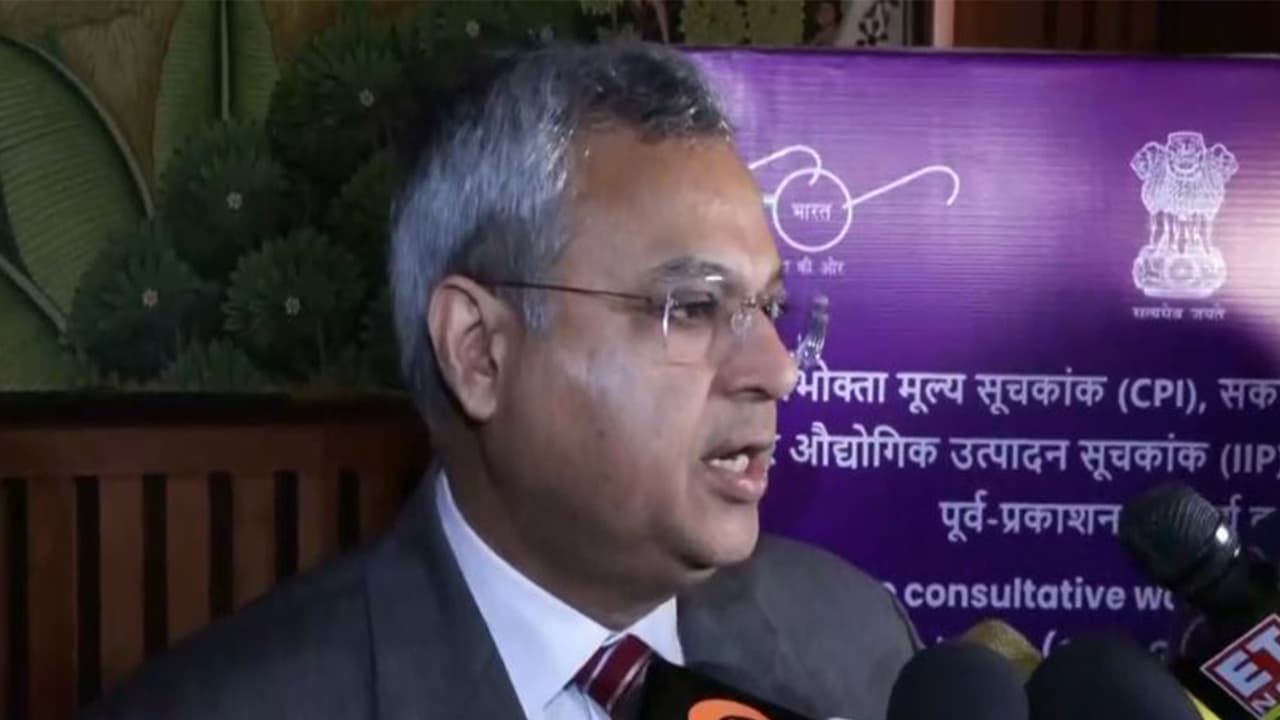
The government is revising the national accounts' base year to reflect economic structural changes, new consumption patterns, and the digital economy's growth over the last decade, according to MoSPI Secretary Saurabh Garg.
Rationale for Revising National Accounts Base Year
The government is undertaking a revision of the base year for national accounts to better reflect structural changes in the economy, evolving consumption patterns, and the rapid expansion of the digital economy over the past decade, Saurabh Garg, Secretary, Ministry of Statistics and Programme Implementation (MoSPI) said on Tuesday.
Speaking on the rationale behind the base revision, Garg said the first and foremost reason is the transformation of the Indian economy in the last 10 years. "Over the past 10 years, the structure of the economy has changed. The type of products that are consumed by people have changed, the digital economy has grown much bigger," he said.
The second key factor, according to Garg, is the significant improvement and expansion in data availability. "The data sources that were available has also changed. We have real-time as well as digital data available. For example, Economic Value Added (EVA) data, Goods and Services Tax (GST) data, Public Financial Management System (PFMS) data etc. "Given these new data sources, it becomes necessary to update our methods," he said.
The third reason relates to international developments. Garg pointed out that global statistical methodologies continue to evolve, with new classifications and definitions being adopted over time. "With the combination of these three reasons, we need to make the best change, and that's what we are doing," he said.
Impact and Methodological Adjustments
On the likely impact of the revision on macroeconomic numbers, Garg said it was premature to speculate. "Once we have the numbers, then we will be able to comment on what exactly are the changes. But in general, we do not expect large deviations from our earlier expectations," he said.
Addressing questions on the use of double deflation, Garg explained that the process helps separate the impact of inflation from real growth when converting current prices into constant prices. "What double deflation essentially does is help us move from current prices to real prices. How much of the change is due to inflation and how much is due to real value changes is what deflation helps us understand," he said.
Garg said MoSPI has been using disaggregated price indices, with the Wholesale Price Index (WPI) being akin to the Producer Price Index (PPI), though some concerns remain. "These doubts will be clarified when we bring out the new base revision," he added.
Garg also said that alternative techniques such as volume extrapolation, based on physical output or volume indicators, are being considered. Details of these approaches will be outlined in an upcoming concept paper, he said. "We are incorporating the additional methodologies and also the additional data sources. It will become more robust, accurate, and even more credible than it is already is," MoSPI Secretary said.
Consultative Process and Implementation
The Ministry of Statistics and Programme Implementation has organized the Second Pre-release Consultative Workshop on the Base Revision of the Gross Domestic Product (GDP), Consumer Price Index (CPI) and Index of Industrial Production (IIP). The workshop brought together a wide spectrum of participants, including eminent economists, experts from financial institutions and the banking sector, subject-matter specialists, users of core statistics, and senior officials from the Central and State Governments.
MoSPI had launched the new CPI series in 2011 with a base year of 2010, later revised to 2012. This revamped CPI includes three indices namely CPI (Rural), CPI (Urban), and CPI (Combined) and is released monthly by the National Statistical Office (NSO).
MoSPI is currently working on revising the base year for CPI to 2024, and for GDP and IIP to 2022-23, the process for which commenced in early 2023. To guide and oversee this exercise, an Expert Group on Base Revision of CPI was constituted on February 27, 2023 under the chairmanship of Ashish Kumar, Ex-Director, UNSIAP and Ex-Director General, CSO. The Group comprises eminent academicians, representatives from the Reserve Bank of India, the Ministry of Labour & Employment, the Ministry of Commerce & Industry, and senior officials from union ministries. (ANI)
(Except for the headline, this story has not been edited by Asianet Newsable English staff and is published from a syndicated feed.)