
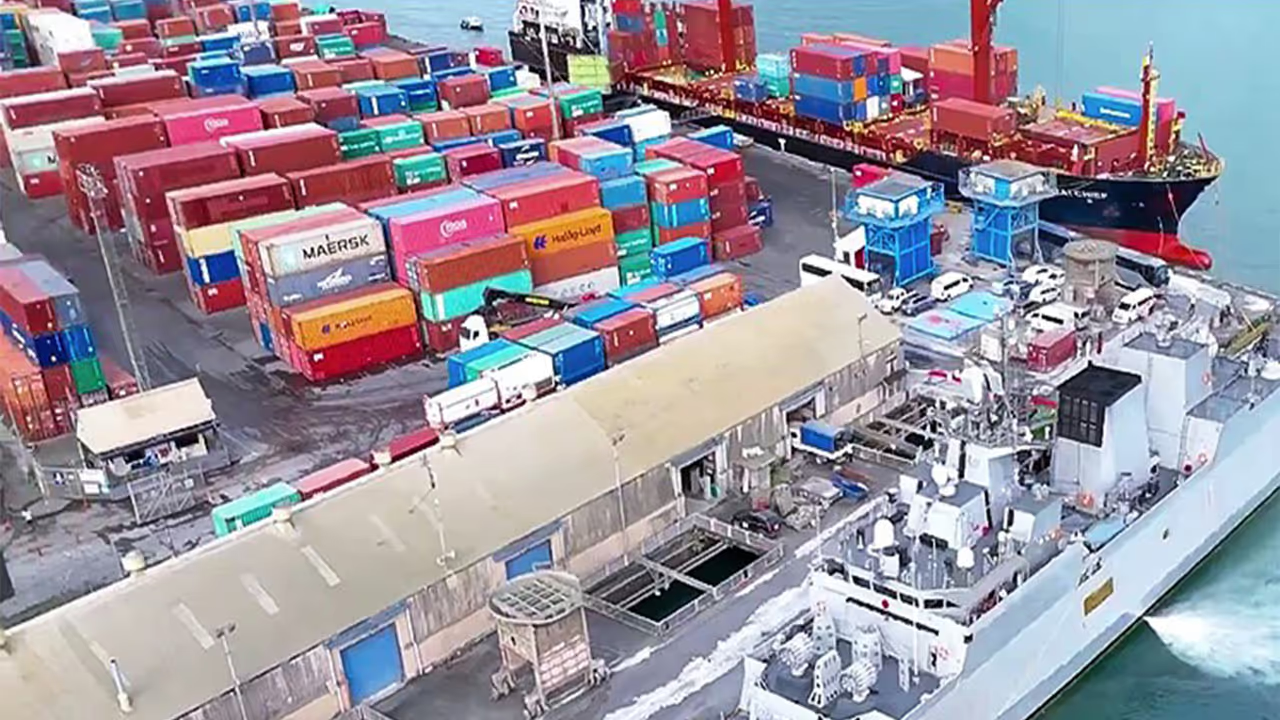
India will now pursue Preferential Trade Agreements (PTAs) instead of full Free Trade Agreements (FTAs) with developing economies like South Africa, a senior official said. This allows for a selective opening of markets on a product-by-product basis.
India Shifts Trade Strategy to Preferential Pacts Over Full FTAs
By Sailesh Yadav New Delhi [India], August 12 (ANI): India will pursue Preferential Trade Agreements (PTAs) rather than full-fledged Free Trade Agreements (FTAs) with developing economies such as South Africa, opting for a calibrated approach that opens up only select product categories rather than deep, across-the-board market access, according to a senior government official.
The official told ANI that South Africa is not a highly developed economy and a full FTA would require a much deeper opening up of the Indian market, a move that may not necessarily serve India's interests. Instead, India has decided to pursue a PTA route, under which both sides will identify specific products of mutual strength and interest: South Africa will get market access in areas where it has strengths, while India will secure access in products of its own interest.
Expanding PTA Negotiations
A Preferential Trade Agreement (PTA) is a trade pact between countries that reduces tariffs and other trade barriers on selected goods traded among member nations. PTA does not remove all tariffs and usually applies only to a selected list of products. The government is also moving ahead with PTA negotiations with Mercosur, the South American trade bloc comprising Brazil and other member nations. Discussions are also being explored for a possible PTA with Mexico and Kenya, while Ecuador has independently approached India expressing interest in a full FTA. On Chile, the official said the Commerce Secretary is scheduled to travel to the country by the end of August or next month to assess whether a mutually beneficial deal can be reached. "If we get a good deal, we are on."
'Whole of Government' Approach Contrasts With Past Negotiations
The official was sharply critical of how free trade agreements were negotiated under the previous UPA government, alleging that stakeholder consultations during that period were largely superficial. Citing the ASEAN agreement as an example, the official said businesses were reportedly promised morning discussions before finalisation of the deal, but instead received a message at night informing them that the signing ceremony was scheduled for the next day leaving industry representatives with no real opportunity to weigh in.
In contrast, the official said, the current government ensures that all concerned stakeholders are consulted and taken on board before any trade agreement is finalised, describing the approach as a "whole of the government, whole of stakeholders" model of negotiation. Illustrating this approach, the official pointed to two recent stakeholder meetings - one on expanding India's shipbuilding and shipbreaking capacity, and another on addressing urea diversion - both of which brought together relevant ministries, industry bodies, and private sector players to arrive at coordinated action plans, reflecting what the official described as a more inclusive and consultative style of policymaking compared to earlier trade negotiation practices. (ANI)
(Except for the headline, this story has not been edited by Asianetnews Editorial staff and is published from a syndicated feed.)