
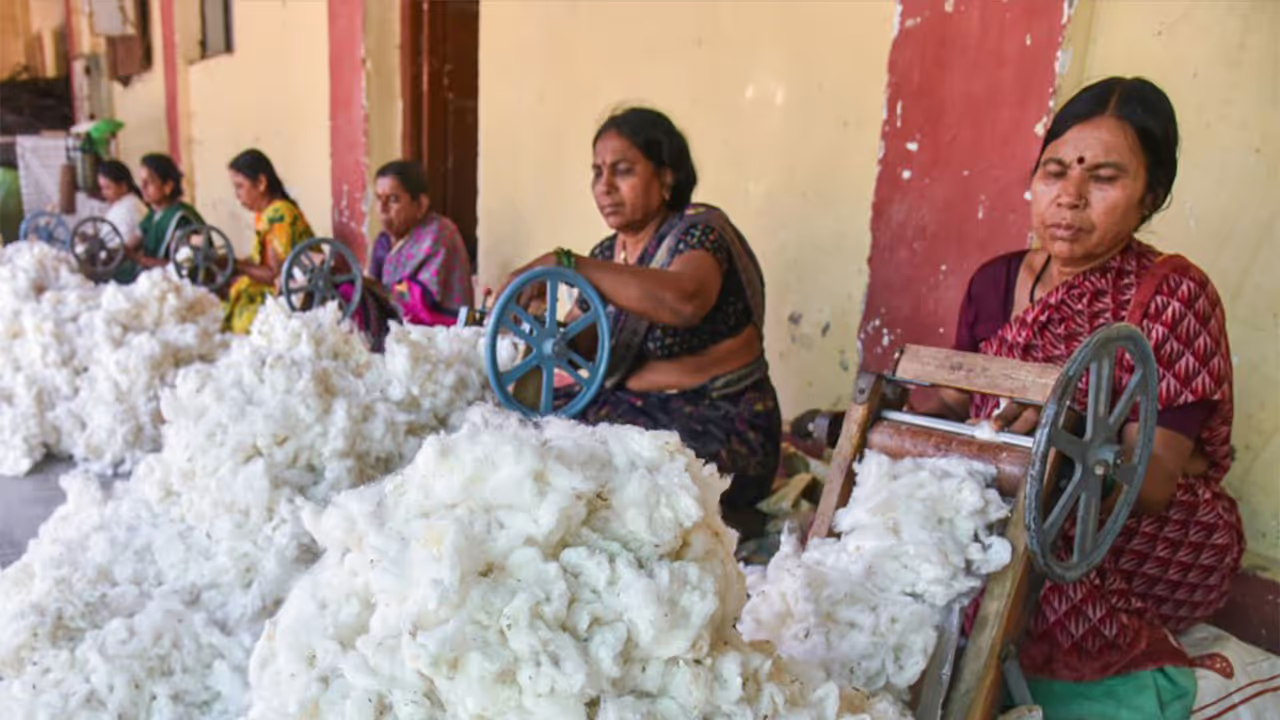
India's cotton surplus is shrinking, making it pricier for textile producers, says a Nuvama report. Declining production, rising imports, and falling exports are pushing the industry to diversify towards man-made fibres to mitigate risks.
India's cotton surplus is narrowing, making cotton more expensive for textile producers and increasing the need to diversify towards man-made fibres, as per a report by Nuvama Institutional Equities.
Shift in Production and Trade
The report noted, India's cotton balance sheet is shifting from a surplus towards equilibrium. Production has declined from a peak of 6.31 billion kg in CS21 to an estimated 4.95 billion kg in CS26, while imports have tripled from 0.26 billion kg to 0.80 billion kg. Meanwhile, exports have fallen sharply from 1.28 billion kg to 0.20 billion kg, while Shankar-6 cotton prices surged from INR 110/kg in CS21 to INR 221/kg in CS23 before moderating to around INR 155/kg, as per the report.
Country-wise trade flows reflect this adjustment, with Bangladesh's mills emerging as key buyers of Indian raw cotton, while imports are increasingly sourced from the US and Australia for fine-staple varieties that India does not produce in sufficient quantities.
Implications for the Textile Industry
Highlighting the implications of this shift, Nuvama noted, "For spinners, the raw material cushion is thinning and the price series is a margin series: spreads compress every time the crop disappoints."
However, for the broader industry, the fading cotton surplus strengthens the case for expanding man-made fibre (MMF) capacity, as the textile value chain increasingly needs to diversify its fibre mix. "The value chain from field to fabric is the map on which the rest of the report moves downstream," it said.
Disappearing Price Advantage
The report further highlighted, India historically bought cotton at an 8-11 per cent discount to global prices as a surplus producer, with domestic prices linked to export parity, however, that discount has now disappeared.
The report further stated, "The FY26 convergence to parity reflects duty waivers rather than fundamentals." According to Nuvama, the exemption was reinstated on January 1, 2026, but waived again only for the June 1-October 31, 2026 period, making the relief temporary and focused on supporting farm incomes rather than improving mill competitiveness. (ANI)
(Except for the headline, this story has not been edited by Asianetnews Editorial staff and is published from a syndicated feed.)