
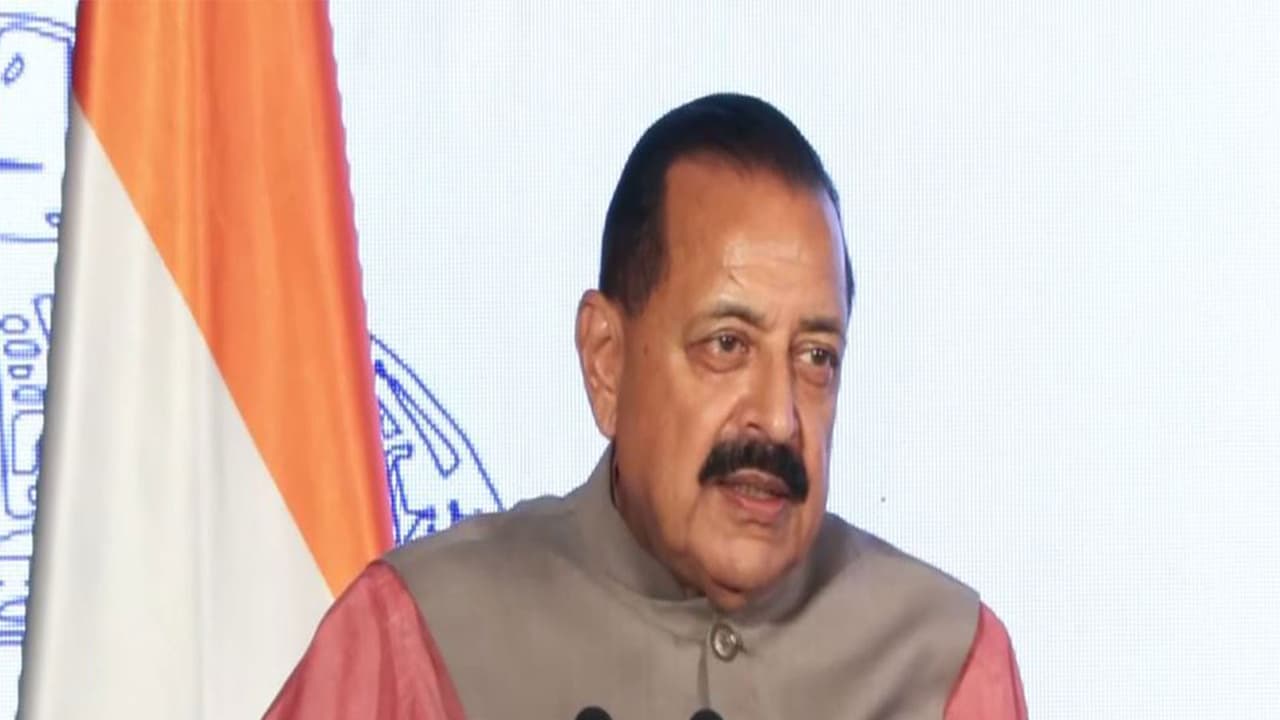
Union Minister Jitendra Singh said India is now progressing alongside leading nations in emerging tech, calling for stronger public-private collaboration. He cited rapid progress in the National Quantum Mission as an example of this advancement.
India is now progressing alongside leading nations in emerging technologies and no longer waits for breakthroughs to happen abroad before embracing innovation, Union Minister of State Jitendra Singh said on Thursday while calling for stronger public-private collaboration in strategic sectors.
"We are now almost at the same level of our progression or progress as any other nation. It's no longer that we wait for experiments to happen, success stories to happen elsewhere and then pick up the news as it was in IT or Internet. Today, we are one of the few nations who have done that," Singh said while addressing a session on future-proofing India's data centres and resilient supply chains at the Annual Leadership Summit of the American Chamber of Commerce.
Call for Public-Private Integration
The minister said India's technology ecosystem requires integration among governments, industry stakeholders and infrastructure providers to accelerate growth in areas such as green energy, digital infrastructure and subsea cable networks.
"Science and technology can be facilitated by the governments, but they won't get into expansion in the absence of the government," he said, stressing that policy support and infrastructure enablers are essential for technological advancement.
Quantum Leap in Technology
Highlighting the progress under the National Quantum Mission, Singh said the programme, launched around three years ago with an eight-year roadmap, has already achieved more than half its targets in less than half the planned time.
"For example, in communication, we laid down for ourselves a target of 2,000 kilometre quantum communication in eight years. Today, in just about three years, we have already achieved nearly 1,000 kilometres," he said. The rapid progress demonstrates India's ability not only to move at the same pace as other nations, but also to go beyond many countries in emerging technologies.
Fostering Global Partnerships and Reforms
Referring to international engagement, Singh said even countries like the United States are increasingly looking towards India for partnerships in advanced sectors.
"We had a US delegation two days back. They also acknowledged that they look forward to doing business with us," he said.
The minister also called for a change in mindset, saying governments alone cannot drive growth in innovation ecosystems. "A change of mindset would also involve not looking up to government for everything," he said.
Singh noted that the Centre has introduced long-term tax incentives for foreign cloud providers and taken several "out-of-box decisions" to support innovation-led sectors.
Among the major reforms, he highlighted the opening of India's nuclear sector to private participation, describing it as something "unimaginable even about two years back".
"Not many countries in the world have opened up their nuclear sector to private players," he said.
Singh also referred to the launch of the National Research Foundation, saying it was designed after studying global models while incorporating wider participation from humanities and social sciences.
The minister further highlighted the Rs 1 lakh crore Research, Development and Innovation (RDI) Fund, saying it would support private sector participation in high-technology sectors through low-interest financing mechanisms.
"Government has come forward to fund private partners," he said, adding that India now has one of its strongest policy support frameworks for science and technology in decades. He stressed that greater integration between public and private stakeholders would be essential for sustaining future growth and innovation in the country.
(Except for the headline, this story has not been edited by Asianet Newsable English staff and is published from a syndicated feed.)