
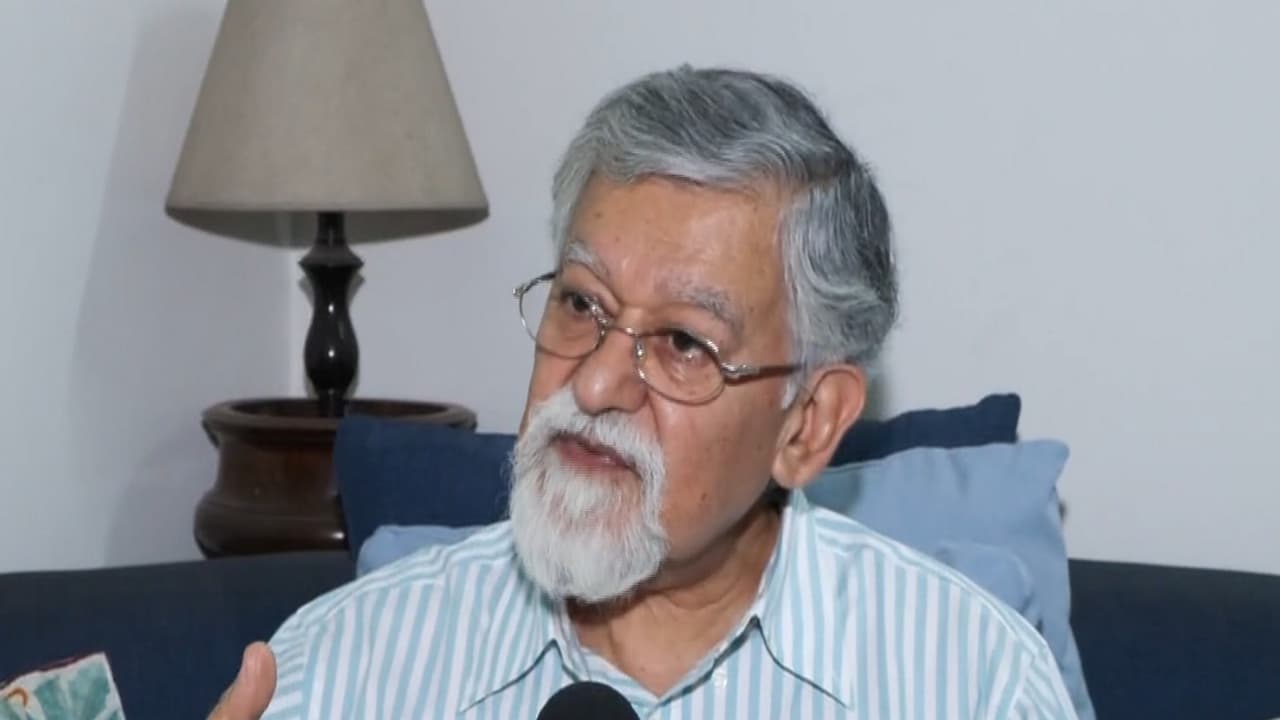
Economist Arvind Virmani says India must reform its tax bureaucracy, streamline clearances, and prioritise FTAs with developed economies to capture global investments shifting from China under the "China-plus-one" strategy.
As global corporations actively diversify their supply chains away from China under the "China-plus-one" strategy, India must aggressively overhaul its tax bureaucracy, streamline single-window clearances, and prioritise Free Trade Agreements (FTAs) with developed economies.
Speaking to ANI, prominent economist and former NITI Aayog member Arvind Virmani, said these structural and external trade reforms are vital for India to successfully capture shifting global investments and overcome domestic bottlenecks.
Overhauling India's Manufacturing for Global Competition
While India has made notable strides via policy shifts and targeted incentives like the Production-Linked Incentive (PLI) scheme, Virmani noted that significant "transition costs" still deter companies from uprooting established bases in China. Historically, Indian manufacturing suffered from a lack of scale. However, Virmani emphasised that competing with China does not require duplicating its massive factory footprints. In economics, a firm only needs to hit a specific threshold to be cost-competitive. If a Chinese factory employs 10,000 workers, an Indian firm can successfully compete with 5,000 employees by scaling efficiently. "You can have two, three factories of five, five... You can compete with that ten," Virmani explained, urging the continuation of the PLI scheme to bridge this gap.
The Production Linked Incentive (PLI) Scheme was launched in 2020 as a strategic reform initiative to strengthen India's manufacturing base, reduce import dependence, enhance global competitiveness and generate employment. The Scheme incentivises incremental production through performance-linked financial incentives, thereby enabling scale, technology adoption and supply chain integration.
Addressing Key Grievances of Foreign Investors
Tax Administration and Procedural Hurdles
Virmani candidly identified the central government's tax administration, encompassing income tax, GST, and tariffs, as the primary grievance for foreign investors. "The foreigner talks to another foreigner who says, "Our case has been going on for twenty years.' That's a big negative. It's a bad signal to people," he said. The problem, he added, stems from the system's tendency to appeal every lost case to a higher level, stretching resolution.
GST also has "identified issues which affect cross-border investment," Virmani said. The problem often isn't the policy itself but the process. "There may be a real issue, but the way it is implemented, the process is wrong. If you can change the process, you can minimise the negative effect."
He attributed these gruelling, decades-long disputes to a systemic bureaucratic tendency to appeal every lost case to higher courts.
Digital Infrastructure Failings
Furthermore, while digital transitions in Special Economic Zones (SEZs) were meant to cut paperwork, system outages during critical export windows leave businesses stranded without alternative channels. "If it doesn't work when you need it, it's no good because the other channel is gone. There is no alternative," he said.
Urgent Reforms Required at the State Level
At the state level, Virmani called for two urgent interventions: Genuine Single-Window Clearances: A few states excel here, but many only claim to have functional single windows on paper, severely hurting their investment inflows. "Where they just say there is a single window, but there isn't, those states don't do well," he said.
Second is addressing legacy image problems. States like Andhra Pradesh and Uttar Pradesh have improved their business environment, but investors may still carry an "old days" perception, he said. "There is also this image problem which has to be addressed."
Virmani advised states to proactively pitch directly to specific multinational companies (MNCs) in targeted sectors, such as electronics. "Define what the sectors are they want, and identify the MNCs. Let's say UP wants electronics companies. Focus on electronics, identify five of them and go individually and say, 'Come and set up. What can we do to facilitate?"
A Strategic Pivot on Free Trade Agreements (FTAs)
Why India Avoided RCEP and Focuses on Developed Nations
Virmani strongly defended India's controversial 2019 decision to opt out of the Regional Comprehensive Economic Partnership (RCEP), despite widespread criticism from fellow economists at the time. He argued that because India's economy directly competes with ASEAN and RCEP nations, acting as a substitute, joining would have flooded domestic markets with competitive goods without offering distinct structural advantages. "Everybody else, my friends included, criticised India for doing this," he said. "But this was the right thing to do."
The reason, Virmani explained, is that India's economy competes directly with most ASEAN and RCEP members. "The Indian economy is a competitor to most of the ASEAN and RCEP states," he said. Signing FTAs with countries that produce the same goods would expose Indian manufacturers to competition without offering clear advantages.
Conversely, he argued India should focus heavily on developed markets like the US, UK, and EU due to deep structural complementarities. Virmani stressed that Free Trade Agreements with developed countries are crucial to making India part of global value chains that are moving out of China. He said, India should "focus on FTAs with developed countries where we are complementary."
The complementarity stems from demography. Developed nations face shrinking workforces, while India's labour force is still growing. "Their demography is negative, ours is positive," Virmani said. In return, high-income countries bring advantages in technology, risk capital, and current market demand.
India's advantage lies in human capital across all skill levels - low-skilled, semi-skilled, and high-skilled labour.
Leveraging FTAs to Attract MNCs
For multinational companies, India offers future demand while developed markets offer current demand. That solves a key challenge for firms relocating under the China-plus-one strategy: minimum efficient scale. "When a company comes to India, they bring their current demand. The market is already there; it's their market. So that MES problem gets taken care of," Virmani said. At the same time, "the future demand is very attractive in India compared to any other country, the most attractive for the future."
Combining India's labour and market potential with the technology and capital of developed-nation MNCs creates an opportunity to build new supply chains. But that ecosystem "takes time," he said, and the government must facilitate the transition. The PLI scheme is one such effort to help firms achieve scale and shift operations.
Delays in FTA Finalisation: A Challenge from Abroad
Because these new FTAs are complementary rather than competitive, Virmani said he sees no major risk to domestic companies, unlike with RCEP-style deals. "I don't see a risk from these new FTAs as there was from the old for the reasons I have just told you. They are complementary versus substitute." The main bottleneck, he said, is no longer on India's side. The Indian government has more flexibility to sign and approve FTAs than the US or Europe, which have "very complicated procedures of approval."
Virmani pointed to the India-EU FTA as an example. After agreement, Europe said the formal legal process may take a year, meaning end-2024. "Now they are saying it may be notified only in 2027," he said. "That is not a problem from our side. That is a problem from their side."
Similar delays have affected the UK and New Zealand agreements. Even though terms were agreed in "one or two months," formalisation has taken much longer. "Unfortunately, it is not in our hands really, but the government is making efforts to convince those people to try and speed it up," Virmani said.
Potential Growth Sectors and Ongoing Negotiations
While Virmani did not list specific sectors, his framework suggests that industries that benefit from technology transfer, global demand, and labour-intensive production stand to gain the most. These include electronics, pharmaceuticals, textiles, auto components, and IT services, sectors where India can pair its workforce with MNC technology and access developed-country markets through tariff-free access. The goal, he said, is to use FTAs to build supply chains that combine comparative advantages: "The comparative advantages of the MNCs from high-income countries and of India."
India has signed or concluded negotiations for multiple major free trade agreements (FTAs), including with the United Kingdom, Oman, New Zealand and the European Union, while negotiations are also underway with countries such as Canada, Israel, Australia, and Peru, as per the Union Commerce Ministry. Negotiations are also underway for FTAs with Peru, Chile, the Eurasian Economic Union (EAEU), Israel and Canada. (ANI)
(Except for the headline, this story has not been edited by Asianet Newsable English staff and is published from a syndicated feed.)