
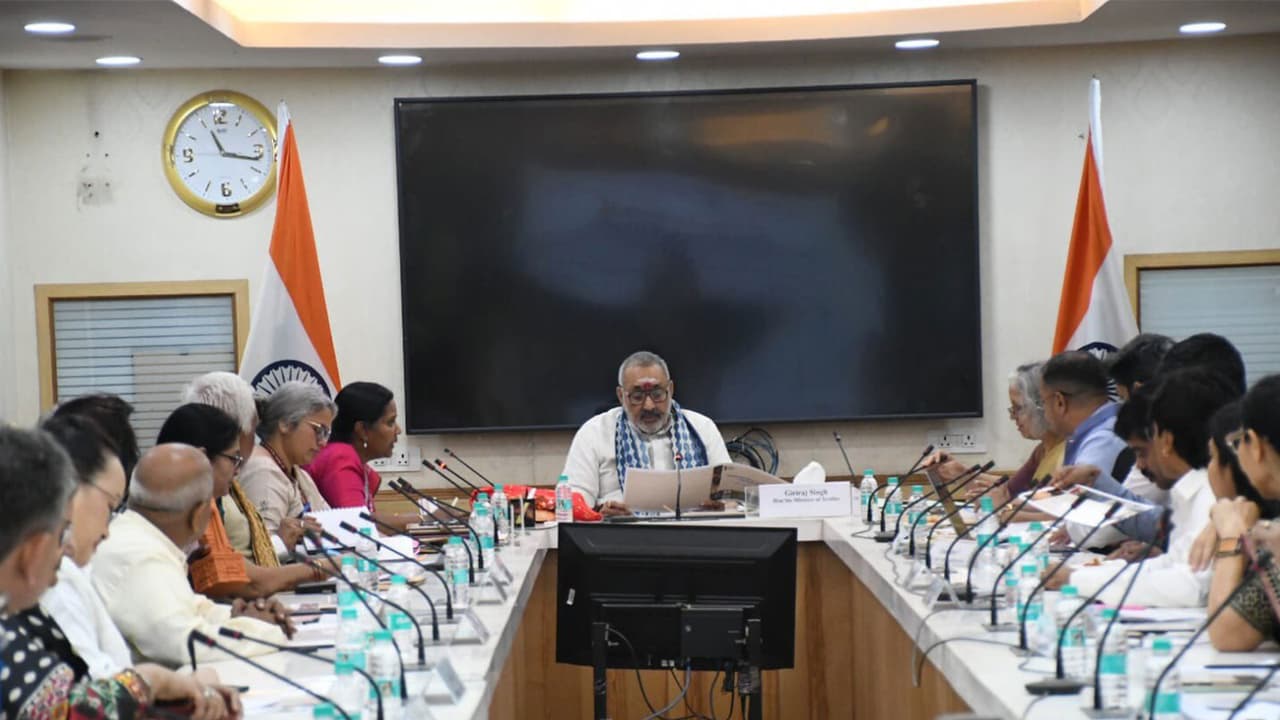
Union Minister Giriraj Singh stated India must shift to higher scale, value, and 12-month garment manufacturing to achieve a USD 350 billion textile economy and expand exports to USD 100 billion by 2030-31, boosting its global trade share.
Union Minister Giriraj Singh stated on Wednesday that India must move towards higher scale, higher value, and 12-month garment manufacturing to achieve a USD 350 billion textile economy. Speaking at a high-level industry interaction in New Delhi, the Minister emphasised that these shifts are essential to expanding exports to USD 100 billion by 2030-31.
As per a press release, the Minister was addressing a high-level industry interaction organised by CII with senior officials from the Ministry of Textiles and leaders from across the textile value chain, today in New Delhi.
Shift to Year-Round Manufacturing
The Minister highlighted a long-term ambition for the sector, noting that India's share in the global textile trade should increase from the present 4.7 per cent to 14.7 per cent. He stressed the necessity of transforming the current garment manufacturing ecosystem, which remains largely oriented toward summer garments. "Currently, much of India's production is oriented towards summer garments, catering to roughly eight months of global demand. Going forward, the industry must expand capabilities to produce garments suitable for all twelve months," Singh said.
He noted that this transition enables India to serve a wider range of international markets and enhance competitiveness.
Focus on Innovation and Sustainability
Singh further identified sustainability and innovation as the primary drivers for the future of the industry. He said that India must diversify into technical textiles, value-added garments and innovative textile products, asserting that the country has strong potential to become a global leader in these segments.
Platform for Global Integration
To strengthen global integration, the Minister pointed toward Bharat Tex, scheduled for July 14-17, as a platform to connect Indian manufacturers with international buyers and investors.
Structural and Raw Material Requirements
Neelam Shami Rao, Secretary, Ministry of Textiles, detailed the structural requirements needed to support this growth. She highlighted the need to "strengthen raw material availability, manufacturing expansion, infrastructure development and market diversification." Rao explained that India's fibre production, currently at 15 million metric tonnes, requires an increase to nearly 23 million metric tonnes, supported by the National Fibre Mission.
Investment and Technology Imperatives
Rohit Kansal, Additional Secretary, Ministry of Textiles, discussed the financial and technological requirements of the transition. He noted that achieving the sector's targets requires "investments of nearly USD 100 billion, particularly in modern machinery and technology." Kansal urged industry stakeholders to increase investments to realise the growth potential of the sector.
Industry Perspective on Scaling Up
Representing the industry, Kulin Lalbhai, Vice Chairman, Arvind Ltd, remarked that the focus must now shift toward building scale in garment manufacturing. He noted that this scale is necessary so that "India is able to meet the rising demand that could emerge as new trade agreements come into effect."
The consultation provided an important platform for industry leaders to share inputs that will help shape upcoming policy initiatives aimed at accelerating the growth of India's textile sector and strengthening its global competitiveness. (ANI)
(Except for the headline, this story has not been edited by Asianet Newsable English staff and is published from a syndicated feed.)