
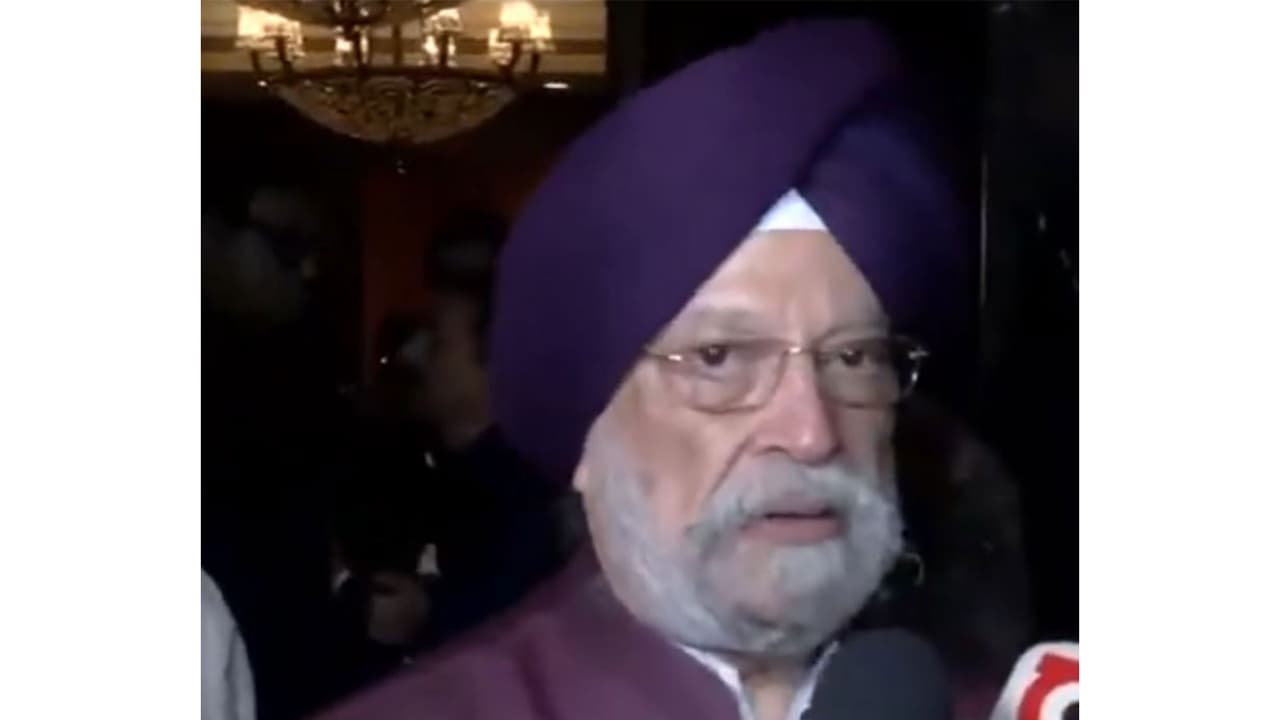
Union Minister Hardeep Singh Puri announced the rollout of 5,200 ethanol dispensing stations in key regions like Delhi-NCR, Mumbai, and Pune. This move aims to support the adoption of flex-fuel vehicles, starting with the launch of a new model.
Ethanol Dispensing Network Expansion
Union Petroleum and Natural Gas Minister Hardeep Singh Puri on Thursday said the government is rolling out around 5,200 ethanol dispensing stations in key regions, including Delhi-NCR, Pune, Mumbai and Nagpur, to support the adoption of flex-fuel vehicles.
Speaking on the sidelines of the launch of the flex-fuel version of Maruti Suzuki WagonR, Puri said earlier efforts to establish E-100 ethanol dispensing stations did not succeed because suitable vehicle models were not available. "There was an attempt earlier to set up a large number of E-100 dispensing stations. But the models were not ready," he said.
The minister said the government is now starting with about 5,200 ethanol dispensing stations and plans to expand the network in phases. "We are starting with about 5200 dispensing stations in the Delhi-NCR region, Pune, Mumbai, Nagpur, etc. This 5200 will hopefully go up to 500 towards the end of 2026, and if this goes as anticipated, then we will go up to 5000 by the end of December 2027," Puri said.
He said wider adoption of flex-fuel vehicles could significantly increase ethanol consumption in the country. "If out of the new vehicles, if 50% are flex-fuel compliant, you'll have another 400 crore litres, or a little less than that, of ethanol that can be utilised...(sic)," he added.
Broader Ecosystem and Agricultural Shift
Puri said the government's broader objective is also to encourage a shift towards less water-intensive crops. "The idea, partly, is to shift from water-intensive crops to maize, which requires less water... So it's an overall ecosystem which is developing..." he said.
Impact on Passenger Vehicle Segment
Addressing the WagonR flex-fuel launch event, the minister highlighted the potential impact of flex-fuel technology in the passenger vehicle segment."Today, India has over 30 crore two wheelers on the roads, but we also have 37 lakh passenger vehicles representing the aspirations of middle-class India, family mobility, and the future of personal transportation," he said.
"When flex fuel technology enters this segment at scale, the impact multiplies dramatically," Puri added.
Strengthening India's Energy Security
The minister also underscored India's energy security efforts, noting that a significant portion of the country's crude oil and LPG imports pass through the Strait of Hormuz.
Puri said India had maintained uninterrupted fuel supplies despite global uncertainties. "In the 93 or 94 days that have elapsed there has not been a single dry out anywhere. There has been no shortage," he said.
He added that domestic LPG production has increased substantially over the years. "We took LPG production, which was at 32,000 metric tons per day. We raised it to 54,000 metric tons. If overall we were consuming 80,000 metric tons a day, and 32 was coming from outside, we were importing 50. Today it's the other way around." Puri said. (ANI)
(Except for the headline, this story has not been edited by Asianet Newsable English staff and is published from a syndicated feed.)