
Global business growth halted in May as the West Asia conflict impacts major economies, reports S&P Global. Europe faces decline, while the US and Japan slow, fueling stagflation fears and pressuring central banks to manage rising inflation.
Global business growth grinds to a halt in May as the conflict in West Asia exerted a growing toll on major economies, according to Flash PMI surveys from S&P Global. The report mentioned that Europe is faced with the most severe impact, with the economies of both the United Kingdom and the eurozone slipping into decline, while expansions in the United States and Japan shifted into lower gears. The report noted that major economies faced stagflationary conditions, creating a significant challenge for central bank policymakers.
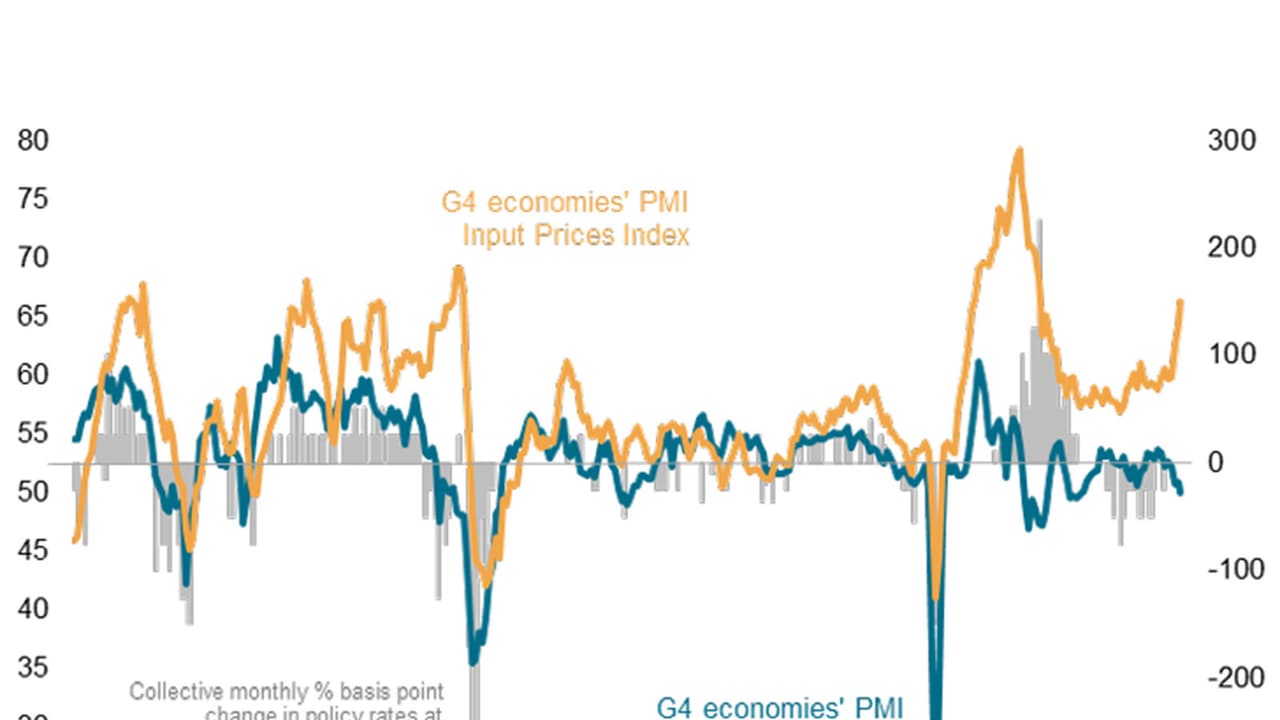
"Services have generally reported the worst deterioration in demand, whereas manufacturers have continued to benefit in May from stockpiling....Manufacturing input price inflation accelerated sharply among the major economies to reach a four-year high, with energy prices also pushing up service inflation," the report said.
The report highlighted that inflation updates for many of the world's largest economies will be in the spotlight in the coming week as policymakers and markets assess the likely next moves in interest rates.
Focus on US Inflation and Fed Policy
After the US consumer price index showed the annual rate of inflation rising to 3.8 per cent in April, its highest since May 2023, the coming week's updated core PCE inflation measure, which is widely touted as the Fed's preferred gauge, will be eagerly awaited. "Kevin Warsh has taken over as Chair of the US Fed's rate setting committee as inflation indicators are flashing red," the report added. As per S&P Global, the CPI index previously rose at a 3.2 per cent annual rate in March, up 0.3 per cent from the prior month.
The report observed that any large uplift would add to market speculation that rates remained on hold for the rest of the year, or that the next move could even be a hike. "S&P Global's flash US PMI survey hinted at yet another rise in price pressure in May as the war triggered more cost growth among businesses," the report stated. With the flash US PMI signaling only modest output growth, the Fed monitored the resilience of the economy amid the conflict. This focus elevated the importance of upcoming US trade data, durable goods orders, and regional survey activity measures from the Chicago, Richmond, and Dallas Feds.
Diverging Pressures in Eurozone and Australia
At the same time, the European Central Bank evaluated regional inflation trends through consumer price indices from Germany, France, and Italy, alongside producer price data from Italy, France, and Spain. "The flash eurozone PMI survey data showed price growth accelerating due to a growing supply shock to the region, but also indicated that the economy has now fallen into a deepening downturn, complicating the policy stance," the report said.
RBA's Rate Hike Dilemma
Similar pressures emerged in Australia, where the reserve bank previously hiked its policy rate at its last three consecutive meetings. The RBA's May meeting concluded with warnings that more rate hikes were likely needed. "However, with PMI data hinting at growing downturn risks for the economy, it will be interesting to see if policymakers move more cautiously," the report added.
Q1 GDP Data and Outlook
The week also featured first-quarter GDP updates for the US, Canada, Brazil, Italy, and Singapore. S&P Global qualified these releases, noting, "in all cases these data are capturing conditions prior to the impact of the war in the Middle East, so hold few signals for the economic outlook."
The report stated that strong first quarters remained important in helping position economies to weather the conflict. (ANI)
(Except for the headline, this story has not been edited by Asianet Newsable English staff and is published from a syndicated feed.)