
Big Tech's AI bill, India's 'AI hedge' rally, and the build-or-rent choice now facing Indian IT
In 2000, America overbuilt fibre-optic cable. The builders lost billions, bandwidth became almost free, and an engineer in Bengaluru became almost as easy to reach as one in Boston. Indian IT spent the next decade growing on that cheap connectivity. However, America is overbuilding again, this time in AI. This results season raised the question that matters most for India: will cheap AI give Indian IT the same break, or the opposite?
In April, JP Morgan downgraded Indian equities, partly because India's large-cap index had "minimal AI, datacenter and semiconductor representation". By September, the same bank was describing India as a natural hedge against AI. In mid-October, the market agreed. As AI stocks sold off from New York to Seoul, the Nifty IT index rose 11.7%, its best week since April 2008, helped by strong results.
Within three weeks, both sides of the AI trade reported: India's IT majors first, then America's four biggest spenders. Together, they showed two industries playing very different games, and an Indian IT sector that had run on the same playbook for two decades now being forced to rethink it.
Related Articles

$202 billion in a quarter: the bill comes due
The American results showed what investors had been running from. Demand for AI is not the problem. Microsoft's Azure grew 48%, with $677 billion of contracts still to deliver. Amazon's AWS backlog reached $578 billion, more than double a year ago. Google Cloud doubled its revenue. Both Microsoft and Amazon say demand still exceeds supply.
The problem is the cost of meeting it. In the July–September quarter, Meta, Alphabet, Microsoft and Amazon together:
- Spent about $202 billion on capex, more than double the $97 billion of a year earlier
- Generated about $176 billion of cash from operations
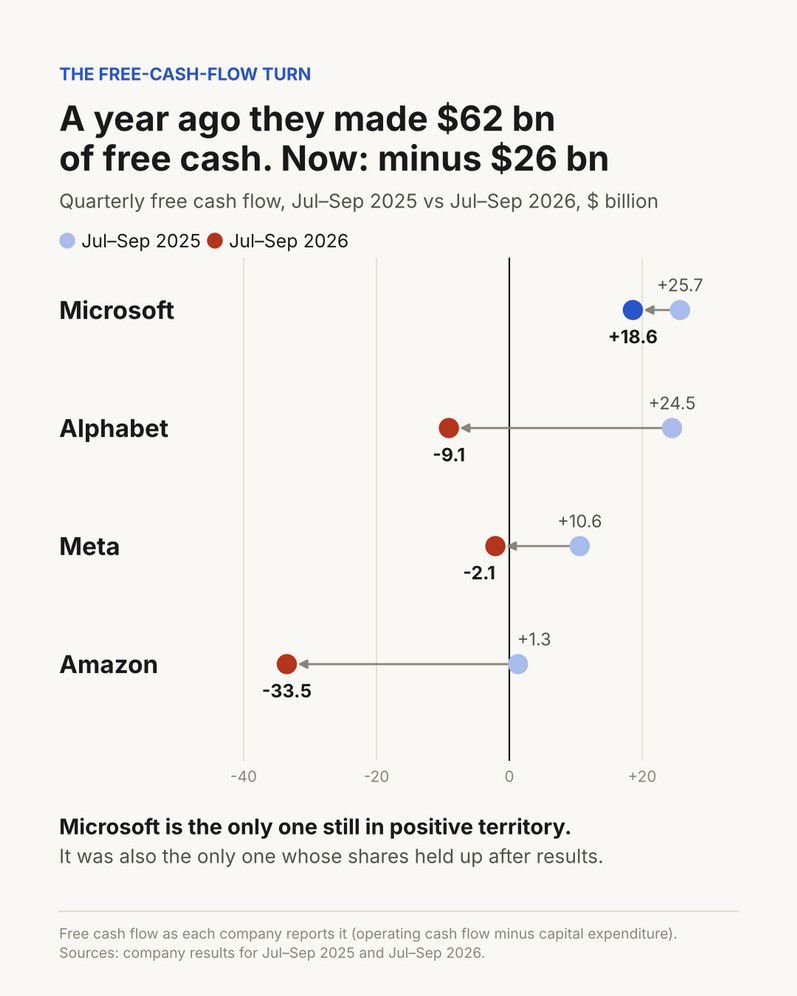
- Produced minus $26 billion of free cash flow, against plus $62 billion a year ago
Investors sold the three that spent more than they generated in cash. Meta fell 7% after its results and Alphabet more than 12%. Amazon fell on Friday, even with AWS growing almost 40%. Microsoft, which spent about $6 billion less than expected and stayed cash-positive, held up.
Alphabet's fall, its worst day since listing in 2004, carried the sharper message. Search, the business that pays for its AI, grew 12% against the 15% analysts expected, and the worry is that AI answers could erode the very search ads that fund the spending. For a CFO, the test is not the size of the capex but the strength of the cash engine behind it.
By Friday, 30 October, the message had spread across the market. The S&P 500's technology sector fell almost 5% in a day, while consumer staples and energy rose. Investors were paying for cash flow and selling cash burn.
For three years the market rewarded whoever spent the most on AI. In October, it started rewarding restraint.
Same boom, different ending?
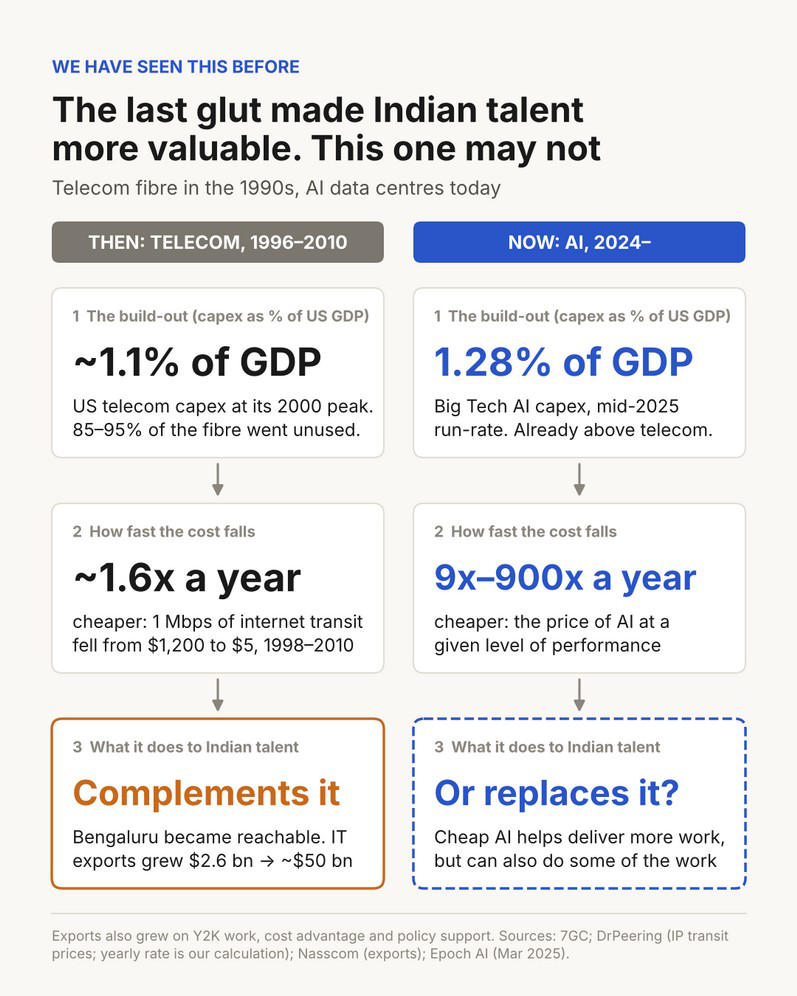
The numbers make the parallel hard to ignore. US telecom capex peaked at about 1.1% of GDP in 2000; Big Tech's AI capex had already passed that by mid-2025. Bandwidth then got cheaper by roughly 1.6 times a year. The price of AI at a given level of performance is falling between 9 and 900 times a year.
The outcome is where the analogy breaks. Cheap bandwidth complemented Indian talent, and the industry's exports grew from $2.6 billion in FY99 to about $50 billion by FY10. Cheap AI can complement that talent, but it can also replace some of it. That makes this cycle much harder to call for India.
That risk is no longer theoretical. On the same Friday, Reddit beat analysts' estimates and still lost 29% of its value in a day, on a warning that Google's AI search is squeezing its traffic. In the same week, Google's own search business, the one that pays for its AI, slowed. AI is reshaping the businesses that sit next to it, including the one funding it. Indian IT sits next to it too.
The plumbers of the AI boom
India's IT majors do not build the AI factories. They help clients use them. JP Morgan calls them "the plumbers of the technology world", and the September quarter showed the plumbing work is real. AI now accounts for over 10% of revenue at TCS ($3.1 billion annualised) and 10.5% at Infosys, and HCLTech's advanced-AI revenue grew 78%.
For two decades, Indian IT ran on a simple playbook: add people, add revenue. Clients owned the servers, the Indian firms supplied the expertise, and they generated cash rather than consumed it. AI is the first thing to seriously break that link. On the surface, that made October's rally logical: the Americans spend first and hope the returns follow, while the Indians collect fees and leave the capital risk to someone else.
Why the hedge may not hold
Plumbers get paid when someone is building. They get paid less when the work gets easier. Three pressures are now visible:
1. The work depends on Big Tech continuing to spend. If investors force a slowdown, the projects built on these platforms slow too.
2. AI is making the old work cheaper. Constellation Research estimates revenue per unit of work is falling 5–15% where AI speeds up delivery. Infosys has cut its full-year growth guidance to 1–2%, and Wipro's large-deal bookings fell almost 60%.
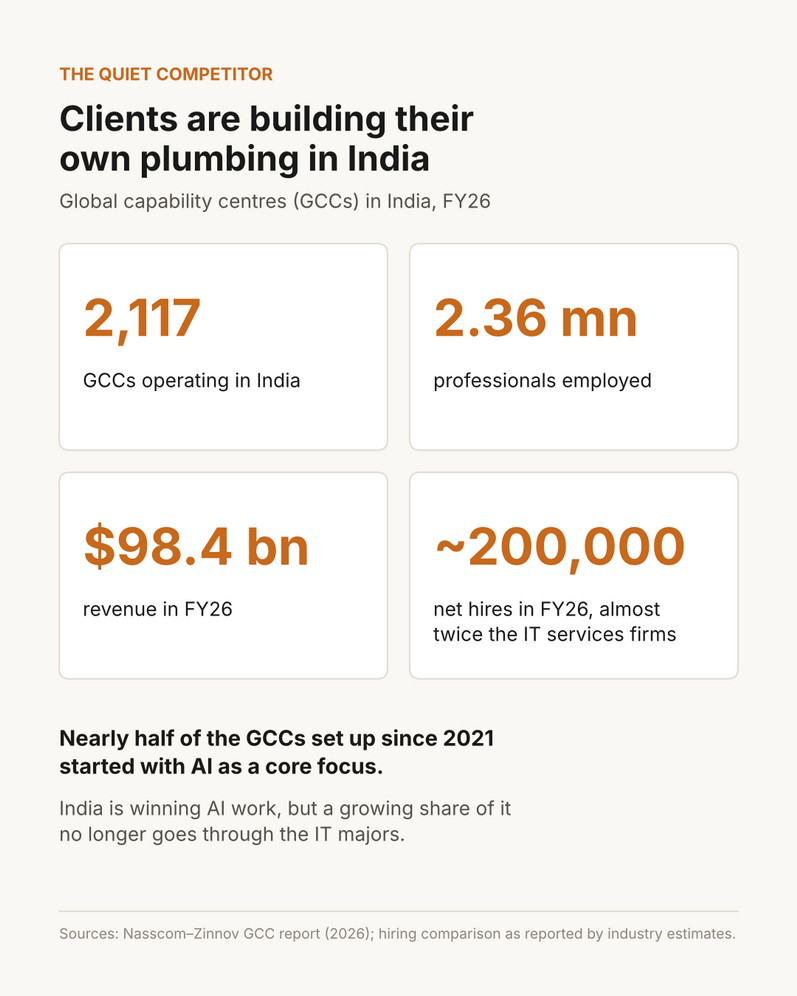
3. Clients are building their own capability in India. India now has 2,117 global capability centres employing 2.36 million people, according to Nasscom and Zinnov. By one industry estimate, they added almost twice as many people as the IT services firms last year. India is winning AI work, but a growing share of it bypasses the IT majors
TCS builds, but splits the bill
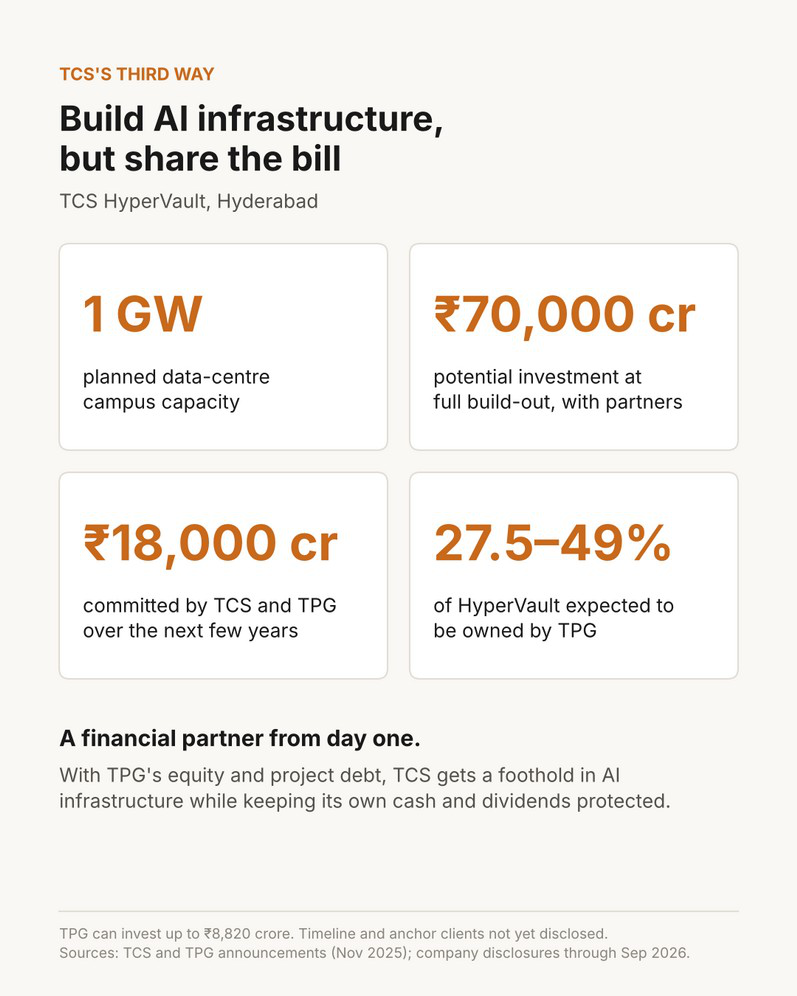
TCS has chosen not to wait. Its data-centre unit, HyperVault, plans a campus of up to 1 GW in Hyderabad, with up to ₹70,000 crore of investment at full build-out. But TPG can take up to 49% of the business, and debt will fund part of the rest.
That is a CFO's answer to an uncertain bet: take the option, share the bill. TCS gets a foothold in AI infrastructure without putting its balance sheet or its dividend record on the line. It has applied the lesson Wall Street taught Big Tech in October before being forced to learn it.
Rent the talent, or own the compute?
The easy reading of October is that India is the AI hedge, the place to hide when the AI trade wobbles. The more useful reading is that both models are under test.
• The American companies are betting that owning the infrastructure will let them capture most of the value, even if it costs them their free cash flow for a few years.
• India's IT companies are betting that the value will sit with whoever helps businesses actually use AI, and that they can grow that business faster than AI shrinks the old one. Only one of these bets can be fully right.
If AI becomes a utility, with cheap and abundant computing, the owners of the infrastructure will struggle to earn back what they have spent, and the integrators will win. If AI concentrates power and pricing in a few platforms, the integrators risk becoming subcontractors on thinner margins. TCS has already decided not to wait and find out.
Whether the rest of the industry follows will say a lot about where India expects to sit in the AI economy: renting out its talent to the companies that own the compute, or owning some of that compute itself. Last time, India rented its talent to the builders and won. This time, it may need to own a piece of what is being built.
Disclaimer: Figures are from company results for the July–September 2026 quarter unless stated otherwise. Capex is the cash each company spent on property and equipment, on the same basis it uses for free cash flow, so that operating cash flow minus capex equals free cash flow.
Sources: Company results and earnings calls for Jul–Sep 2026; JP Morgan notes (Feb, Apr, Sep 2026), as reported; NSE; 7GC; DrPeering; Nasscom; Epoch AI (Mar 2025); Nasscom–Zinnov GCC report (2026); Constellation Research, as reported; TCS/TPG HyperVault disclosures; Fortune (Alphabet, 29 Oct 2026); Reuters (Reddit, 30 Oct 2026); US market closing data for 30 Oct 2026