
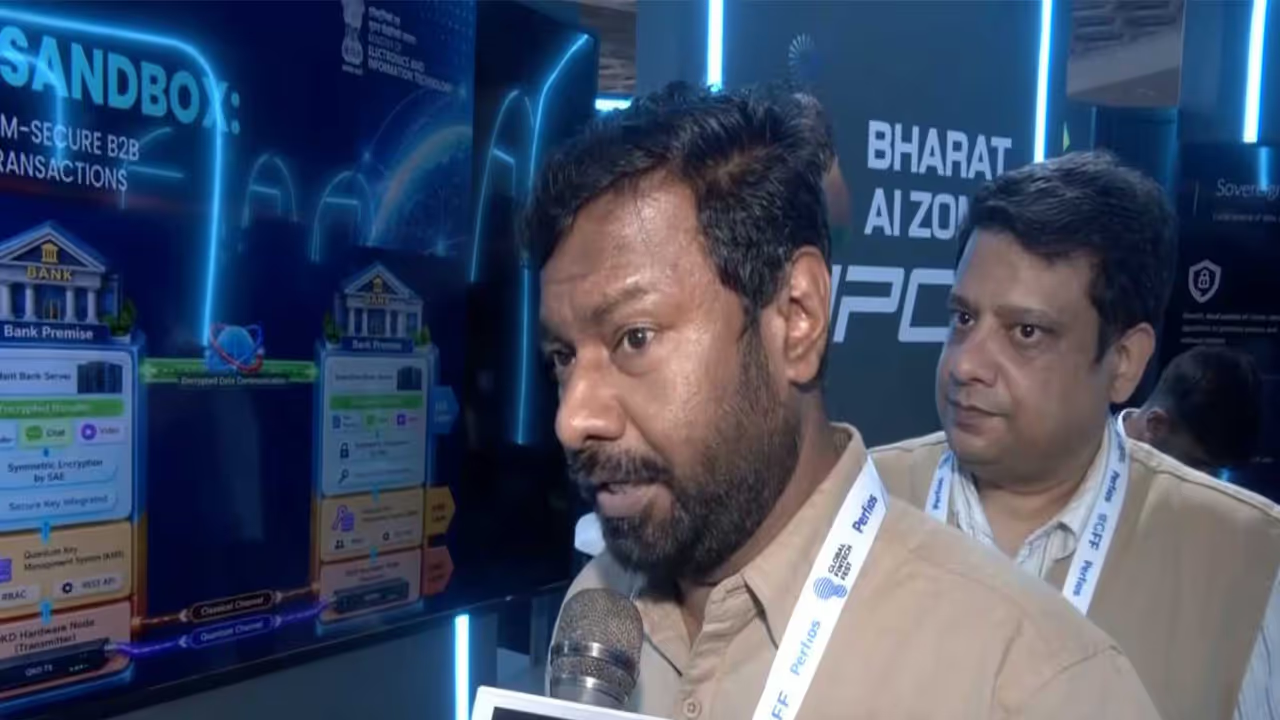
The Centre for Development of Advanced Computing (C-DAC) is developing quantum key distribution technology to enable highly secure bank-to-bank transactions, a system C-DAC scientist Deepu CV calls the 'future of communication' for the sector.
C-DAC's Quantum Leap in Banking Security
The Centre for Development of Advanced Computing (C-DAC) is working on quantum key distribution technology that could be used to provide highly secure communication for bank-to-bank transactions, C-DAC Scientist Deepu CV said on Thursday. Speaking to ANI on the sidelines of the Global Fintech Fest (GFF) 2026 in Mumbai, Deepu said C-DAC has taken up a number of projects in quantum technologies, including quantum key distribution, as it expands its research beyond advanced computing. “Speaking about quantum key distribution, this is the future of communication in which highly secured transactions between banks can happen,” he said. Deepu said C-DAC has developed a quantum key distribution sandbox aimed at demonstrating quantum-secure transactions between banks. “This is actually a quantum key distribution sandbox which is for quantum secure transaction between bank to bank,” he said.
How the System Secures Transactions
Explaining the system, Deepu said a quantum key generated at one bank can be shared with another bank for securing communication between the two entities, with encryption at both ends. “There is a quantum key which is generated in one bank receiver and which has been given to the other bank. Both sides encryption will be there,” he said.
Understanding Quantum Technology and QKD
Quantum technology uses principles of quantum mechanics, the branch of physics that describes the behaviour of matter and energy at extremely small scales. Quantum computing uses these principles to process certain types of calculations differently from conventional computers. Quantum key distribution, or QKD, is a related but distinct quantum technology. It uses quantum properties to allow two parties to establish encryption keys in a way designed to make attempts to intercept the key detectable. This makes the technology relevant for sectors such as banking and financial services, where highly secure communication is important.
C-DAC's Role and Technology Transfer
Deepu said C-DAC acts primarily as a research and technology provider rather than directly working on consumer-facing payment systems such as the Unified Payments Interface (UPI). “We do the back-end kind of thing. So we are the technology providers. Being an R&D company, we develop the technology and give it to the industry as a TOT kind of thing,” he said. TOT refers to transfer of technology, under which technologies developed by research institutions are transferred to industry for deployment and commercial use.
Challenges and Opportunities
He added that the emerging technology still faces challenges, including the limited number of players operating in the field and the high security requirements of banking transactions. “There are quite a few challenges because this is a new technology coming in this area,” Deepu said, adding that banking transactions require a high level of security. C-DAC functions under the Ministry of Electronics and Information Technology and works in areas including high-performance computing and advanced digital technologies. Deepu said the presence of banks, non-banking financial companies and other financial-sector participants at GFF could also provide opportunities for technology transfer, industry interaction and feedback on emerging technologies.
(Except for the headline, this story has not been edited by Asianetnews Editorial staff and is published from a syndicated feed.)