
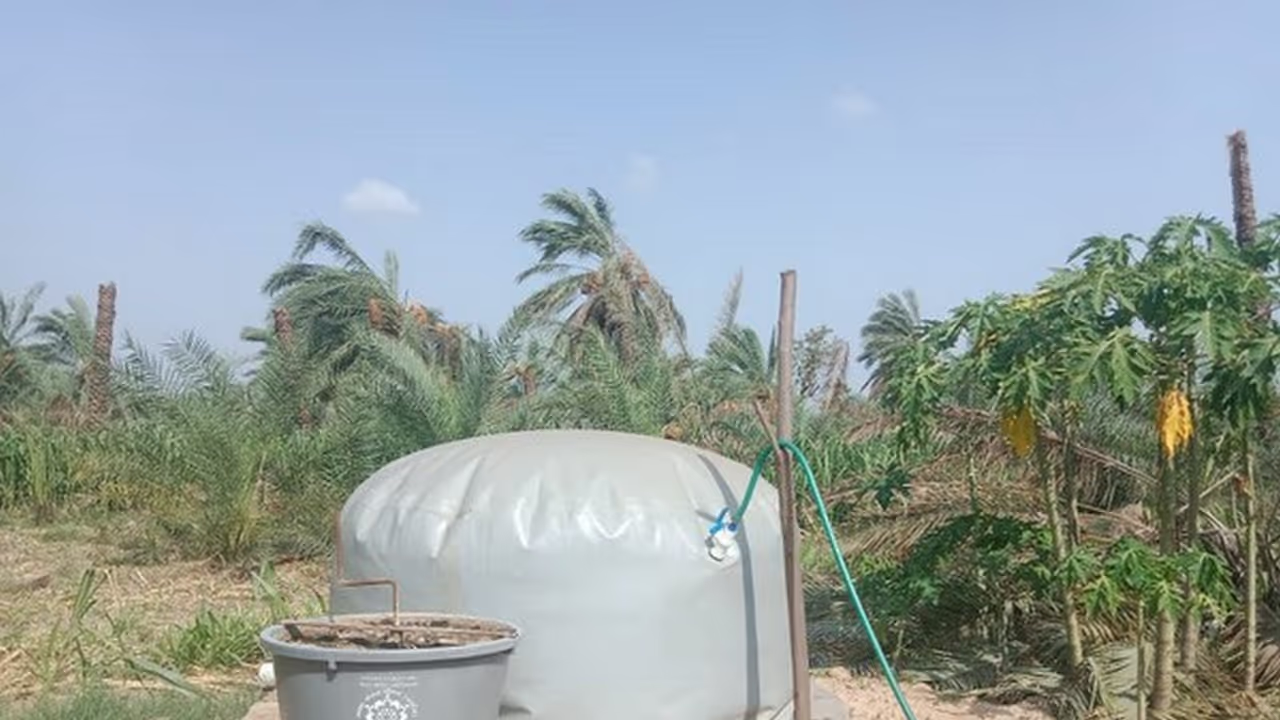
India's bio-CNG industry is calling for assured long-term offtake, consistent policy support, and faster approvals to make decentralised plants bankable, which leaders say is critical for accelerating the country's clean-energy transition.
India's bio-CNG industry is calling for assured long-term offtake arrangements, consistent policy support and faster approvals to scale decentralised plants nationwide, as these measures are critical to making projects bankable and accelerating the clean-energy transition.
Making Bio-CNG Projects Bankable
"Policy support, assured offtake, carbon credits, and ESG-linked financing remain critical to making bio-CNG projects bankable," KL Bansal, Chairman and Managing Director at DEE Development Engineers, said.
Bansal said decentralised bio-CNG can scale sustainably only if backed by robust feedstock supply chains, assured long-term offtake and strong execution, pointing to India's biomass power sector as a proven model where decentralised agricultural waste sourcing and stable offtake enabled reliable operations over time.
He added that policy support, carbon credits, and ESG-linked financing are important for bankability, but stressed that plant reliability and execution quality will ultimately determine long-term viability, especially as bio-CNG continues to play a role in hard-to-electrify sectors such as heavy transport and industry.
"India has a robust proof of concept in the biomass power segment, in which the country has been able to utilise agricultural waste for the production of power through the use of long-term PPAs, having the ability to integrate with the national power grid and decentralised feedstock sourcing for an extended period of time," Bansal said.
Boosting Circular Economy and Air Quality
Utkarsh Gupta, Founder and Chief Executive Officer of Gruner Renewables, said decentralised green CNG plants directly support India's circular economy goals.
"Green CNG plants play a critical role in India's clean-energy transition by closing the loop between waste management, energy generation, and agriculture," he said. "They convert agricultural residue, organic waste, and manure into clean transport fuel, transforming what were traditionally environmental liabilities into productive assets."
Gupta said decentralised deployment could also deliver measurable air-quality gains, especially in pollution-hit regions.
"Large-scale adoption of bio-CNG can have a direct and measurable impact on air quality, especially in regions such as Delhi-NCR," he said, adding that it helps curb the open burning of agricultural and organic waste. "The presence of distributed plants near consumption centres also lowers emissions associated with long-haul fuel transportation," he said.
Overcoming Feedstock and Logistical Hurdles
However, both executives said feedstock availability and logistics remain key challenges as the sector scales. Gupta pointed to Napier grass as a viable solution for decentralised plants.
"Napier grass is commercially viable due to its extremely high biomass yield per acre, with the ability to support multiple harvests annually," he said, adding that it "offers reliable, year-round feedstock availability."
To manage risks, Gupta said Gruner relies on multiple feedstock streams. "Gruner follows a diversified feedstock sourcing strategy, incorporating Napier grass, agricultural residue, press mud, and organic municipal waste," he said.
Digital aggregation is also central to sustaining decentralised operations. "Through Kisani Urjaa, Gruner enables tech-led, last-mile feedstock aggregation by digitally onboarding farmers and institutions, establishing structured contracts, forecasting demand, and coordinating logistics," Gupta said.
They said faster approvals and policy consistency would accelerate deployment. "The sector would benefit from quicker project approvals through single-window systems, more consistent incentives across states, and smoother feedstock movement and logistics," Gupta said.
Future Role in Energy Mix
While electric mobility and green hydrogen are gaining momentum, Bansal said bio-CNG would remain relevant. "Bio-CNG will continue to play a vital role in hard-to-electrify segments such as heavy transport, construction equipment, and industrial applications," he said.
(ANI)
(Except for the headline, this story has not been edited by Asianet Newsable English staff and is published from a syndicated feed.)