
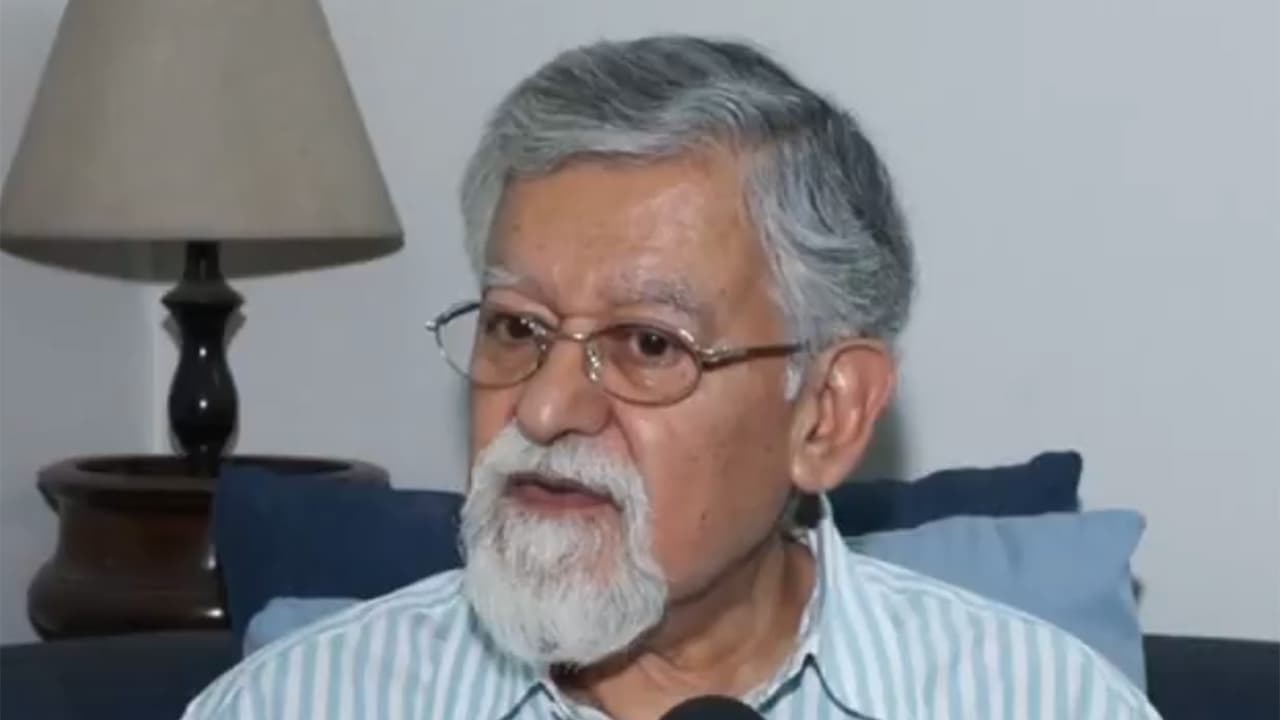
Amid West Asia tensions, former NITI Aayog member Arvind Virmani advises a two-pronged strategy: a gradual pass-through of rising oil/gas prices and aggressively accelerating long-term reforms in solar, storage, and distribution networks.
Former NITI Aayog member Arvind Virmani on Sunday outlined a strategic roadmap as escalating geopolitical tensions in West Asia disrupt global supply chains and drive up energy costs. Speaking with ANI, Virmani suggested navigating this crisis by adopting a two-pronged strategy by implementing a gradual pass-through of rising oil and gas prices in the immediate term, while aggressively accelerating long-term structural reforms across its solar, storage, and distribution networks.
Warning that the macroeconomic impact of the West Asian conflict is already registering across the Indian economy, Virmani said, "India imports 70 to 80 per cent of its oil and gas. The price increase has already taken place to the extent that war has disrupted logistics through the Gulf and also production facilities." Because India relies on imports for 70 to 80 per cent of its oil and gas requirements, supply-chain bottlenecks in the Gulf and disruptions to production facilities have immediately inflated the nation's import bill. According to Virmani, this hit to national income is already a reality.
Short-Term Strategy: Managing Price Pass-Through
The critical policy challenge now lies in how the government distributes these elevated costs across the economy. Virmani identified three core levers for managing the price. "There are three elements to pass-through, and that is the choice the government makes. First, how much do oil companies absorb the price increase instead of passing it on fully or partially? Second, how much does the government absorb, either through excise reduction or other means? And finally, what is passed through to consumers," Virmani said. Consumers, he said, include industry as well as households.
Logistics disruptions have already pushed up global prices of key inputs like sulphur, polypropylene and fertiliser. "World prices are up. For fertiliser, the government is involved, so the subsidy will automatically go up and that will affect the fiscal," he said.
Given the uncertainty, Virmani said the best approach is a gradual increase in domestic oil and gas prices as more information comes in. "Some of the oil prices have gone up. The earlier WPI showed that sulphur-related items had gone up. So that is the process of gradual pass-through," he said.
Long-Term Vision: Accelerating Energy Reforms
For the medium to long term, Virmani said India must incentivise alternative energy sources, with solar as the biggest opportunity. While government policies, PLI schemes and the EV push have helped, "more remains to be done," he said. "In the short term, I think a gradual rise of particularly oil and gas prices is necessary, so it gives the right signals to industry because they have to adapt, they have to find alternative sources, they have to minimise the use, etc. In the longer term, I think the real issue is to incentivise alternative sources of energy. Solar is a big opportunity in India. Of course, the government and the public have been doing a lot on that, but there is more to be done. Partly because we have a market system, we have given incentives for PLI, EVs, etc., but more remains," he said.
Incentivising Solar Adoption and Storage
He highlighted time-of-day pricing as the most critical reform for solar adoption. "Production of solar occurs in the middle of the day when there's a lot of sunlight. But much of the use is focused on the evening when the sun goes down. Time-of-day pricing incentivises adjustment, particularly by industry, to shift production away from peak-demand hours when prices are high," Virmani explained. This must be paired with accelerated investment in storage, he said. "Much of the production occurs mid-day, so you have to store it if you want to use it in the evening or morning. Storage is very important."
In April, Union Minister for New and Renewable Energy and Consumer Affairs, Food and Public Distribution, Pralhad Joshi, stated that India ranks third globally in Renewable Energy Installed Capacity, according to the Renewable Energy Statistics 2026. He said India has moved ahead of Brazil in the ranking. The International Renewable Energy Agency released the statistics as of December 2025.
Distributed Renewable Energy (DRE) from Solar has emerged as a significant component of this growth, contributing 16.3 GW (36%) out of the 44.61 GW installed during 2025-26. This includes 7.6 GW under PM KUSUM and 8.7 GW from rooftop solar.
According to the Ministry, India crossed the 150 GW milestone with a cumulative installed solar capacity of 150.26 GW as on March 31, 2026. 150.26 GW includes 110.43 GW of Utility scale, 25.73 GW of Roof top and 14.10 GW of KUSUM & off-grid projects.
Urgent Need for Distribution System Reform
Virmani also called for urgent reform of the electricity distribution system to handle solar power and new loads like induction cooking and EV charging. Citing cases abroad where distribution networks collapsed under sudden demand spikes, he said reforms must be coordinated rather than done through isolated incentives.
He pointed to Andhra Pradesh as a "ray of hope" after the state freed up its distribution system. "They are saying anybody who wants to set up a data centre is free to generate their own electricity and distribute or not distribute. Freeing up the distribution system can have great efficiency effects," he said.
The Government of Andhra Pradesh has introduced a free electricity program for handloom and power loom weavers. Through this initiative, handloom units receive up to 200 units of electricity free every month, while power loom units are provided 500 free units monthly at no charge. Around 93,000 handloom weavers and 11,488 power loom weavers are expected to benefit directly from the scheme. To support the program, the government plans to allocate nearly Rs 150 crore each year.
"These are some of the things we have to do in a coordinated manner now, rather than just giving individual incentives and letting it happen," Virmani added.
(Except for the headline, this story has not been edited by Asianet Newsable English staff and is published from a syndicated feed.)