
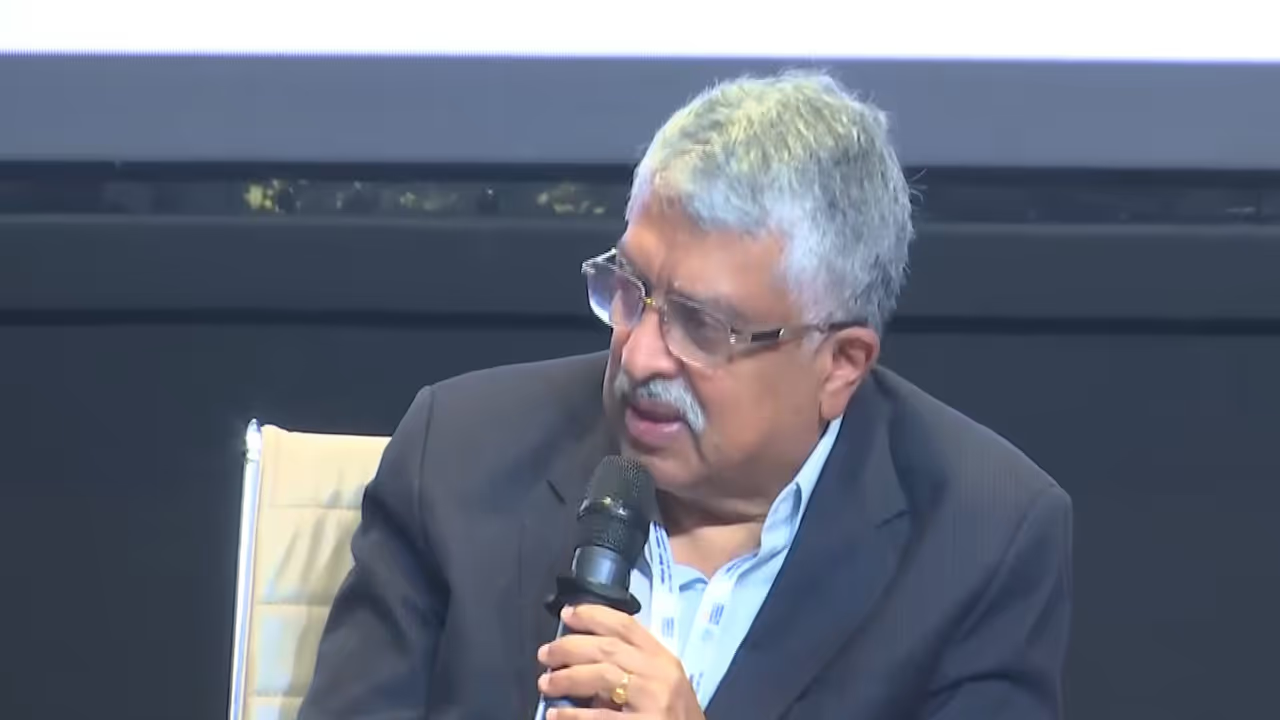
Infosys co-founder Nandan Nilekani states AI agents on open networks are crucial for societal change. He stresses removing language barriers and lowering AI inference costs for mass adoption, citing India's UPI as a successful model.
Artificial Intelligence serves as a fundamental construct for large-scale societal transformation when integrated with open networks and decentralised ecosystems. Speaking at a panel during the India AI Summit 2026 in Delhi, Nandan Nilekani, Infosys co-founder, emphasised that the convergence of AI agents and open architectures is the fastest way to diffuse technology productively to improve lives.
"So if a user is there who is a farmer or somebody who is producing a little bit of electricity, if they can very easily transact with somebody else through an agent, which is in their own language, then suddenly this is inclusion at a massive scale. So I really see AI agents on an open network as the fundamental construct for massive diffusion of technology," he said.
India's Open Network Blueprint
Nilekani noted that India's experience with open networks, such as the Unified Payments Interface (UPI), provides a proven blueprint for growth. He stated that these principles are now embedded in newer systems like Beckn. "Open networks allow many actors and innovators to build applications on the edge using AI," Nilekani said.
Simplifying Technology and Removing Language Barriers
He identified the primary power of AI agents as their ability to remove complexity for the end user, particularly in sectors like agriculture and energy. The removal of language barriers is a critical component of this technological diffusion.
Nilekani highlighted several Indian initiatives, including Bhasini and AI for Bharat, which aim to make technology accessible in local languages and dialects. "There are many initiatives, Voice AI, there's a Bhasini of the government, there's AI for Bharat, there's the Google project. Language as a barrier will go away. So if you combine language, so a person talks to the agent in their own language, and then the agent does some transaction while hiding all the complexity behind it, then that's the holy grail," he added.
The Economic Imperative: Reducing AI Costs
Addressing the economic viability of these systems, Nilekani stressed the necessity of reducing the cost of AI inference. He argued that for AI to work for the masses in the Global South, the cost per query must drop significantly. "Broadly speaking, I think, especially in the global south, the cost of AI inference has to drop dramatically because if you're serving a customer with one query and that costs Rs 500 or something. It's not going to work"
He explained that while the current industry focus remains on training larger models, the shift must eventually move toward making inference cheaper to ensure widespread adoption. "Low-cost inference combined with agents that hide complexity is the key to massive diffusion," Nilekani said.
'Plug-and-Play' Capability for Societal Impact
He illustrated this with the example of AgriConnect, an open network for farmers. By plugging advanced weather models into such a network, millions of farmers instantly gain access to granular, predictive data. This "plug-and-play" capability of open networks allows for the rapid integration of new AI sources and capabilities to solve pressing societal challenges. (ANI)
(Except for the headline, this story has not been edited by Asianet Newsable English staff and is published from a syndicated feed.)