Manipal Hospital’s Two-Wheeler Emergency Team Takes on Bengaluru Traffic to Reach Patients in Time
Synopsis
As Bengaluru’s traffic creates challenges for emergency responders, Manipal Hospital’s first responders are using two-wheelers to navigate congested roads and reach patients faster when every second matters.
Bengaluru, October 01, 2026: Waiting at a traffic light during a medical emergency is every patient’s worst nightmare, and Bengaluru’s kilometre-long traffic congestion is turning it into a daily reality. During a medical crisis, even a single minute can make a life-changing difference. Keeping this in mind, Manipal Hospitals has introduced Emergency First Responders on Two Wheels, allowing first responders to reach areas of the city with narrow roads or heavy traffic that are often inaccessible to conventional ambulances.
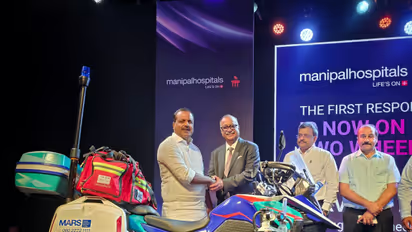
The initiative was unveiled by Shri U.T. Khader, Minister for Health and Family Welfare, Government of Karnataka; Shri C. Mallikarjun, Additional Commissioner, Department of Transport, Government of Karnataka; Shri Gyanendra Kumar, Additional Commissioner, Department of Transport, Government of Karnataka; and Dr. H. Sudarshan Ballal, Chairman, Manipal Hospitals. The Health Minister also formally flagged off the First Responder Bike Ambulances, marking the official launch of the service.
Bengaluru’s pothole-ridden streets and heavy traffic make it one of the most accident-prone cities in the country. This makes the safety of emergency responders just as important as that of the patients they serve. To ensure rapid response times across Bengaluru, these bike ambulances are deployed across major high-traffic zones such as Old Airport Road, Indiranagar, Domlur, Halasuru, Hebbal, RT Nagar, Nagawara, Whitefield, Varthur, Marathahalli, Sarjapur Road, Yeshwanthpur, Rajajinagar, Malleshwaram, Vasanth Nagar, Yelahanka, and Hennur.
Designed for quick access during emergencies, these bikes are equipped with life-saving equipment, first-aid kits, portable oxygen cylinders, trauma supplies, and advanced portable medical devices like portable ECGs and Automated External Defibrillators (AEDs). A compact medical storage compartment is mounted at the rear, with oxygen cylinders and fire extinguishers placed on the sides, while front siren and beacon lights help clear traffic.
Both the motorcyclist and pillion are provided special safety helmets with inbuilt microphones that allow them to stay in constant contact with patients, ambulance staff and hospital emergency teams. To maximise visibility, pillion riders carry reflective emergency backpacks that help them safely manoeuvre through busy streets, especially at night.
When an emergency call is received at the helpline (080-22221111), the emergency room doctor and command centre assess the situation and dispatch the nearest bike ambulance along with a regular ambulance. The bike paramedic reaches the scene first, assesses the patient, initiates immediate care, and relays real-time health data to the hospital. Once the regular ambulance arrives, the patient is safely handed over for hospital transport.
Speaking at the event, Shri U.T. Khader, Minister for Health and Family Welfare, Government of Karnataka, said “Bike ambulances and first responder systems are crucial for providing timely emergency medical assistance in congested cities, where even a few minutes’ delay can be critical. I appreciate Manipal Hospitals for launching the First Responder Bike Ambulance service, which will help ensure that emergency care reaches patients without delay and can save lives.”
He added, “I believe this initiative can serve as a model for other hospitals to adopt similar services. Whether government or private, providing quality healthcare to people should remain the priority.”
Dr. H. Sudarshan Ballal, Chairman, Manipal Hospitals, noted, “In emergency care, every minute counts. In a city like Bengaluru, where traffic congestion can delay conventional ambulances, response times can stretch from 20–30 minutes to even longer during severe congestion. Such delays can have critical consequences for patients. The Manipal First Responder Service has been introduced to bridge this crucial gap, enabling trained responders to reach patients in around 10 minutes, initiate essential emergency care, and provide timely assistance while the ambulance is on its way. Our objective is simple: to ensure that traffic does not stand in the way of saving a life.”
With this purpose-driven initiative, Manipal Hospitals continues to redefine urban emergency response, ensuring that expert medical care is never stuck in traffic.
Explore the latest Lifestyle NewsFood and RecipesHealth NewsAsianet News Official App