From Chips To 6G: How PM Modi's Red Fort Speech Set India's Tech Agenda
Synopsis
India has entered a new phase of semiconductor manufacturing, with Prime Minister Narendra Modi saying three plants have started production and five to eight more could come up over the next seven to eight years. Government is seeking greater chip-making capacity and technological self-reliance.
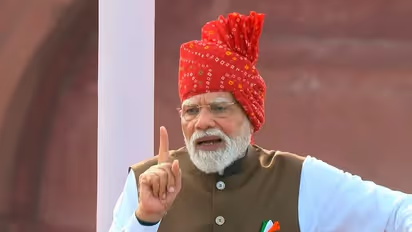
Prime Minister Narendra Modi on Saturday said India has entered a new phase in semiconductor manufacturing, with three plants already producing chips and more facilities expected to come up over the next seven to eight years. His announcement, made from the Red Fort on Independence Day, underlined the government's push to reduce India's dependence on imported technology and build a stronger domestic electronics industry.
Three semiconductor plants are now producing
PM Modi said three semiconductor plants have already started production and that exports have begun from the facilities. He added that India could see another five to eight plants becoming operational in the coming years.
Three companies, Micron, Kaynes and CG Semi, have already started commercial production under the government's semiconductor programme. Another company is expected to begin operations in 2026.
A Viksit Bharat must also be an Aatmanirbhar Bharat.
Lasting strength comes from building our own capabilities. This is the conviction behind ‘Make in India’ and Vocal for Local.
The transformation is already visible. India is developing an entire semiconductor manufacturing… pic.twitter.com/UhOh8dcjQ1— Narendra Modi (@narendramodi) August 15, 2026
The development marks an important shift for India. For years, the country discussed the need to manufacture semiconductors domestically, but lacked large-scale facilities capable of producing them. The government now wants India to become an important part of the global semiconductor supply chain.
What is the Semicon India Programme?
The government approved the Semicon India Programme, also known as Semicon 1.0, in December 2021 with an outlay of Rs 76,000 crore. Its main objective was to create a semiconductor and display manufacturing ecosystem in India.
Under the programme, 12 semiconductor projects have been approved across six states. Together, they represent investment commitments of more than Rs 1.64 lakh crore.
The three plants that have started commercial production are part of this broader effort. The government expects these projects to create manufacturing capacity and strengthen supporting industries, supply chains and technical skills.
In July 2026, the government approved Semicon 2.0 with a much larger outlay of Rs 1,27,500 crore. The programme is designed not only to support chip manufacturing but also semiconductor intellectual property, chip design and system design.
'We Were Friends Before We Were Sisters': DNA Test Reunites Indian-Born Women
Why are semiconductors significant?
Semiconductors are at the heart of almost every modern technology. They are used in smartphones, computers, vehicles, medical equipment, communication systems and industrial machinery.
A stronger domestic semiconductor industry therefore has implications far beyond chip factories. It can help India improve supply-chain security, reduce exposure to global shortages and strengthen its position as companies look for manufacturing bases outside traditional hubs.
Modi said India must focus on quality and become a trusted partner in global supply chains. This is particularly important as countries and companies seek more diversified and reliable sources for critical technology.
Not Originally Indian? The 1,000-Year Middle Eastern Journey of Your Favourite Crispy Jalebi
Electronics and mobile manufacturing have expanded
India's semiconductor push is part of a wider expansion in electronics manufacturing. Modi said electronic manufacturing has increased sevenfold, while mobile phone production has risen 33 times.
The Production Linked Incentive scheme for Large Scale Electronics Manufacturing has attracted around Rs 96,000 crore in the mobile phone segment. Companies including Apple, Google and Foxconn have expanded mobile phone production in India.
Smartphones became India's biggest individual exported commodity in financial year 2025-26, overtaking petroleum, gems and jewellery, according to official data.
The government also approved a Rs 62,500-crore mobile phone manufacturing scheme in July. It aims to increase production, raise domestic value addition and make supply chains more resilient.
'New APJ Abdul Kalam': Young Inventor Levin Paulose Creates Clever Home Gadgets, Wins Praise (WATCH)
From chips to artificial intelligence
The government's technology ambitions extend beyond semiconductors. Modi highlighted quantum computing, artificial intelligence, space technology and data centres as emerging areas where India needs to build greater capability.
The IndiaAI Mission, with an outlay of about Rs 10,372 crore, is aimed at expanding access to computing infrastructure and supporting AI development.
By June 2026, shared computing capacity under the mission had crossed 45,000 GPUs. By August, 237 projects had accessed subsidised AI computing, accounting for 93.18 lakh GPU hours.
The government has also approved 13 projects under the mission's safe and trusted AI pillar. These projects cover areas such as deepfake detection, privacy protection, bias mitigation, explainable AI and AI risk assessment.
UPI Charges Above Rs 2,000? What The New Law Means For Users
India's next target: 6G and cyber security
PM Modi also set out a broader technological goal, saying India should lead in next-generation communication technology. He called for Made-in-India 6G technology to reach every part of the country.
The prime minister also stressed the importance of using India's young workforce to strengthen cyber security.
The message from the Red Fort was therefore broader than a semiconductor announcement. India is seeking to build an ecosystem spanning chips, electronics, artificial intelligence, telecommunications and advanced computing.
The challenge now will be turning investment commitments into factories, products and exports at scale. If the planned semiconductor projects come online as expected, they could give India's technology ambitions a stronger manufacturing foundation.
(With inputs from agencies)
Stay updated with the Breaking News Today and Latest News from across India and around the world. Get real-time updates, in-depth analysis, and comprehensive coverage of India News, World News, Indian Defence News, Kerala News, and Karnataka News. From politics to current affairs, follow every major story as it unfolds. IMD cities weather forecastsRain Cyclone Asianet News Official App