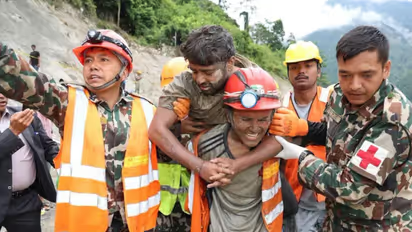
For nearly 10 days, Sanjay Sah was trapped inside a dark tunnel in Nepal, unsure whether he would ever see daylight again. As rescue teams worked to reach him, Sah said he held on to hope by chanting the Krishna Mahamantra.
Sah, a mechanical foreman from Saptari, was among two workers pulled alive from the debris-filled Trishuli-3A Hydropower Project tunnel on Friday, nearly 10 days after devastating floods and debris swept through the region.
His account of those days has emerged as one of the most emotional stories from the Nepal disaster, not only because he survived, but because he said his first instinct during the disaster was to try to save others.
After being rescued, Sah told the Nepal Army's medical team about the ordeal he faced inside the tunnel, reported Aaj Tak.
He said that during the most difficult moments, he kept chanting the Krishna Mahamantra and what makes this even more miraculous is that today happens to be Janmashtami. With darkness around him and no certainty about when help would arrive, the chanting became a source of hope as he waited for rescuers.
Sah also said he believed that a rescue team would eventually reach him.
His survival came after days of uncertainty, with rescuers battling huge amounts of mud and debris to reach workers trapped inside the hydropower tunnel.
Sah was working inside the project's control room when the disaster struck.
According to his account, around 40 to 45 people were present there at the time. Normally, the control room would have only one operator and four or five other people, but a large number of people had gathered there when the disaster hit.
Sah said he immediately told everyone to get out.
His responsibility at the control room was to ensure people's safety, and he focused on helping others escape first. By the time he tried to make his own way out, the situation had changed and it was too late.
The floodwater and debris had entered the tunnel, leaving him trapped inside.
Inside the tunnel, Sah said he was able to communicate with only three or four people nearby, either by speaking to them directly or by calling out and hearing their voices.
But he feared there could have been more people trapped deeper inside the long tunnel.
Sah said the tunnel extended a considerable distance and that some workers may have been carried further inside by the force of the water. He also expressed concern that not everyone might have managed to escape.
His comments could add to the questions surrounding the fate of other workers still unaccounted for following the disaster.
Sah was not the only worker to emerge alive from the tunnel.
Kabir Maharjan, who was from Kathmandu and had worked at the Trishuli-3A project for around seven years, was also rescued on Friday.
His wife, Heera Shobha, described his return as getting a 'second life'.
For days, the family had been waiting anxiously for news. She said the uncertainty had made it difficult for them to eat or sleep properly, but they continued to believe that Maharjan was alive and would eventually return.
She last spoke to her husband at around 7:30 am on the morning of the disaster. Soon afterwards, the floods changed everything.
The two men were rescued by the Nepali Army and Armed Police Force, with assistance from foreign rescue teams.
Their survival came after days of intensive search operations at the hydropower project, one of several sites badly hit by the floods and massive debris flows.
The rescue has provided a rare moment of hope amid a disaster that has left thousands dead or missing across Nepal and Tibet.
For Sah, however, the story is also about what happened before rescuers reached him.
He first tried to get others out of danger. Then, trapped in darkness for days, he waited for his own chance to be saved, keeping himself going by chanting the Mahamantra.
The scale of the disaster remains enormous.
Nepal's disaster authority has reported 1,259 bodies recovered and 5,083 people missing. Across the border in Tibet, Chinese state media has reported 21 deaths and 541 missing.
The combined reported toll is therefore 1,280 dead and 5,624 missing.
More than 800 foreigners from at least 34 countries are also reportedly among those missing in Nepal and Tibet, including tourists and pilgrims.
Against that backdrop, the rescue of Sah and Maharjan has offered families and rescuers a powerful reminder that hope can survive even in the most desperate conditions.