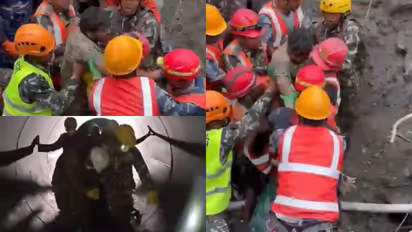
Two hydropower workers were pulled alive from a debris-filled tunnel in Nepal on Friday, September 4, in an extraordinary rescue that has brought fresh hope to families still waiting for news of their missing loved ones.
The workers, identified as 30-year-old Sanjay Sah and 45-year-old Kabir Maharjan, were rescued from the Trishuli 3A Hydropower Project in Rasuwa district. Their rescue came on the ninth day after the devastating August 26 floods and debris flow that swept through the Himalayan region.
Video released by Nepal's energy ministry showed rescuers cheering as one of the workers emerged through a muddy opening. He was helped to his feet before being carried on rescuers' backs towards a waiting helicopter.
Images from the operation showed the second worker covered in mud, with his hands pressed together in prayer. One of the rescued men was also seen folding his hands in gratitude, a deeply emotional moment that has resonated with viewers as the rescue video spreads online.
🇳🇵 After 9 days trapped inside a flooded hydropower tunnel, 2 workers have been pulled out ALIVE in Nepal.
Rescue crews are pumping air into the tunnels and racing to reach at least 42 more at this site, with hundreds feared trapped elsewhere.
A tiny piece of good news in a…— Mario Nawfal (@MarioNawfal) September 4, 2026
The Nepal Army said both workers were receiving medical treatment, while rescue operations were continuing.
Home Minister Sudan Gurung identified Sah as a mechanical foreman and Maharjan as a mechanical supervisor.
Maharjan's brother, Amir Maharjan, told AFP that the news had brought immense relief to the family. He said: "I am so happy, my heart is lighter."
🇳🇵🚨 নেপালে ত্রিশূলী-3A জলবিদ্যুৎ প্রকল্পের সুড়ঙ্গের ভিতর থেকে উদ্ধারকর্মীরা একজনকে নিরাপদে উদ্ধার করেছেন। চলমান উদ্ধার অভিযানের মধ্যে এই সাফল্য স্বস্তির খবর।#Nepal
pic.twitter.com/FAJrt6UWbU— Smita Patil (@patil45802) September 4, 2026
Nepal Electricity Authority (NEA) Mechanical Foreman Sanjay Shah has been successfully rescued from the Trishuli 3A tunnel.
The news of his safe rescue brings immense joy and relief. ❤️🙏
जय जय नेपाल 🇳🇵 pic.twitter.com/ZnxVgzUWLI— Kumar Bhaskar (@kumarbhaskar2_) September 4, 2026
The rescue was particularly significant because no hydropower workers trapped underground had been confirmed alive during the earlier days of the search.
Rescuers had been working around the clock to clear thick layers of mud and debris blocking the tunnel. Reports said teams had dug through around 50 to 60 metres of debris before reaching the trapped workers.
The workers became trapped after a massive wall of mud, rock and debris swept through the region on August 26.
The disaster followed a huge glacial and rock collapse near the China-Nepal border, triggering a destructive debris flow through Himalayan valleys. The torrent destroyed roads, bridges, settlements and hydropower infrastructure.
At least 12 hydropower projects were damaged or destroyed, with hundreds of workers feared missing from several project sites. Officials had earlier believed that more than 100 people could potentially be alive inside tunnels.
The breakthrough at Trishuli 3A has given rescuers renewed hope that others could still be alive inside tunnels across the disaster-hit region.
Rescue teams, including soldiers and specialist personnel, have continued searching despite extremely difficult conditions. Hard-packed debris, damaged infrastructure and the destruction of roads have made access to several locations exceptionally difficult.
The United Nations has warned that reaching isolated communities remains a major challenge, with cargo drones and porters being considered to deliver aid where roads have been destroyed.
The rescue also came at a crucial moment for families. Some relatives of missing people had begun performing symbolic funeral rites after days without information, reflecting the growing fear that many victims would never be found.
The scale of the disaster remains enormous.
Nepal's disaster authority reported 1,259 bodies recovered and 5,083 people missing. Across the border in Tibet, Chinese state media reported 21 deaths and 541 missing.
Together, the reported toll stands at 1,280 dead and 5,624 missing. More than 800 foreigners from at least 34 countries are reportedly among those missing in Nepal and Tibet, including tourists and pilgrims.
The disaster has been described by Nepal's foreign minister as a "Himalayan tsunami", highlighting the extraordinary force of the ice, rock, mud and floodwater that tore through the valleys.
However, the rescue of Sah and Maharjan has provided a rare moment of hope amid the devastation and is also a powerful reminder that even after days beneath tonnes of debris, survival is still possible.
(With inputs from agencies)