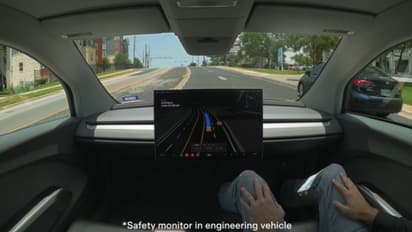
Tesla has moved one step closer to its long-promised robotaxi future after beginning engineering tests of its production Cybercab on public roads in Austin, Texas. The latest milestone was confirmed by Tesla CEO Elon Musk, who shared a video showing the Cybercab driving through city streets without a steering wheel or pedals.
A safety monitor was inside the vehicle during the test, but there were no driver controls, matching the design Tesla first revealed in 2024.
Cybercab with no steering wheel or pedals driving around Austin pic.twitter.com/Oo7uPoOjhp
— Elon Musk (@elonmusk) June 30, 2026
The tests mark the first time production-ready Cybercabs have been seen operating on public roads, signalling that the company is moving beyond concept vehicles.
Tesla introduced the Cybercab on October 10, 2024, as a fully autonomous vehicle built specifically for ride-hailing services. Unlike existing Tesla models fitted with self-driving software, the Cybercab was designed from the beginning to operate without traditional driving controls, according to a report by Basenor .
The latest road tests come about 20 months after the vehicle was unveiled, a pace that many industry watchers had not expected.
The company has already been testing autonomous ride services in Austin using Model Y vehicles. Those services gradually expanded across the city during the first half of 2026, with public robotaxi rides becoming available in June. The Cybercab now represents the next stage of Tesla's autonomous transport plans, the Basenor report added.
The footage also offered the clearest look yet at the Cybercab's interior. Instead of a dashboard filled with driving information, the vehicle features a simple central display created for passengers.
As there is no driver, the screen is designed mainly to show ride details and other passenger information. Tesla says the current programme is still an engineering test, meaning the vehicles are collecting real-world data before any wider commercial rollout.
While many people praised Tesla's progress, the viral video also triggered a lively debate online about whether driverless cars without steering wheels are ready for everyday use.
Several users described the technology as a glimpse into the future. One person wrote that this was how transport should already have looked years ago, while another said it was a much bigger achievement than many people realise.
It is definitely safer to have automated vehicles interacting with only other automated vehicles designed to interact with each other rather than allowing a hit and run which I had happen to me when I was driving
— JackIDE (@Jack__IDE) June 30, 2026
Imagine explaining this to someone 20 years ago: "A car with no steering wheel just drove itself through the city." They'd probably ask what movie you watched. 😅
— Gems In Ernest (@gemsinernest) June 30, 2026
Another user joked that anyone still doubting autonomous driving in 2026 only needed to watch a Cybercab calmly driving through Austin traffic to understand how quickly the technology is advancing.
Some users were excited enough to ask when the Cybercab would begin offering public rides, while others said they would happily own one if it allowed them to completely relax during daily journeys.
Wife Earning More Than Husband Cannot Automatically Claim Maintenance, Karnataka High Court Rules
But not everyone was convinced!
Many users admitted they would still feel safer with a steering wheel and pedals, even if they never needed to use them. Others questioned what would happen if another vehicle suddenly lost control or if the Cybercab encountered an unexpected emergency.
Man that's so scary. Took me a while to adjust to trusting fsd in my model Y with pedals and steering wheel.
— Zane Kelly (@ImZaneKelly) June 30, 2026
I have a question is this in the experimental phase or past it.
Hypothetically speaking who is responsible in an mva because there are idiots driving ability impaired, distracted and or late for work. I’m just trying to wrap my head around this!— Sandra (@Hawkeye___63) June 30, 2026
What is a safety monitor actually doing when FSD is doing all the work? Is there a hot stop button or voice command that halts everything, which the safety monitor can activate at any moment?
If not, then it’s just a useless part of the system and needless regulation.— Jeff Beck (@Xapp_TV) June 30, 2026
Some also wondered what role the onboard safety monitor actually plays during testing and whether there is an emergency stop system available if something goes wrong.
Cybersecurity was another major concern, with several people asking whether the vehicles could ever become targets for hackers.
Others raised legal questions, including who would be responsible if a fully autonomous vehicle became involved in a road accident caused by another driver.
A few users remained firmly against the idea of buying a car without traditional controls, saying they would prefer to keep driving themselves.
Australian Arrested at Bangkok Airport Over Killing Teen Girl Found in Suitcase Near Pattaya
Although the Cybercab is still in the engineering test phase, the latest demonstrations suggest Tesla is steadily moving towards commercial deployment.
The company has not announced when the Cybercab will begin carrying paying passengers yet, but its successful public road testing is likely to increase attention from both regulators and the wider automotive industry.
Nevertheless, the debate continues. Supporters see the Cybercab as the future of transport, while critics believe more testing is needed before driverless vehicles without steering wheels become a common sight on public roads
Find the latest Technology News covering Smartphone Updates, AI (Artificial Intelligence) breakthroughs, and innovations in space exploration. Stay updated on gadgets, apps, and digital trends with expert reviews, product comparisons, and tech insights. Download the Asianet News Official App from the Android Play Store and iPhone App Store for everything shaping the future of technology.