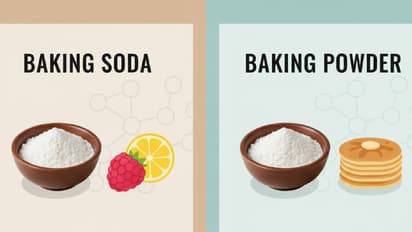
Baking powder and baking soda are staples in every kitchen. Both help make our cakes and bakes light and fluffy by releasing gas into the batter. But are they the same? Let's find out
Baking soda and baking powder are common kitchen items. They both release gas into batter, making our bakes light and fluffy. But many people often get confused and think they are the same.
26
Use
In reality, baking soda and baking powder are completely different. Using one for the other can lead to a baking disaster. For instance, your cake might not rise properly, it could taste bad, or the texture might just be all wrong. So, it's super important to know which one to use and when.
36
Use of Baking Soda
Baking soda is pure sodium bicarbonate. This white powder needs an acid to work—think dahi, buttermilk, lemon juice, or even brown sugar. When they mix with some moisture, they create carbon dioxide gas, making the batter rise. This reaction is super fast, so you must bake the batter immediately.
Baking powder, on the other hand, is a complete package. It's a mix of baking soda, an acid, and a stabiliser like cornstarch. This means the acid is already included. You use it in recipes that don't have any other acidic ingredients.
56
Types of Baking Powder
Baking powder comes in two types. Single-acting powder reacts as soon as it gets wet. Double-acting powder gives a second kick—it reacts once with moisture, and then again when it heats up in the oven.
66
About
Yes, you can substitute them in a pinch, but the measurements are key. Baking soda is much stronger, about 3 to 4 times more than baking powder. So, for 1 tsp of baking soda, you'd need to use 3 tsp of baking powder. But be careful! Using the wrong amount can stop your cake from rising. Too much baking soda gives a bitter, soapy taste, while excess baking powder can leave a metallic aftertaste.