
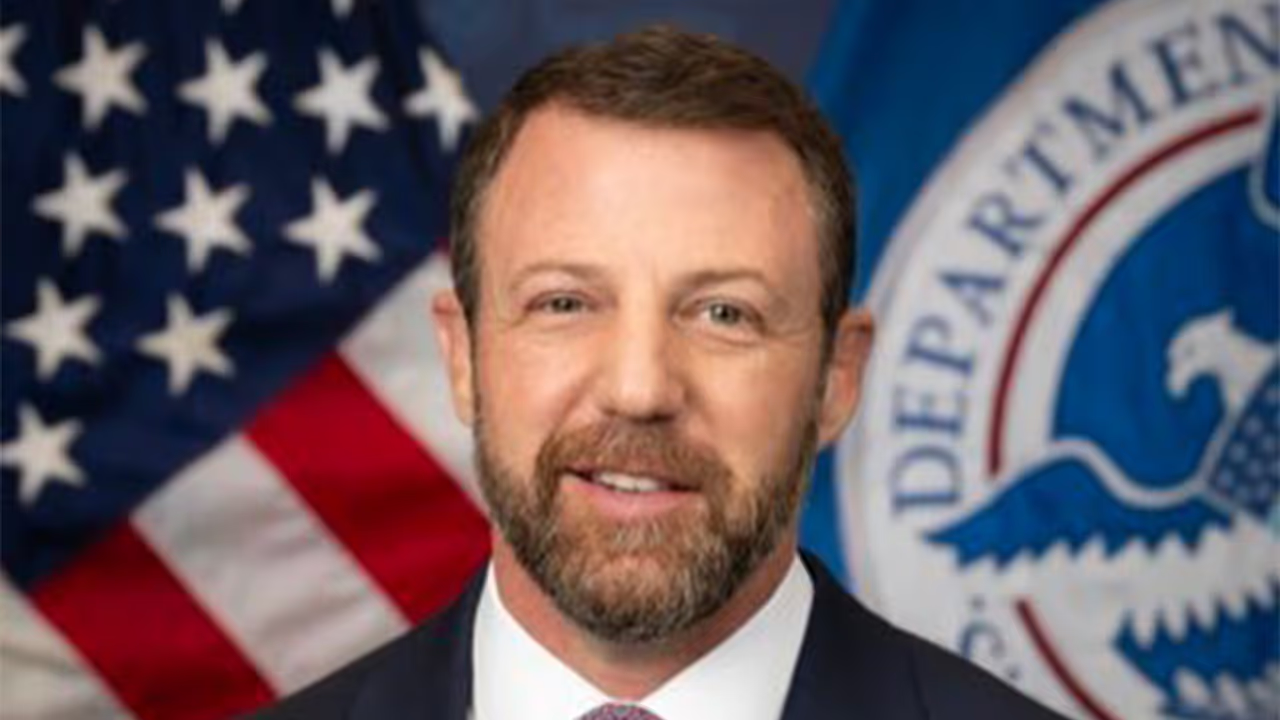
The longest government shutdown in US history has ended after 76 days. US Secretary of Homeland Security Markwayne Mullin announced the reopening of DHS after the House passed a bill to fund the department, sending it to President Trump.
Record 76-Day Shutdown Concludes
United States Secretary of Homeland Security Markwayne Mullin on Thursday (local time) informed that the government shutdown has ended after 76 days, calling it the "longest government shutdown in history".
The House on Thursday unanimously approved a Senate-passed bill to fund most of the Department of Homeland Security, a move expected to formally end the 76-day shutdown that has disrupted several agencies.
In a post on X, Mullin announced that "@DHSgov is back open," with funding for ICE (US Immigration and Customs Enforcement) and CBP (US Customs and Border Protection) to be secured through reconciliation "with no Democrat votes."
Mullin said, "To be clear, this Democrat shutdown never should have happened," and thanked federal employees "who have continued to protect the homeland every single day without a guaranteed paycheck," adding that President Trump and DHS leadership are "very grateful to be in the fight with you to Make America Safe Again."
After 76 days, the longest government shutdown in history is over. @DHSgov is back open, @ICEgov and @CBP will be funded through reconciliation (with NO Democrat votes) so liberals can’t play games with federal law enforcement funding. To be clear, this Democrat shutdown NEVER… — Secretary Markwayne Mullin (@SecMullinDHS) April 30, 2026
Legislative Process and Impact
According to CBS News, the bill was passed by voice vote and now heads to President Trump's desk for signature.
CBS News reported that the shutdown began on February 14 and became the longest partial government shutdown in US history. While Immigration and Customs Enforcement (ICE) and Border Patrol were largely shielded by prior funding, other agencies, including the Coast Guard, Transportation Security Administration, and FEMA (Federal Emergency management Agency), faced significant operational strain.
House Speaker Mike Johnson said the legislative strategy involved a two-track approach, explaining, "We held the homeland bill, the underlying funding bill, because we had to ensure that they could not isolate and eliminate those two critical agencies," according to CBS News, citing his remarks.
He added that once the funding resolution was secured, lawmakers could proceed with additional legislation.
The news report also noted that Adm. Kevin Lunday of the Coast Guard described morale within his workforce as "furious," calling the prolonged funding lapse "incredibly frustrating."
CBS News said the shutdown's resolution followed weeks of political deadlock, with Republicans and Democrats divided over funding priorities tied to immigration enforcement agencies and broader DHS operations. The reconciliation process is expected to be used to finalise additional funding measures in the coming weeks.
(ANI)
(Except for the headline, this story has not been edited by Asianet Newsable English staff and is published from a syndicated feed.)