
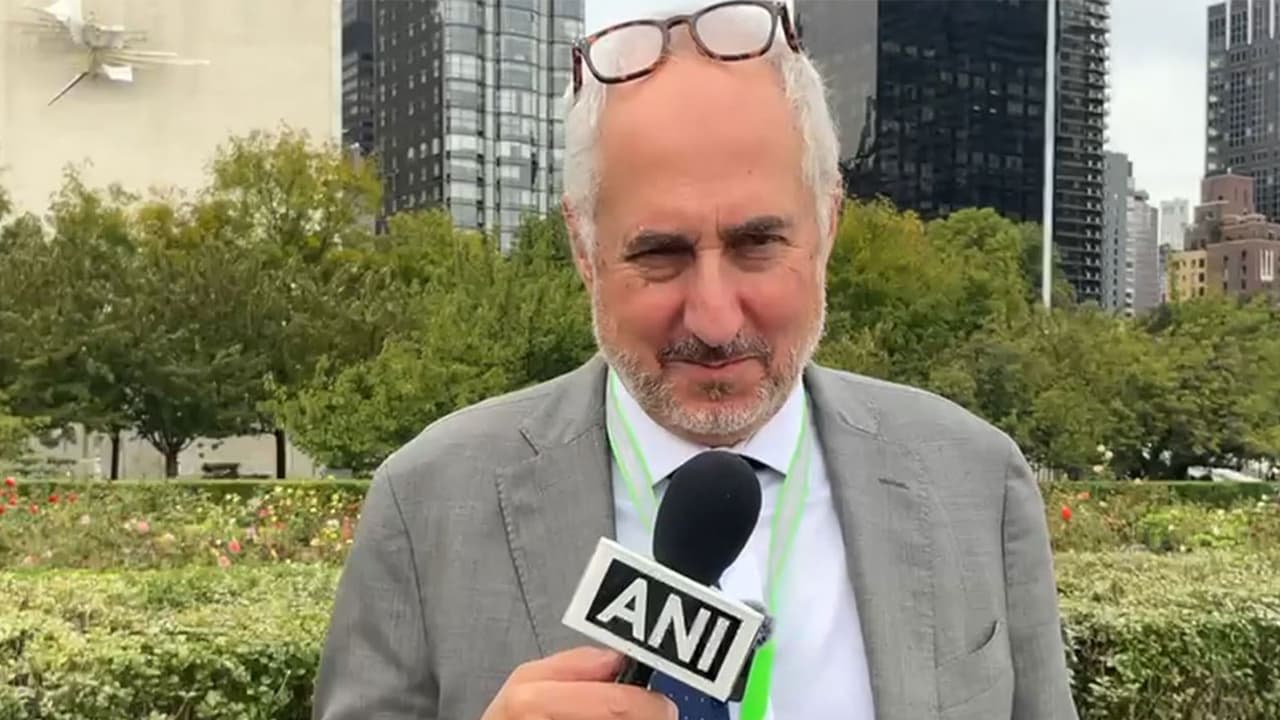
UN spokesperson Stephane Dujarric defended the UN's efficacy, stating it is as strong as its members. This followed US Secretary of State Marco Rubio's claims that the international system is broken and failing to solve major global conflicts.
Debates over the state of global multilateral governance took centre stage during the high-level United Nations General Assembly week, drawing remarks from top American and United Nations officials regarding international conflicts, institutional efficacy, and sovereign priorities.
UN Spokesperson on Institutional Efficacy
Stephane Dujarric, the Spokesperson for United Nations Secretary-General Antonio Guterres, spoke to ANI regarding the organisation's role and capabilities in maintaining global peace and security. Addressing criticisms surrounding multilateral institutions, Dujarric stated, “The UN's role in peace and security, particularly through the Security Council, is only as strong as its strongest member states and as strong as all of its member states want it to be."
"As the former US ambassador Richard Holbrooke once said, ‘You can't blame Madison Square Garden if the Knicks lose, right?’ It is up to all the member states that signed on to the Charter to recommit to diplomacy, to recommit to international law, and to recommit to limiting the use of power within the framework of international law. I think that was Secretary-General Antonio Guterres's very strong message to the General Assembly on Tuesday," he said.
US Laments 'Broken' International System
These remarks followed statements made by US Secretary of State Marco Rubio on Wednesday, who asserted that it “would be great” if a functional international system existed to manage global disputes, pointing to conflicts between Thailand and Cambodia, the potential conflict between India and Pakistan, the situation in the Democratic Republic of Congo (DRC) and Rwanda, Sudan and Iran in the straits.
Speaking to reporters in New York, Rubio noted that many global leaders share the view that current multilateral mechanisms are falling short. “We see the utility in the international system. We're here...I think the President has said that the United Nations, for example, has tremendous potential, but it's not living up to it...” Rubio told reporters.
“I think multiple leaders...pointed to the fact that the international system is failing, and it's failing because it has grown beyond its mandate. It has grown beyond its intent. "It's involved in all kinds of things that (it) shouldn't be involved in, and it's unable to solve virtually any major conflict in the world,” he added.
The top US diplomat remarked that there is a broad consensus that the international framework is broken because it has “broken itself” and strayed from its core focus.
“It would be great if we had a functional international system, for example, that could deal with a war between Thailand and Cambodia that occurred, or a potential conflict between India and Pakistan...Right now, we don't seem to have a functional international system that can address it,” he stated.
Rubio further mentioned that without such a system, individual nations will continue to act according to their sovereign priorities.
'US Will Always Act in National Interest'
“I want to be clear because this is not an attack on the international system. But at the end of the day, the US will always act, at least as long as President Trump is in office; we will always act in the national interest of our country, not in the interest of the international order. "We will never put the international order above the interest of the United States,” Rubio emphasised.
These comments follow recent addresses at the UN General Assembly where US leadership touched upon international conflicts.
India Rejects Third-Party Mediation with Pakistan
New Delhi has consistently maintained that any understanding regarding the cessation of hostilities with Pakistan was reached purely through direct bilateral communication between the Directors General of Military Operations (DGMOs) of both nations, firmly reiterating that New Delhi rejects any form of third-party intervention or external mediation.
(Except for the headline, this story has not been edited by Asianet Newsable English staff and is published from a syndicated feed.)