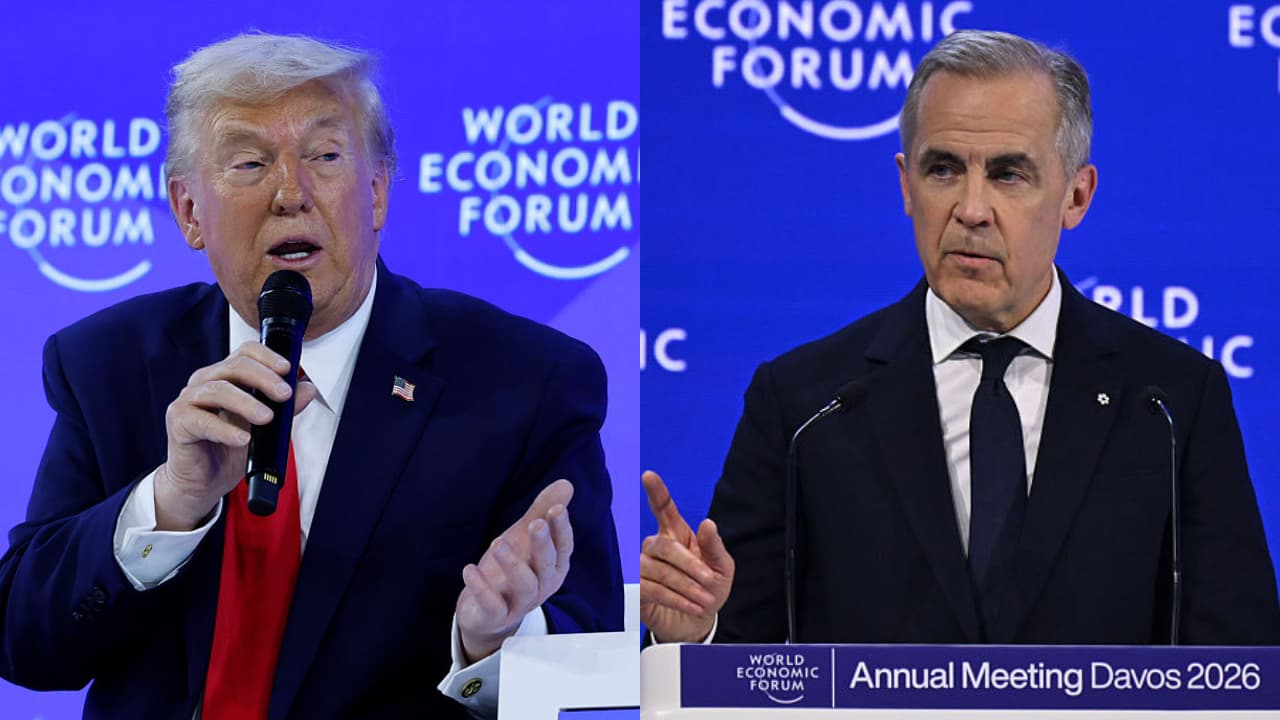
Carney’s push for middle-power autonomy and criticism of the US-led global order triggered a sharp exchange, highlighting rising tensions between Washington and Ottawa.
In a striking escalation of diplomatic tensions, US President Donald Trump has withdrawn an invitation to Canadian Prime Minister Mark Carney to join his newly formed “Board of Peace,” a high-profile initiative announced at the 2026 World Economic Forum in Davos, Switzerland.
The move comes after a series of public exchanges between the two leaders that underscored deeper disagreements over global governance, national sovereignty, and the future role of middle powers like Canada.
The Board of Peace, envisioned by Trump as a multibillion-dollar international body to help manage conflict zones and support reconstruction efforts — initially focused on Gaza — was pitched as a prestigious assembly of global leaders.
Related Articles

Countries joining the board are expected to contribute financially and engage in diplomatic coordination. Trump took to his social media platform Truth Social to post a formal note rescinding Carney’s invitation, stating that the invitation “is withdrawing” without offering specific reasons, though the decision appeared linked to Carney’s recent public remarks.
Tensions between the US and Canada began to surface sharply at the World Economic Forum. Earlier in the week, Carney delivered a candid speech warning that the longstanding US-led, rules-based global order was undergoing a “rupture.”
His remarks, broadly interpreted as a critique of recent American foreign policy, resonated across global diplomatic circles and earned a standing ovation from the Davos audience. While Carney did not name Trump during his address, his message emphasized the importance of middle powers resisting coercion by larger states and charting more independent diplomatic courses.
Trump responded directly on Wednesday at Davos, dismissing Carney’s perspective and insisting that Canada should be grateful to the United States, remarking publicly -- according to multiple reports -- that “Canada lives because of the United States.” The comment drew immediate attention for its assertive tone toward a historic ally.
Carney, upon returning to Canada, struck a firm rebuttal. Speaking to a national audience, he stated emphatically, “Canada doesn’t live because of the United States. Canada thrives because we are Canadian,” stressing that Canada’s strength comes from its own values, pluralism, and economic autonomy. While acknowledging a strong partnership between the two countries, Carney left no doubt that Canada seeks its own course in shaping its future in a changing global landscape.
The dispute has broader implications for relations between the two neighbours. Canada has been pursuing a strategy of economic diversification and political independence, including forging new trade ties and engaging with a wider circle of global partners.
Trump’s comments and the Board of Peace fallout have galvanized Canadian political support around Carney’s leadership, with analysts noting rising domestic backing for his assertive diplomacy.
For the United States, the decision to withdraw Canada’s invitation reflects deeper strains within traditional alliances as Trump’s foreign policy continues to prioritize an assertive and transactional approach to international relations. Critics of Trump have argued that his rhetoric and tactics risk alienating longstanding partners, weakening collective diplomatic efforts on issues ranging from peace negotiations to trade cooperation.
Despite the diplomatic spat, both nations maintain robust economic and cultural ties. The US remains Canada’s largest trading partner, with significant cross-border investment, shared defense commitments, and integrated supply chains in critical sectors such as automotive, energy, and technology. The tensions over the Board of Peace thus occur against a backdrop of deeply interlinked economic interests that continue to bind the two countries together.
Observers also see the episode as emblematic of a broader shift in global politics. Middle powers like Canada are increasingly asserting their sovereignty and pushing back against the expectations of deference to larger powers. Carney’s calls for collaboration among middle powers to uphold democratic values and resist coercive economic and political strategies reflect a growing debate within international relations about the balance between alliance reliance and autonomous foreign policy.
The cancellation of Canada’s participation in the Board of Peace serves as a stark illustration of how personal diplomacy, public statements, and national pride can influence international initiatives. As global leaders continue to grapple with conflicts from Gaza to Russia-Ukraine and rising geopolitical competition, the episode between Trump and Carney highlights the complexity of maintaining cooperative global structures in a fracturing world order.
(With inputs from agencies)