
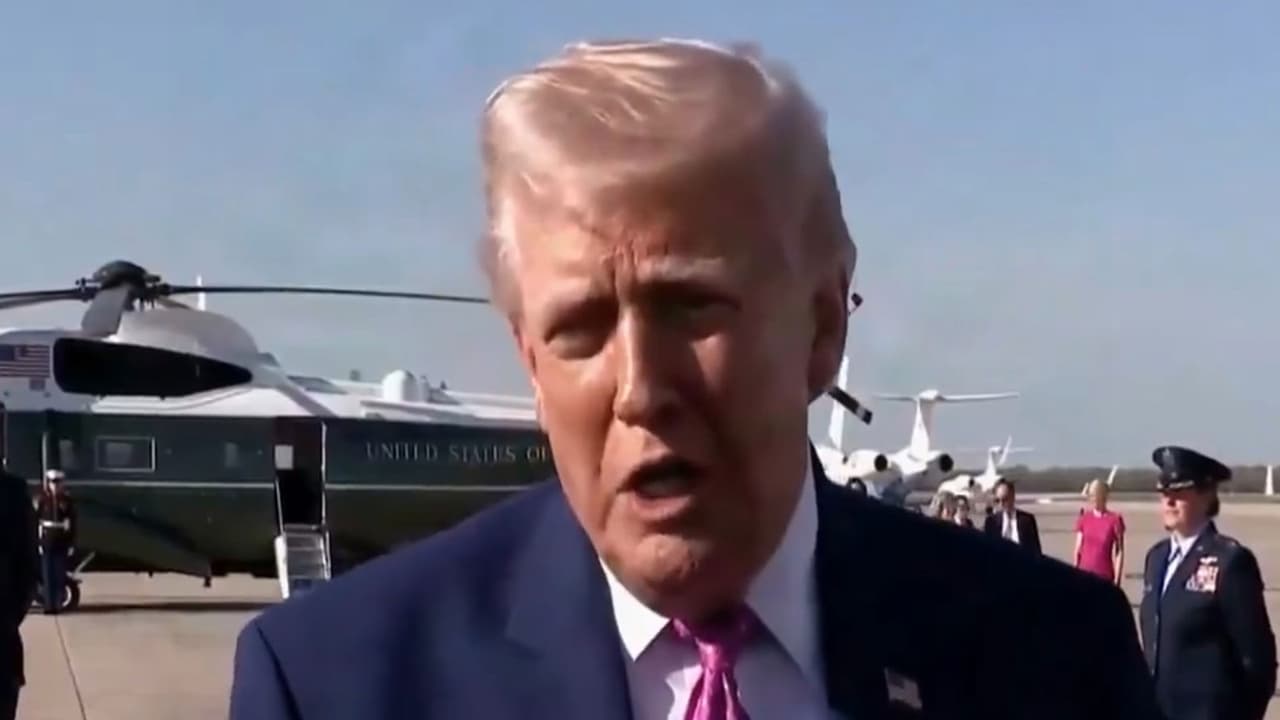
US President Trump says he will reopen the Gulf 'with or without' a deal as VP JD Vance heads to Pakistan for talks. An Iranian delegation is in Islamabad but has set preconditions, including a Lebanon ceasefire, before negotiations can begin.
Trump Vows to Reopen Gulf 'With or Without' Deal
US President Donald Trump on Saturday (local time) indicated plans to reopen the Gulf region amid ongoing hostilities in West Asia, asserting that the United States would move ahead "with or without", even as Vice President JD Vance heads to Pakistan for crucial talks with Iran. Speaking at Joint Base Andrews (JBA) before Vance's departure, Trump asserted that Iranian forces have been militarily defeated and that the vital waterway will be reopened regardless of the outcome of the ongoing negotiations. "Well, I wish them luck. He's got a big thing. I'll find out what's going on. They're militarily defeated, and now we're going to open up the gulf (Strait of Hormuz) with or without a deal. But that'll be open, we're going to be on the straight as they call it," Trump said.
The US President further emphasised that the process was expected to move swiftly, while also leaving open the possibility of decisive action if delays occur. "I think it's going to go pretty quickly, and if it doesn't, we'll be able to finish it off one way or the other. It's going well. The Navy's gone, the Air Force is gone, all anti-aircraft is gone, the leaders are gone, and the whole place is gone. So we'll see how it turns out. So it's US Vice President JD Vance, Special Envoy Steve Witkoff and Trump's son-in-law Jared Kushner. They have a good team, and they meet tomorrow, so we'll see how it all works out," he added.
Iranian Delegation Arrives in Pakistan for Talks
Meanwhile, the Iranian delegation, led by Speaker of the Iranian Parliament Mohammad Baqer Qalibaf, has arrived in Pakistan's Islamabad late on Friday to attend peace talks with the United States, as reported by Iranian State Media Press TV, aimed at achieving a comprehensive end to hostilities in West Asia.
As reported by the Islamic Republic of Iran Broadcasting (IRIB), the Iranian delegation comprises representatives from multiple key sectors, including security, political, military, economic, and legal domains, reflecting the broad scope and significance of the proposed discussions. The high-level delegation includes Iran's Foreign Minister Seyed Abbas Araghchi, along with Ali Akbar Ahmadian, Secretary of Iran's Defence Council, and Abdolnaser Hemmati, Governor of the Central Bank of Iran. Several members of the Iranian parliament are also part of the visiting team.
Iran Sets Preconditions for Dialogue
However, Tehran still stresses the acceptance of preconditions issued earlier by Galibaf, noting that if the conditions aren't met, then it may lead to the failure of the negotiations, as reported by Press TV Meanwhile, Speaker of Iran's Parliament, MB Ghalibaf, in a post on X, said that two measures agreed upon between the parties remain unfulfilled, stressing that progress on these issues is essential before any dialogue can take place.
According to Ghalibaf, the ceasefire in Lebanon and the release of blocked Iranian assets are set as the preconditions before negotiations can take place in Islamabad. "Two of the measures mutually agreed upon between the parties have yet to be implemented: a ceasefire in Lebanon and the release of Iran's blocked assets prior to the commencement of negotiations. These two matters must be fulfilled before negotiations begin," Ghalibaf said in his post.
Fragile Ceasefire Hangs in the Balance
The developments come as the fragile ceasefire agreement between the United States and Iran hangs in the balance, with Tehran stating that the truce also includes the halt to Israeli military operations in Lebanon. However, both Washington and Israel have maintained that the ceasefire does not extend to Hezbollah targets, a disagreement that has further complicated diplomatic efforts and heightened the risk of the truce collapsing.
US Delegation Departs with Cautious Optimism
Meanwhile, US Vice President JD Vance, earlier in the day, departed for Pakistan's capital of Islamabad to take part in talks with Iran, expressing optimism about the negotiations while warning against any lack of sincerity from Tehran. Addressing reporters before departure, Vance said the United States is open to constructive engagement if Iran approaches the discussions in good faith. "We're looking forward to the negotiation. I think it's going to be positive. As the president of the United States said, if the Iranians are willing to negotiate in good faith, we're certainly willing to extend the open hand," he said.
However, he cautioned that Washington would not respond favourably if Iran attempts to act in bad faith during the talks. "If they're going to try to play us, then they're going to find that the negotiating team is not that receptive," Vance added.
Vance will be leading the US delegation to Islamabad for talks this weekend. According to White House Press Secretary Karoline Leavitt, along with Vance, US Special Envoy Steve Witkoff, and the son-in-law of US President Donald Trump, Jared Kushner, will be part of the delegation.
The first round of those talks will take place on Saturday morning, local time. The meeting between the two sides is set to take place to end the over-month-long conflict in West Asia and follows an immediate ceasefire agreement between the US and Iran for two weeks. (ANI)
(Except for the headline, this story has not been edited by Asianet Newsable English staff and is published from a syndicated feed.)