
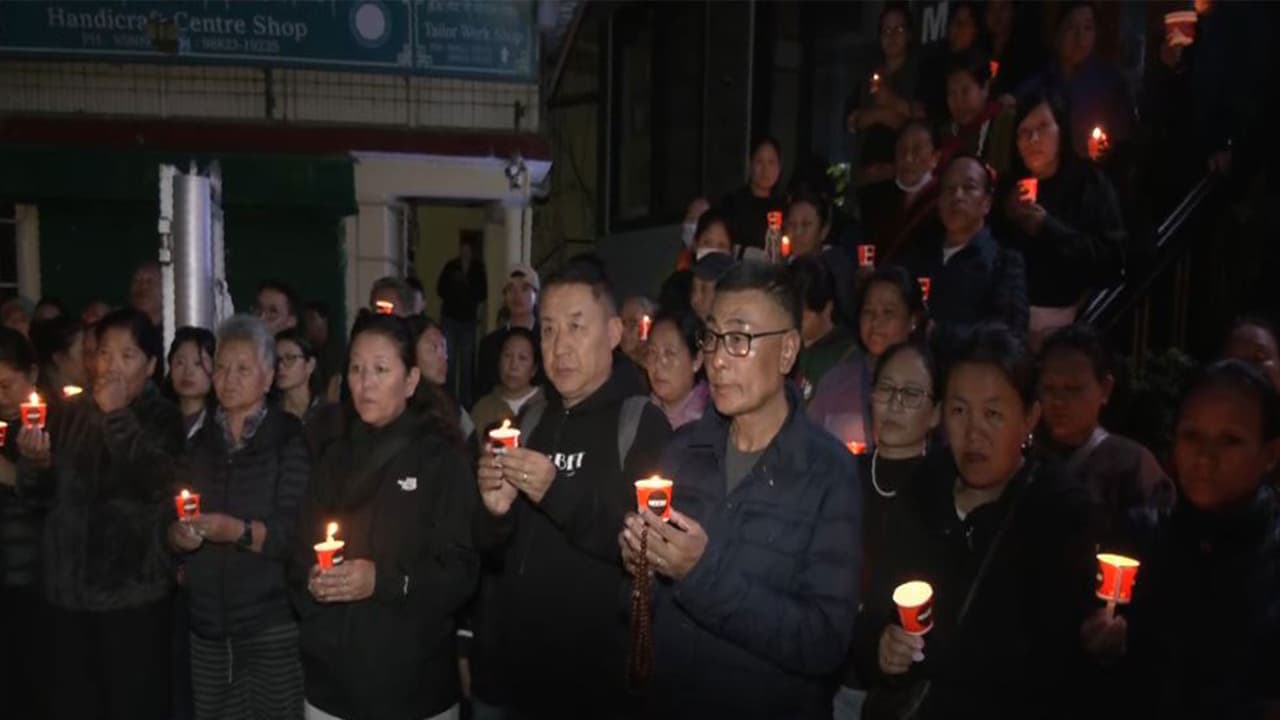
Tibetans in Dharamshala held a candlelight vigil to mourn victims of the Nakchu earthquake, while activists blamed Chinese environmental practices for increasing the region's vulnerability to such natural disasters.
Candlelight Vigil for Earthquake Victims
Hundreds of Tibetans gathered in McLeodganj, Dharamshala, for a candlelight vigil organised by the Tibetan Youth Congress (TYC) to mourn the victims of a devastating earthquake in Tibet’s Nakchu region. Participants marched with candles to express their condolences to those who lost their lives and show solidarity with affected Tibetan families.
Tsering Chomphel, president of the Tibetan Youth Congress, said the vigil was organised to honour the victims and stand in solidarity with the people affected by the disaster. “Today, the Tibetan Youth Congress organised this candlelight vigil to express our condolences to those who lost their lives and show solidarity with our Tibetan brothers and sisters in the Kham region and Nakchu,” Chomphel said.
Environmental Concerns and Casualties
He also alleged that environmental degradation caused by Chinese government activities in Tibet had contributed to the region’s vulnerability to natural disasters. Referring to mining and dam construction, he said such activities had affected Tibet’s fragile ecosystem, with consequences extending beyond the Tibetan plateau. Chomphel further expressed concern over the reported casualties, saying the initial information indicated 16 deaths, but subsequent updates suggested that the toll had risen to more than 20. He added that many people had been injured and several villages and livelihoods affected.
Calls for Accountability
Gompo Dhondup, a member of the Tibetan Parliament-in-Exile, also expressed his condolences to the bereaved families and prayed for the speedy recovery of those injured. “This is very unfortunate. There is a tragic earthquake in the Nakchu region, and the information is all censored. We are relying on the information released by the Chinese state,” Dhondup said. He questioned the accuracy and completeness of the reported casualty figures, expressing concern that the actual toll could be higher than officially disclosed. He also highlighted the loss of lives and property caused by the earthquake.
Dhondup echoed concerns over environmental damage in Tibet, alleging that destructive activities carried out by the Chinese government over the past six decades had contributed to the region’s environmental vulnerability. “China has to be accountable for all this destruction and the incidents that are happening inside Tibet,” he said.
The candlelight vigil brought together members of the Tibetan community to remember those killed in the earthquake and draw attention to the plight of people affected by the disaster. Participants offered a collective expression of grief, solidarity and prayers for the victims and their families.
Seismic Activity and Official Reports
Tibet saw another earthquake of magnitude 4.1 on the Richter scale strike the Tibet region on Friday afternoon, according to the National Center for Seismology (NCS). This was after a powerful earthquake with a magnitude of 7.0 had already struck Tibet. The seismic event occurred at 14:03:19 Indian Standard Time (IST) at a shallow depth of 10 kilometres. Taking to X, the National Center for Seismology posted: "EQ of M: 4.1, On: 23/10/2026 14:03:19 IST, Lat: 32.402 N, Long: 93.675 E, Depth: 10 Km, Location: Tibet." According to the data shared by the nodal agency, the epicentre was located at Latitude 32.402 North and Longitude 93.675 East.
As per Xinhua's latest report published today, at least 16 people died and 11 of the 32 injured people were in serious condition, while 21 sustained minor injuries, as of 2:25 am (local time). More than 300 houses had collapsed in the affected region. (ANI)
(Except for the headline, this story has not been edited by Asianet Newsable English staff and is published from a syndicated feed.)